

Illegal Dispossession Act 2005: How to Recover Grabbed Ancestral Land in KP Without Traveling to Pakistan
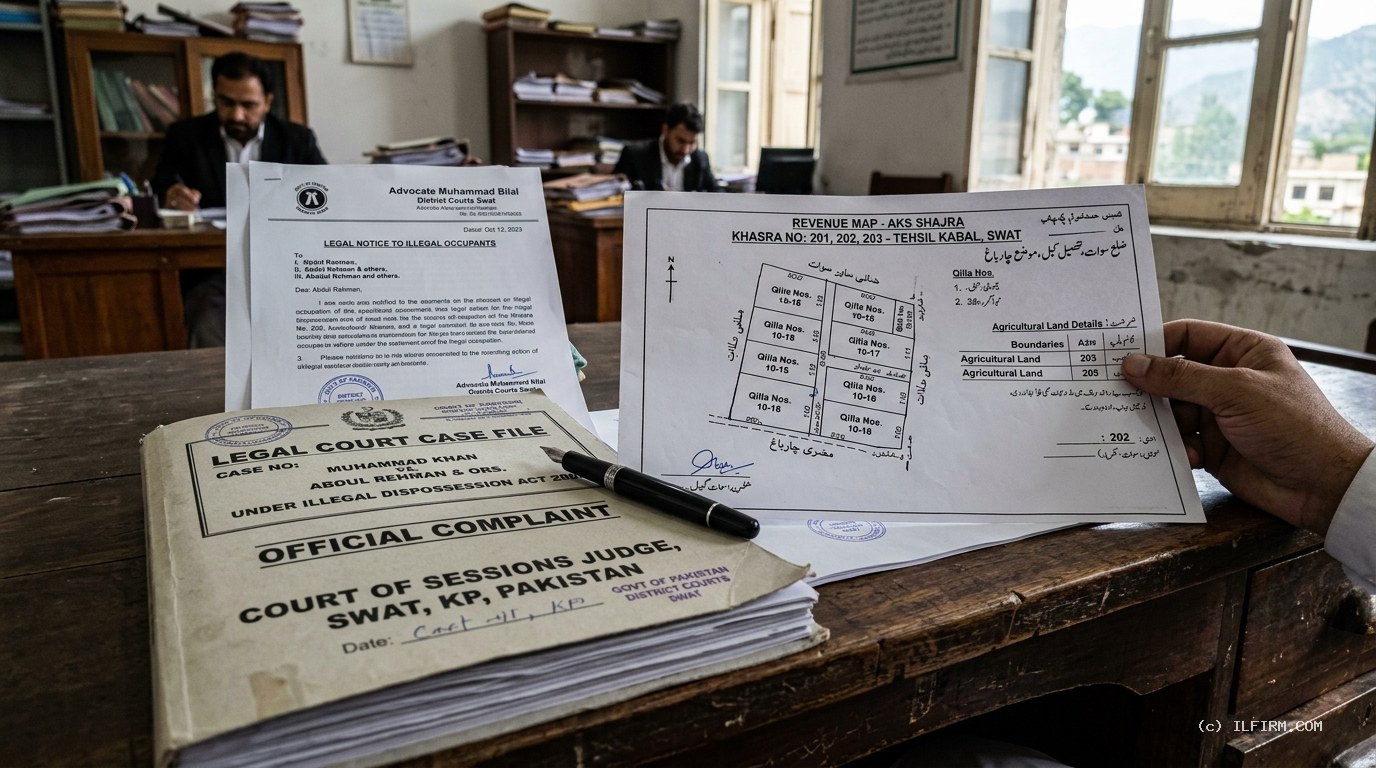
Executive Summary
One of the most agonizing dilemmas confronting overseas Pakistanis in the UAE, UK, Saudi Arabia, and Europe is the unlawful encroachment or outright grabbing of their ancestral lands, residential plots, or commercial buildings in Pakistan during their absence abroad.
Historically, victims were trapped in decades-long civil suits for possession under the Specific Relief Act 1877, navigating endless appeals while land grabbers (Qabza Mafia) enjoyed illegal profits.
To provide a swift, deterrent, and summary remedy, the Parliament enacted the Illegal Dispossession Act, 2005 (Act XI of 2005). Under this statute, property grabbing is classified as a serious criminal offense punishable by up to 10 years imprisonment, heavy fines, and summary court orders for immediate restoration of possession.
Crucially, an overseas owner can initiate, prosecute, and win an Illegal Dispossession proceeding through a licensed High Court advocate via consular Power of Attorney without leaving their country of residence.
1. What Constitutes an Offense Under the Illegal Dispossession Act?
Under Section 3 of the Illegal Dispossession Act 2005:
"No person shall, without lawful authority, enter into or upon any property with intent to dispossess, grab, control, or occupy it, or having lawfully entered, unlawfully remain in or upon the property.”
Key Legal Elements Established by the Supreme Court of Pakistan:
In landmark judgments (including the renowned Mst. Asma vs. Additional Sessions Judge and Bashir Ahmad vs. Additional Sessions Judge cases), the Supreme Court clarified that the Act does not merely apply to professional criminal gangs or notorious land mafias; it applies equally to any individual, relative, neighbor, or tenant who unlawfully dispossesses the lawful owner or occupies property without lawful authority.
┌────────────────────────────────────────────────────────────────────────┐│ CIVIL SUIT VS. ILLEGAL DISPOSSESSION │
├───────────────────────────────────┬────────────────────────────────────┤
│ REGULAR CIVIL SUIT (1877) │ ILLEGAL DISPOSSESSION ACT (2005) │
├───────────────────────────────────┼────────────────────────────────────┤
│ • Decided by Civil Judge │ • Direct trial by Court of Session │
│ • Lengthy trial (5 to 15 years) │ • Fast-track statutory priority │
│ • Purely civil restitution │ • Criminal conviction (up to 10 yrs│
│ • No police involvement │ • Direct police eviction warrants │
│ • Complex appellate stages │ • Immediate Section 7 interim relief│
└───────────────────────────────────┴────────────────────────────────────┘
2. Fast-Track Relief: Section 7 & Section 8 Orders
The most powerful weapon in the Act for overseas clients is the ability to obtain immediate interim relief:
A. Section 7: Interim Restoration of Possession
The Sessions Court can pass an interim order evicting the illegal occupant and placing the lawful owner or their appointed attorney back into physical possession even while the trial is ongoing, provided a prima facie case of unlawful dispossession is demonstrated.
B. Section 8: Final Eviction & Compensation
Upon conclusion of trial, the court:
1. Sentences the convict to rigorous imprisonment (up to 10 years).
2. Directs the local police and revenue authorities to execute physical eviction and restore unencumbered possession.
3. Awards substantial monetary compensation and costs of litigation to the victim for mental anguish and lost rental yields.
3. Step-by-Step Procedure for Overseas Clients
Step 1: Evidence Compilation
Gather all historical title documents:
Certified Fard Malkiat showing ownership prior to the act of dispossession.
Genealogical tree (Shajra Nasab) proving inheritance rights.
Clear photographic/video evidence of encroachment, broken locks, or unauthorized construction.
Copies of police station complaints or Roznamcha reports (if any).
Step 2: Special Power of Attorney Execution
The overseas owner executes a specific Special Power of Attorney via the NADRA Digital Portal or the nearest Pakistani Consulate/Embassy, authorizing International Law Firm to file and prosecute the complaint.
Step 3: Direct Complaint before the Court of Session
Our senior advocates draft and file a formal criminal complaint directly in the Court of District & Sessions Judge (e.g., Swat, Buner, Malakand, Dir).
Step 4: Judicial Inquiry & Police Inquiry (Section 5)
Under Section 5, the Sessions Judge directs the local Officer In-charge of the Police Station (SHO) or a Revenue Officer (Tehsildar) to conduct an urgent preliminary inquiry within 15 days to ascertain who was in actual possession and verify the manner of dispossession.
Step 5: High Court Oversight (Dar-ul-Qaza Mingora Swat Bench)
If corrupt elements attempt to delay police reports or if adverse interim orders are passed, our High Court advocacy team moves urgent criminal revision petitions before the Peshawar High Court (Dar-ul-Qaza Mingora Swat Bench) under Section 435/439 Cr.P.C. to maintain strict judicial momentum.
4. Crucial Defenses You Must Be Prepared For
Illegal occupants frequently deploy specific tactics to escape criminal liability:
1. Plea of Civil Dispute: The accused claims there is an oral agreement to sell (Zabani Baye) or unpartitioned co-ownership. Our chambers counters this by demonstrating absence of written title deeds, absence of banking consideration, and cross-examining fraudulent witnesses.
2. Delayed Complaint: Filing years after dispossession can weaken the urgency of summary relief. Action must be taken promptly upon discovering the illegal encroachment.
5. Frequently Asked Questions (FAQs)
Q1: Can a tenant who refuses to vacate be prosecuted under this Act?
A: Where a tenancy agreement has clearly expired, notice to vacate was served, and the occupant retains possession through force, intimidation, or without lawful right, superior courts have held that an Illegal Dispossession complaint is maintainable.
Q2: What if the local police are colluding with the occupants?
A: Because the complaint is filed directly before the Sessions Judge, the police cannot dismiss the matter. Furthermore, the Sessions Court holds contempt powers and can assign the inquiry to a senior judicial magistrate or higher-ranking police officer (SP/DSP).
Reclaim Your Ancestral Land with Senior High Court Advocates
Do not let squatters or predatory relatives usurp your family inheritance while you reside abroad.
Chambers Litigation Retainer:
Direct filing before the District & Sessions Court
Section 7 Emergency Interim Eviction Motions
Peshawar High Court (Dar-ul-Qaza Swat Bench) Criminal Advocacy
- Bi-weekly video case memos and certified court orders
👉 Contact Our Emergency Litigation Team via WhatsApp: [Start Immediate Action](https://ilfirm.com/overseas/?region=uae) | Chambers: Opposite Dar-ul-Qaza (High Court Bench), Mingora, Swat.
High Court & Dar-ul-Qaza Chambers Counsel
Require Immediate Case Review or Remote PoA Execution?
Our senior advocates represent overseas Pakistanis residing in the UAE, Saudi Arabia, UK, and USA before the Peshawar High Court (Dar-ul-Qaza Mingora Bench), Supreme Court, and District Courts without international travel.