

Special Power of Attorney vs. General Power of Attorney in Pakistan: Which Should Expats Use to Protect Assets?
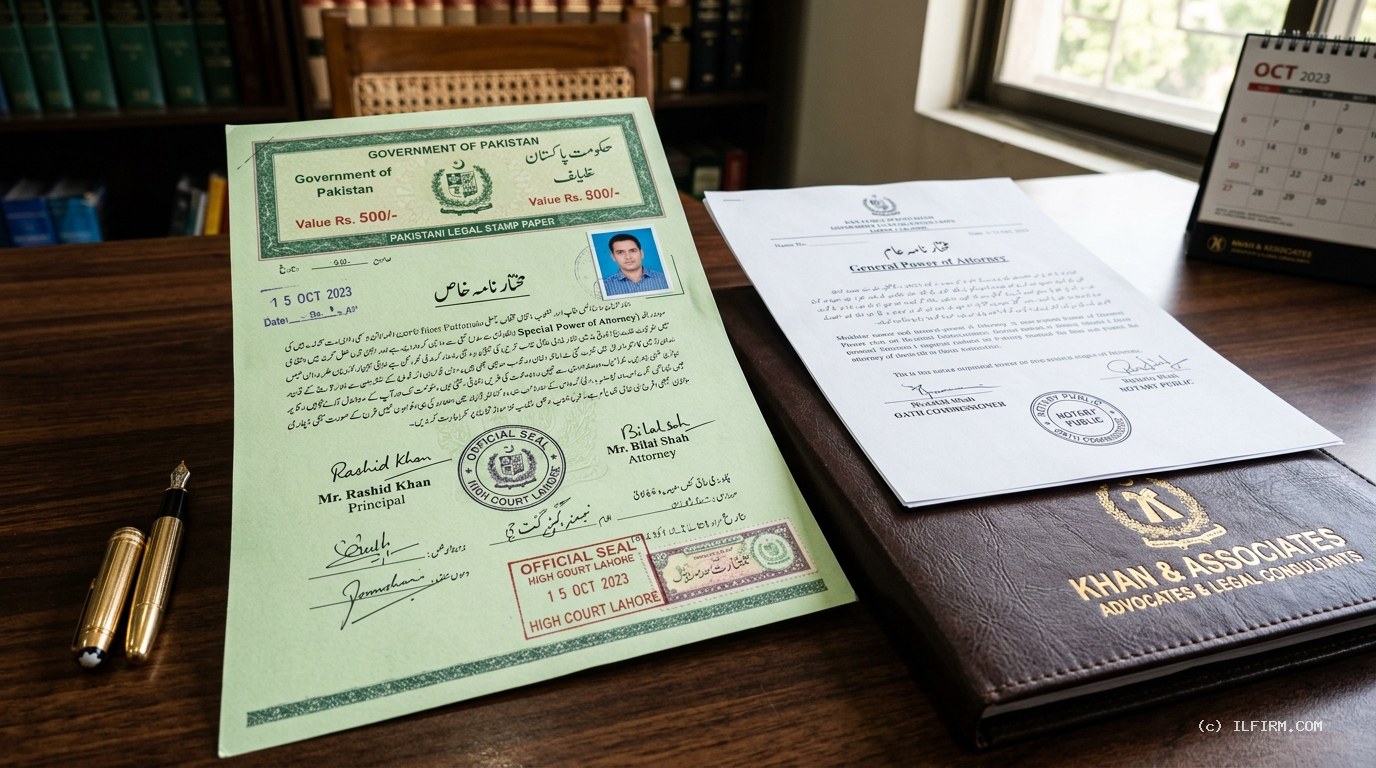
Executive Summary
Every year, hundreds of overseas Pakistanis living in Dubai, London, New York, and Riyadh discover that their most prized properties in Pakistan—inherited family lands, residential plots, or commercial shops—have been secretly mortgaged, transferred, or sold without their genuine consent.
In the overwhelming majority of these tragic cases, the root cause is identical: the ill-advised execution of a General Power of Attorney (Mukhtar Nama Aam).
Entrusting an agent, relative, or friend with sweeping, unrestricted authority over your affairs in Pakistan without strict legal boundaries creates an open invitation to fraud.
This guide examines the statutory distinction between a Special Power of Attorney (Mukhtar Nama Khas) and a General Power of Attorney (Mukhtar Nama Aam), breaks down landmark Supreme Court of Pakistan precedents, and outlines the exact legal procedure to revoke or cancel an existing Power of Attorney before irreparable damage occurs.
1. Statutory Comparison: Special vs. General Power of Attorney
┌────────────────────────────────────────────────────────────────────────┐│ SPECIAL POWER OF ATTORNEY VS. GENERAL POWER OF ATTORNEY │
├───────────────────────────────────┬────────────────────────────────────┤
│ SPECIAL PoA (MUKHTAR NAMA KHAS) │ GENERAL PoA (MUKHTAR NAMA AAM) │
├───────────────────────────────────┼────────────────────────────────────┤
│ • Confined to single specific task│ • Broad, unrestricted powers │
│ • Example: Defend Civil Suit #45 │ • Authority over all present & │
│ or obtain Fard from Patwari │ future properties in Pakistan │
│ • Automatically extinguishes upon │ • Extremely high risk of fraud, │
│ completion of designated task │ unauthorized sale & mortgaging │
│ • Strongly recommended by courts │ • Regarded with judicial suspicion │
│ • Inexpensive registration fee │ • Subject to mandatory registration│
└───────────────────────────────────┴────────────────────────────────────┘
2. Landmark Supreme Court Rulings on Powers of Attorney
The superior courts of Pakistan have established strict jurisprudence to protect property owners against abuse by attorney-holders:
A. The Principle of Strict Construction (Strictissimi Juris)
In the landmark judgment reported as PLD 2010 Supreme Court 342 and reiterated in 2021 SCMR 135, the apex court ruled:
“A Power of Attorney must be construed strictly. The court will not infer or imply any power that is not explicitly and specifically conferred by the text of the deed itself.”
B. General Words Do Not Authorize Sale
Vague or generic boilerplate phrases such as “my attorney is empowered to manage, supervise, and deal with my property in all respects as if he were the owner” do not confer the power of sale. If a Power of Attorney does not expressly state the word “Sale” (Baye), specify the precise Khasra and Mauza details, and describe the boundaries, any sale deed executed by the attorney is void ab initio.
C. Fiduciary Duty of the Attorney
Under Section 214–218 of the Contract Act 1872, an attorney stands in a fiduciary relationship of trust with the principal:
The attorney is legally bound to act with absolute good faith.
The attorney must remit the entire sale proceeds to the principal.
An attorney cannot sell the property to himself, his spouse, or close relatives without the full, written, and informed consent of the principal. Any secret profit or self-dealing transaction will be summarily set aside by the court.
3. How to Revoke or Cancel an Existing Power of Attorney
If you suspect that your attorney is colluding with adversaries, making unauthorized commitments, or ignoring your instructions, you must act decisively to revoke the power:
[1. Revocation Deed] ───► [2. Sub-Registrar Recording] ───► [3. Public Newspaper Notice]│
▼
[Final Protection] ◄─── [5. Revenue/Court Caveat] ◄─── [4. Direct Legal Notice to Agent]
Step 1: Draft a Formal Deed of Cancellation (Ibtal Nama)
Our chambers prepares a formal Deed of Revocation / Cancellation (Ibtal Nama-e-Mukhtar Nama) referencing the original registration number, date, and book entry of the existing Power of Attorney.
Step 2: Registration Before the Sub-Registrar
Under Section 17 of the Registration Act 1908, if the original Power of Attorney was registered before a Sub-Registrar, the Revocation Deed must also be formally registered with the same Sub-Registrar’s office.
Step 3: Public Notice in Daily Newspapers
We publish a formal public warning notice in two widely circulated daily newspapers (one Urdu, one English) in the district where the property is situated, putting the general public, banks, and prospective buyers on notice that the attorney has no further authority.
Step 4: Direct Service of Legal Notice via Registered Post
We dispatch a formal legal notice under Section 206 of the Contract Act 1872 via registered courier and TCS to the attorney’s residential address, formally terminating agency powers.
Step 5: Filing Caveats in Court & Revenue Offices
We submit certified copies of the Revocation Deed directly to:
The Halqa Patwari & Tehsildar (restraining any revenue mutation / Intiqal).
The Senior Civil Judge and District Judge (informing all pending judicial benches).
4. The Expat Golden Rule: Use “Single-Purpose” Special Deeds
When hiring an advocate or family member from the UAE, UK, or Saudi Arabia:
1. Never sign an open-ended General Power of Attorney.
2. Always restrict the deed to a single court suit, a single revenue mutation, or a single parcel of land.
3. Explicitly exclude the power to sell, mortgage, gift, or compromise unless absolutely necessary.
4. Include an automatic expiry date (e.g., valid for 12 months only).
5. Frequently Asked Questions (FAQs)
Q1: Does a Power of Attorney survive the death of the principal?
A: Absolutely not. Under Section 201 of the Contract Act 1872, an agency is automatically terminated upon the death of the principal. Any sale executed by an attorney after the owner’s demise is fraudulent and criminal.
Q2: Can I execute a Revocation Deed while residing outside Pakistan?
A: Yes. You can execute the Deed of Revocation before the Pakistani Consulate/Embassy in your country of residence, or via the NADRA Digital Portal, and courier it to our chambers for immediate Sub-Registrar and Revenue recording.
Protect Your Real Estate with International Law Firm
Audit your existing legal instruments and revoke dangerous powers before fraudulent transfers occur.
Chambers Power of Attorney Services:
Precision Bilingual Special PoA Drafting (NADRA / Embassy Compliant)
Fast-Track Revocation & Cancellation of Defective Deeds
Sub-Registrar, Patwari & Court Caveat Filings
Fraud Recovery Lawsuits under Specific Relief Act 1877
👉 Direct WhatsApp Assistance: [Consult Chambers Advocates](https://ilfirm.com/overseas/?region=uae) | Chambers: Opposite Dar-ul-Qaza Mingora Swat Bench, KP.
High Court & Dar-ul-Qaza Chambers Counsel
Require Immediate Case Review or Remote PoA Execution?
Our senior advocates represent overseas Pakistanis residing in the UAE, Saudi Arabia, UK, and USA before the Peshawar High Court (Dar-ul-Qaza Mingora Bench), Supreme Court, and District Courts without international travel.