

How to Verify Land Records & Property Titles in Swat & Malakand from Abroad: Patwari, Fard & Registry Due Diligence
Executive Summary
Real estate in Swat, Kalam, Bahrain, Mingora, and across the Malakand Division holds immense sentimental and commercial value for overseas Pakistanis in the UAE, UK, Saudi Arabia, and the United States. However, property transactions in this region are fraught with unique jurisdictional nuances. Unlike urban centers where digital land management systems are fully centralized, land in Swat operates under a hybrid framework of traditional Settlement (Bandobast), Patwari revenue books, and Sub-Registrar deed registries.
Unscrupulous sellers, fraudulent power of attorney holders, and estranged relatives frequently prey on overseas buyers by forging documents, executing double mutations, or selling unpartitioned joint ancestral shares (Mushaa).
This guide details the exact procedural protocol practiced by our High Court chambers to conduct thorough property title due diligence without requiring the overseas owner to physically visit the Patwarkhana or Revenue Courts.
1. The 4 Essential Revenue Documents You Must Verify
Before disbursing any earnest money (Biyana) or finalizing an agreement to sell, every overseas investor must obtain certified copies (Naqal) of four key revenue instruments:
┌────────────────────────────────────────────────────────────────────────┐│ THE 4-PILLAR REVENUE VERIFICATION │
├─────────────────────┬──────────────────────────────────────────────────┤
│ 1. FARD MALKIAT │ Proof of recorded ownership from the Patwari │
│ 2. INTIQAL (MUTATION│ Record of chronological ownership transfer │
│ 3. AKS SHAJRA │ Cadastral revenue map showing physical boundary │
│ 4. SUB-REGISTRAR BOK│ Verification of prior registered sale deeds │
└─────────────────────┴──────────────────────────────────────────────────┘
A. Fard Malkiat (Record of Rights / Jamabandi)
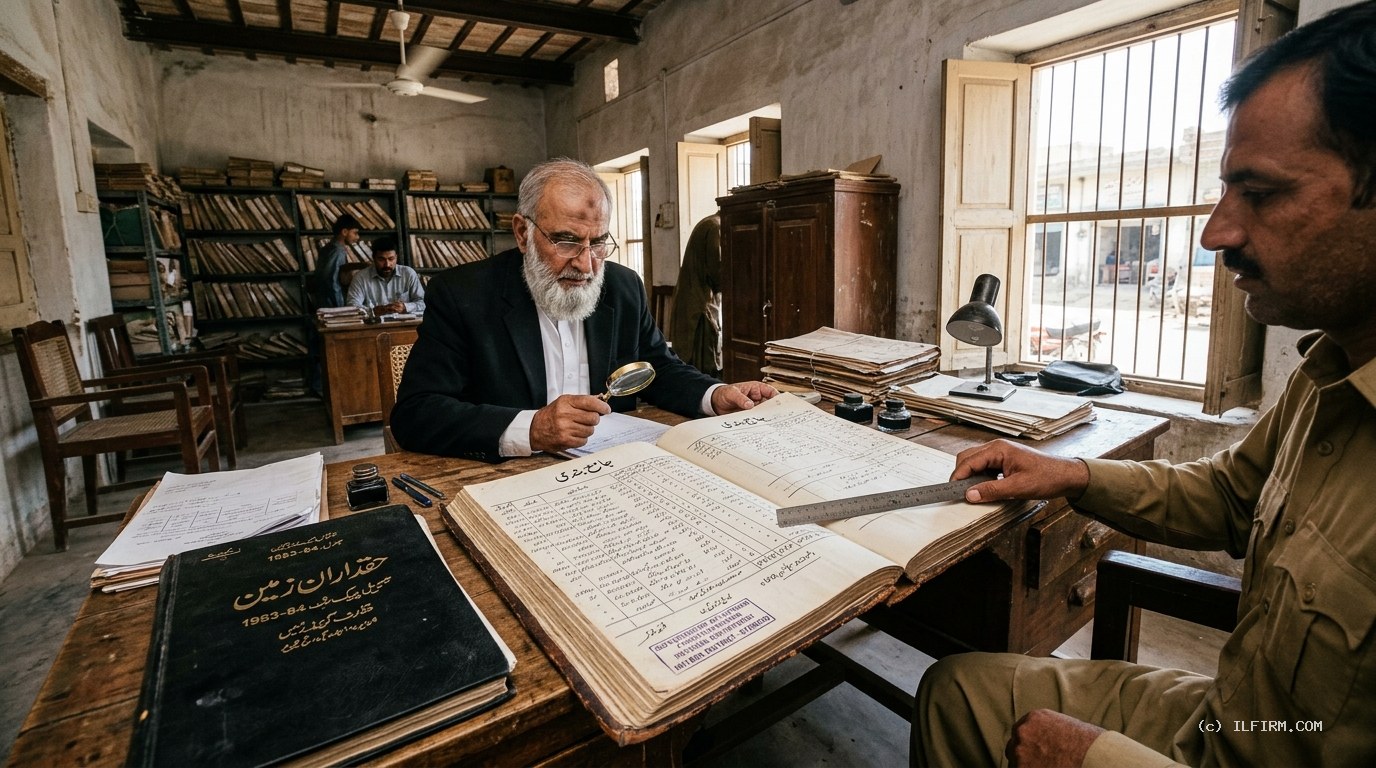
The Fard Malkiat is extracted from the Register Haqdaran Zameen (Misal-e-Meyat or Jamabandi). It proves who is currently recorded as the owner of the land parcel.
What to check: Ensure the Fard is issued specifically for Baye (Sale Purpose) and bears the official stamp and signature of the Halqa Patwari and Kanungo. Check the remarks column (Khana-e-Kaifiyat) for any encumbrances, bank mortgages, stay orders, or revenue court disputes.
B. Register Intiqalat (Mutation Register)
An Intiqal documents the actual legal event through which the current seller acquired the land (e.g., Inheritance / Wirasat, Sale / Baye, or Gift / Hiba).
The Danger: Under settled Supreme Court jurisprudence, an Intiqal is not a title deed in itself; it is merely an administrative record for fiscal tax-collection purposes. If the underlying transaction was illegal or fraudulent, the mutation will be quashed by the revenue authorities or civil court.
C. Aks Shajra (Cadastral Map & Demarcation)
Even if documents appear legitimate on paper, the physical plot may not match the revenue map. The Aks Shajra displays the precise layout, dimensions, Khasra boundaries, and public access roads.
Chamber Rule: A physical demarcation (Nishan-Dahi) conducted by the Girdawar/Kanungo in the presence of neighboring owners is vital to ensure the seller is not selling a riverbed, state-owned forest land, or unapproachable cliffside.
D. Sub-Registrar Bahi Records (Registered Sale Deeds)
In municipal and commercial areas of Mingora, Saidu Sharif, and Kanju, properties are frequently transferred via registered deed (Baye-Nama). Our legal team audits the annual index registers at the Tehsil Sub-Registrar’s office to confirm the deed was neither forged nor cancelled.
2. Common Scams Targeting Overseas Property Buyers in KP
Scam 1: The Joint Ancestral Property Trap (Baye of Mushaa)
A seller offers to sell “10 Marlas” of prime road-facing land. In reality, the land is unpartitioned joint family land (Shamilat / Mushaa). The seller has an abstract ownership share in the estate, but has no legal right to sell specific prime road frontage without a formal partition suit (Taqseem) under Section 135 of the Land Revenue Act, 1967. Other co-sharers can immediately obtain a court stay order and halt your possession.
Scam 2: The Expired or Revoked Power of Attorney
A local agent claims to act on behalf of the original owner through a Power of Attorney executed years ago. If the principal has passed away, the Power of Attorney automatically extinguishes under law. Any sale deed executed posthumously is completely void ab initio.
Scam 3: Pending Injunctions in Dar-ul-Qaza Mingora Bench
Sellers intentionally conceal ongoing constitutional writ petitions or civil litigation. Under Section 52 of the Transfer of Property Act, 1882 (Doctrine of Lis Pendens), any transfer made during the pendency of a court dispute is subject to the final decree of the court. The buyer cannot claim status as a bona fide purchaser without notice.
3. The Chambers Remote Title Due Diligence Protocol
For our expatriate clients in the UAE, UK, and Saudi Arabia, our chambers executes an exhaustive 5-step investigative procedure:
1. Intake & Scanning: We collect photocopies of existing documents, CNIC details, and seller representations.
2. On-Ground Revenue Inspection: A dedicated junior advocate and revenue clerk physically visit the relevant Tehsil Office (Mingora, Kabal, Barikot, Matta, Khwazakhela) to inspect the original Latha (cloth cadastral map) and Roznamcha Waqiati (Patwari daily diary).
3. Litigation Search: We search the court cause lists and records of the Senior Civil Judge Swat, District & Sessions Court, and the Peshawar High Court (Dar-ul-Qaza Mingora Bench) to confirm zero pending lawsuits, stay orders, or lis pendens caveats on the Khasra number.
4. Boundary Verification: Physical inspection of possession (Qabza) on the ground to certify that no encroachers or tenants (Muzaraeen) claim tenancy rights under tenancy legislation.
5. Formal Legal Opinion Certificate: We deliver a formal, written Chamber Title Clearance Report outlining risks, encumbrances, and clear recommendations.
4. Frequently Asked Questions (FAQs)
Q1: Can a Patwari issue a fake Fard?
A: Unfortunately, yes. Corrupt or compromised revenue officials occasionally issue bogus Fards from superseded Jamabandis. This is why our chambers cross-checks the Fard against the permanent Misal-e-Haqiat archived in the District Revenue Record Room (Muhafiz Khana).
Q2: What should I do if a dispute arises after purchase?
A: Immediately file an emergency application for temporary injunction under Order 39 Rules 1 & 2 CPC to prevent the adverse party from alienating, altering, or creating third-party interests in the property.
Protect Your Investment with International Law Firm
Never wire funds for property in Swat or Malakand without verified chambers due diligence.
Standard Verified Kit (AED 1,300 / £275 / $350):
Complete Patwari Fard, Mutation, & Sub-Registrar Audit
Physical Cadastral Boundary Check
Court Litigation Clearance Report
45-Min Video Briefing with Senior High Court Advocate
👉 Inquire Directly via WhatsApp: [Start Property Due Diligence](https://ilfirm.com/overseas/?region=uae) | Chambers: Opposite Dar-ul-Qaza (High Court Bench), Mingora, Swat.
High Court & Dar-ul-Qaza Chambers Counsel
Require Immediate Case Review or Remote PoA Execution?
Our senior advocates represent overseas Pakistanis residing in the UAE, Saudi Arabia, UK, and USA before the Peshawar High Court (Dar-ul-Qaza Mingora Bench), Supreme Court, and District Courts without international travel.