

Supreme Court CPLA Appeals in Pakistan: The Complete Guide to Civil & Criminal Petitions for Leave to Appeal (Article 185(3)) Against High Court Judgments

Executive Summary: The Apex Forum of Pakistani Jurisprudence
In the constitutional and judicial hierarchy of Pakistan, the Supreme Court of Pakistan stands as the ultimate arbiter of legal controversy, the guardian of fundamental constitutional freedoms, and the final repository of appellate justice. Every year, thousands of litigants across the four provinces and federal territories conclude exhausting legal battles in the trial courts, District Courts, Special Tribunals, and High Courts—including the Peshawar High Court (Dar-ul-Qaza Mingora Swat Bench), Lahore High Court, High Court of Sindh, High Court of Balochistan, and Islamabad High Court.
When an adverse, arbitrary, or legally untenable judgment is rendered by a Division Bench or Single Bench of a High Court, the aggrieved litigant confronts the apex appellate threshold. Unlike subordinate judicial tiers where an appeal is frequently available as an automatic statutory entitlement, appellate entry into the Supreme Court of Pakistan is strictly regulated by constitutional mandates. Except in narrow, statutorily specified categories where an appeal lies as of right, an aggrieved party must seek the discretionary indulgence of the apex bench by filing a Civil Petition for Leave to Appeal (CPLA) or a Criminal Petition for Leave to Appeal (Cr.PLA) under Article 185(3) of the Constitution of the Islamic Republic of Pakistan, 1973.
For overseas Pakistanis residing in the United Kingdom, United Arab Emirates, Saudi Arabia, the United States, and across the globe, understanding the rigorous mechanisms of Supreme Court advocacy is vital. High-stakes ancestral land disputes in Khyber Pakhtunkhwa, contested commercial agreements, constitutional writ controversies, and malicious criminal proceedings often culminate in apex challenges. This comprehensive legal practice guide delivers an exhaustive, authoritative blueprint of the statutory architecture, landmark superior court precedents, procedural roadmaps, strict limitation rules, and practical litigation strategies governing CPLA advocacy before the Supreme Court of Pakistan.
Core Doctrine: Discretionary Jurisdiction vs. Automatic Appeal
A Petition for Leave to Appeal under Article 185(3) is not an appeal in the conventional sense; it is a formal petition seeking the Supreme Court’s preliminary leave to convert the grievance into a regular appeal. The petitioner must establish that the impugned High Court judgment violates established legal principles, involves a substantial question of law of public importance, or suffers from gross perversity resulting in grave injustice.
1. Constitutional & Statutory Architecture: Article 185 Demystified
The appellate jurisdiction of the Supreme Court of Pakistan is constitutionally enshrined in Article 185 of the Constitution of Pakistan, 1973. A rigorous understanding of this provision requires distinguishing between appellate jurisdiction exercised as of right under Clause (2) and discretionary leave-granting jurisdiction exercised under Clause (3).
A. Appeal as of Right: Article 185(2)
Under Article 185(2), an appeal lies directly to the Supreme Court from any judgment, decree, final order, or sentence of a High Court without the prerequisite of seeking leave, provided the case falls within specified statutory parameters:
- Reversal of Acquittal to Capital Punishment [Art. 185(2)(a)]: Where the High Court on appeal reverses an order of acquittal of an accused person and sentences him to death, imprisonment for life, or transportation for life.
- Withdrawal and Conviction by High Court [Art. 185(2)(b)]: Where the High Court has withdrawn for trial before itself any case from any subordinate court and has convicted the accused and sentenced him to death or life imprisonment.
- Contempt of Court Sentences [Art. 185(2)(c)]: Where the High Court has sentenced any person for contempt of the High Court.
- High-Value Civil Controversies [Art. 185(2)(d) & (e)]: Where the subject matter of the dispute exceeds statutory pecuniary limits (historically fifty thousand rupees) and the High Court judgment varies or reverses the subordinate court’s decree.
- High Court Certificate of Fitness [Art. 185(2)(f)]: Where the High Court itself certifies that the case involves a substantial question of law as to the interpretation of the Constitution.
B. The Discretionary Apex Realm: Article 185(3) (CPLA)
In practice, over ninety-eight percent of cases reaching the Supreme Court do not fall within the narrow confines of Article 185(2). Consequently, litigants must invoke Article 185(3), which mandates:
“An appeal to the Supreme Court from a judgment, decree, order or sentence of a High Court in a case to which clause (2) does not apply shall lie only if the Supreme Court grants leave to appeal.”
The phrase “shall lie only if the Supreme Court grants leave to appeal” represents a constitutional gatekeeping mechanism. The apex court does not exist to re-examine mundane factual controversies or act as a routine court of third instance. Leave is granted exclusively where the petitioner demonstrates that the High Court committed a jurisdictional error, overlooked vital statutory mandates, misread material evidence, or resolved an unsettled question of general legal importance.
C. Inherent Powers & Complete Justice: Article 187
Complementing Article 185 is Article 187 of the Constitution, which vests the Supreme Court with extraordinary powers to issue directions, orders, or decrees necessary for doing “complete justice in any case or matter pending before it.” While this plenary power enables the court to rectify technical procedural injustices, superior court jurisprudence dictates that Article 187 cannot be deployed to override express statutory prohibitions or invent substantive legal rights where none exist.
D. Binding Precedent & Executive Assistance: Articles 189 & 190
Under Article 189, any decision of the Supreme Court, to the extent that it decides a question of law or is based upon or enunciates a principle of law, is constitutionally binding on all other courts in Pakistan. Subordinate judges, revenue authorities, and High Court benches are strictly bound by its ratio decidendi. Furthermore, under Article 190, all executive and judicial authorities throughout Pakistan are constitutionally mandated to act in aid of the Supreme Court, ensuring that apex decrees and injunctions enjoy immediate, nationwide enforceability.
2. Landmark Superior Court Precedents: Principles Governing Grant of Leave
A successful CPLA demands rigorous doctrinal alignment with established Supreme Court jurisprudence. Senior Supreme Court advocates structure their leave petitions around key binding precedents published in official legal reporters (PLD, SCMR, CLC):
1. Scope of Discretionary Leave & Substantial Questions of Law
PLD 1989 SC 166 | 1998 SCMR 1863 | 2021 SCMR 1310
The Supreme Court has consistently held that Article 185(3) does not confer an automatic right of appeal. The court will not grant leave merely because a different view of the evidence was possible. The petitioner must establish that the case raises a substantial question of law of general public importance or that the High Court committed a manifest illegality resulting in a grave miscarriage of justice.
2. Principle of Non-Interference with Concurrent Findings of Fact
2022 SCMR 1072 | 2023 SCMR 380 | PLD 2015 SC 380
Where the trial court, the first appellate court, and the High Court (under Section 115 CPC Civil Revision or Article 199 Constitutional Writ) have arrived at concurrent factual findings, the Supreme Court exercises extreme circumspection. Interference is justified only where the petitioner proves that the findings are based on misreading of material evidence, non-reading of primary records, or inferences that no reasonable judicial mind could conceivably draw.
3. Limits of the “Complete Justice” Power under Article 187
PLD 2020 SC 556 (Federation of Pakistan v. Justice Qazi Faez Isa)
The apex court clarified that the plenary jurisdiction under Article 187 to do complete justice is remedial and equitable, designed to fill procedural voids. However, it cannot be exercised in contravention of express constitutional provisions, nor can it circumvent mandatory statutory periods of limitation or abrogate fundamental principles of natural justice.
4. Interim Stay Orders Pending CPLA Adjudication
2019 SCMR 1129 | 2016 SCMR 1420
Under Order XII, Rule 4 of the Supreme Court Rules, 1980, the court possesses the power to grant interim injunctive relief, stay execution of decrees, or suspend High Court operation. Relief requires satisfying the classical tripartite test: (i) strong prima facie case for the grant of leave, (ii) balance of convenience favoring the petitioner, and (iii) imminent threat of irreparable loss or destruction of the subject matter.
5. Strict Enforcement of Limitation & Condonation Standards
PLD 2017 SC 692 | 2020 SCMR 204
The law of limitation in the Supreme Court is enforced with absolute rigidity. Section 5 of the Limitation Act, 1908 requires a day-to-day explanation of delay. Counsel negligence, administrative paperwork delays, or the absence of an overseas litigant do not constitute valid legal grounds for condonation. Once the period of limitation expires, a valuable vested right accrues in favor of the opposing party.
6. Non-Maintainability Against Interlocutory Orders
2024 SCMR 415 | 2018 SCMR 1891
The Supreme Court discourages piecemeal litigation. CPLAs filed against interim, interlocutory, or remand orders of High Courts are routinely dismissed unless the order is demonstrated to be void ab initio, passed without subject-matter jurisdiction, or calculated to cause irreversible injustice.
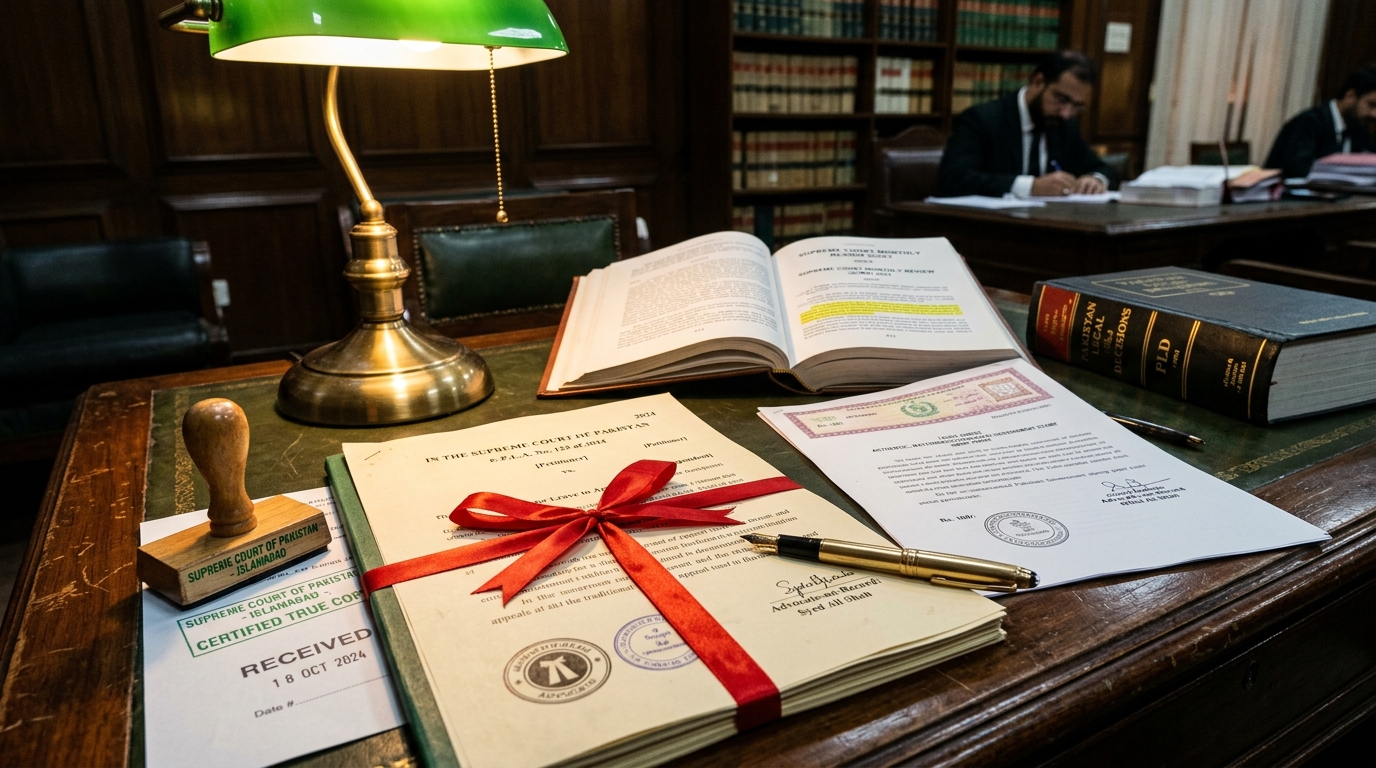
A formal Supreme Court CPLA legal paper book dossier featuring authentic judicial stamp paper, certified High Court decrees, and official Supreme Court Monthly Review (SCMR) precedents.
3. Procedural Roadmap: Step-by-Step CPLA Trajectory
Navigating a Supreme Court appeal requires adherence to the strict procedural choreography established by the Supreme Court Rules, 1980. The trajectory from an adverse High Court judgment to apex adjudication unfolds across six defined phases:
Phase 1: Procuring Certified Copies & Computing Limitation
The moment a High Court Bench (such as the Peshawar High Court Dar-ul-Qaza Mingora Swat Bench) announces an adverse judgment or dismisses a writ petition under Article 199 or civil revision under Section 115 CPC, the limitation clock begins. The advocate must immediately submit an urgent application for Certified True Copies of the judgment and decree sheet. Under Section 12 of the Limitation Act, 1908, the time requisite for obtaining certified copies is excluded from the computation of the limitation period, provided the application was filed before limitation expired.
Phase 2: Engaging Supreme Court Counsel — The Dual-Advocate Rule
Practice before the Supreme Court of Pakistan is strictly bifurcated by statute. A litigant cannot file a petition through an ordinary High Court advocate. Representation requires two specialized practitioners:
- Advocate-on-Record (AOR): An attorney specially enrolled under the Supreme Court Rules responsible for drawing, settling, and formally instituting pleadings, verifying affidavits, receiving process, and certifying that the paper book complies with apex standards.
- Senior Advocate Supreme Court (ASC) / Senior ASC: The senior courtroom litigator briefed by the AOR to present oral legal arguments before the bench during motion hearings and final appellate proceedings.
Phase 3: Drafting the CPLA Paper Book Dossier
The CPLA is instituted in the form of a bound “Paper Book” prepared in accordance with Order XII (Civil) or Order XXIII (Criminal) of the Supreme Court Rules, 1980. The paper book comprises:
- Title Page & Index: Complete party particulars, registry filing details, and indexed pagination.
- Memo of Petition: Formulation of the precise, substantial questions of law upon which leave is sought.
- Concise Statement of Facts: Chronological narration of the dispute from trial court to High Court.
- Grounds of Appeal: Detailed legal grounds demonstrating misreading, non-reading, jurisdictional defect, or misapplication of precedent.
- Impugned Judgment & Decree: Certified copies of the High Court judgment and formal decree sheet.
- Subordinate Court Records: Certified judgments of the trial court, first appellate court, revenue courts, framing of issues, oral depositions, and documentary exhibits.
- AOR Certificate: Mandatory certificate signed by the Advocate-on-Record attesting to the fitness of the grounds and confirming no prior petition on the same subject has been filed.
- Affidavit & Power of Attorney (Vakalatnama): Duly attested affidavit and Vakalatnama executed in favor of the AOR and ASC. For overseas Pakistanis, this requires consular attestation or digital verification.
Phase 4: Registry Institution & Objection Removal
The petition is filed at the Principal Seat in Islamabad or one of the permanent Branch Registries (Peshawar, Lahore, Karachi, or Quetta). The Institution Branch scrutinizes the paper book for technical defects. If objections are raised (e.g., deficiency of court fees, non-certified exhibits, pagination discrepancies), the AOR is granted fourteen days to rectify objections. Upon clearance, the petition receives a formal CPLA number.
Phase 5: Preliminary Motion Hearing & Emergency Stay Relief
The CPLA is fixed before a two-member or three-member bench of the Supreme Court for preliminary motion hearing. At this stage, the Senior Advocate Supreme Court presents oral arguments to persuade the bench that a substantial legal question exists. If real property is threatened with demolition, mutation, or third-party alienation (such as in complex land title disputes), counsel argues the stay application under Order XII, Rule 4. The bench may issue notice to the respondents, grant interim injunctive status quo, or requisition the lower court records (LCR).
Phase 6: Leave Granted — Transition to Regular Civil Appeal
If the bench finds merit in the petition, it announces: “Leave is granted.” Upon grant of leave:
- The petition is formally converted into a Regular Civil Appeal (CA) or Criminal Appeal (Cr.A).
- Interim relief is typically confirmed to remain operative until final disposal of the appeal.
- Parties are directed to deposit security for costs and file detailed Concise Statements within prescribed timelines.
- The appeal is placed on the regular hearing roster for conclusive adjudication.
4. Comparative Legal Remedies Matrix
Selecting the correct appellate or review remedy is vital to avoid fatal procedural dismissal. The table below delineates the statutory frameworks governing superior court remedies in Pakistan:
| Remedy | Governing Provision | Competent Forum | Limitation Period | Court Fee / Valuation | Scope of Review | Interim Stay Available? |
|---|---|---|---|---|---|---|
| Civil CPLA | Art. 185(3) Constitution & Order XII SC Rules 1980 | Supreme Court of Pakistan | 60 Days (from HC Judgment) | Rs. 250 Fixed Stamp + Security Costs | Substantial question of law, perversity, grave injustice | Yes (Order XII, R 4) |
| Criminal CPLA | Art. 185(3) Constitution & Order XXIII SC Rules 1980 | Supreme Court of Pakistan | 30 Days (from HC Judgment) | Nil / Exempt in State custody | Misapplication of criminal law, illegal conviction, bail | Yes (Bail / Suspension) |
| Appeal as of Right | Art. 185(2) Constitution & Order XII SC Rules | Supreme Court of Pakistan | 30 Days (from Certificate/Death Sentence) | Standard Court Fees | Full appellate rehearing on law and facts | Yes |
| Review Petition | Art. 188 Constitution & Order XXVI SC Rules 1980 | Supreme Court (Same Bench) | 30 Days (from SC Judgment) | Fixed Fee | Error apparent on the face of the record only | Rare / Exceptional |
| Intra-Court Appeal (ICA) | Law Reforms Ordinance 1972, Section 3 | High Court (Division Bench) | 20-30 Days (Provincial variance) | Fixed Nominal | Only against Single Bench Writ order where no appeal lay | Yes |
5. Practical Timelines & Procedural Deadlines
In Supreme Court litigation, calculating deadlines with mathematical accuracy is essential. Failure to institute the petition within the limitation period results in incurable dismissal under Order XII, Rule 1:
Civil CPLA Limitation: 60 Days
A Civil Petition for Leave to Appeal must be instituted within sixty (60) days from the date of the impugned High Court judgment or decree. If an application for a certificate of fitness was made to the High Court and refused, the petition must be filed within thirty (30) days of such refusal.
Criminal CPLA Limitation: 30 Days
Under Order XXIII of the Supreme Court Rules, 1980, a Criminal Petition for Leave to Appeal (such as challenging refusal of bail under Section 498 Cr.P.C. or upholding of conviction) must be filed within thirty (30) days of the High Court order.
Certified Copy Exclusion (Section 12)
The period elapsed between the date of applying for certified copies at the High Court Copying Agency and the date on which copies are notified as ready for delivery is excluded. However, unexplained delays in taking delivery are counted against the petitioner.
Objection Removal: 14 Days
When the Supreme Court Registry issues a requisition note listing procedural or technical defects in the paper book, the Advocate-on-Record must rectify all objections within fourteen (14) days, failing which the petition is placed before the Judge-in-Chambers for dismissal.
6. Essential Document Checklist for CPLA Filing
Before lodging a CPLA dossier before the Supreme Court Registry, ensure that every document on this statutory checklist is assembled, paginated, and authenticated:
- Certified Copy of Impugned High Court Judgment: Bearing official court seal, date of application, and date of delivery.
- Certified Copy of High Court Decree Sheet: Required in civil suits to establish formal adjudication of rights.
- Certified Trial Court & Appellate Court Records: Judgments, decrees, order sheets, and revenue record extracts.
- Certified Copies of Pleadings: Plaint, written statement, framed issues, and memorandum of first appeal.
- Material Documentary Exhibits: Sale deeds (Bainama), revenue fards (Jamabandi), Aks Shajra, or disputed contracts.
- Advocate-on-Record (AOR) Certificate: Stating that the grounds are well-founded and no prior petition was instituted.
- Petitioner’s Non-Filing Affidavit: Sworn affirmation that no other CPLA is pending on the same subject matter.
- Power of Attorney (Vakalatnama): Duly signed by petitioner and accepted by AOR and ASC.
- Application for Interim Injunction (Stay Order): Supported by an emergency affidavit of urgency.
- Application for Condonation of Delay (CM): If filed beyond 60 days, accompanied by medical or documentary proof.
7. Special Advisory for Overseas Pakistanis (UK, USA, UAE, Saudi Arabia)
Overseas Pakistanis are disproportionately targeted in fraudulent property litigation, land grabbing, and forged revenue mutations across Pakistan. Due to prolonged absence from the country, overseas litigants frequently discover that trial courts and High Courts have passed ex-parte decrees or adverse revision judgments affecting their ancestral estates.
Through our dedicated Overseas Pakistani Legal Aid Desk, expatriates can institute and pursue Supreme Court CPLA litigation without international travel:
- Remote Power of Attorney Execution: Overseas petitioners can execute a Special Power of Attorney (PoA) before the Pakistan High Commission London, Consulates in Manchester, Birmingham, Bradford, Dubai, Jeddah, or Riyadh, or via the NADRA Digital Power of Attorney Portal.
- MOFA Counter-Attestation: Once received in Pakistan, our chambers coordinates immediate attestation with the Ministry of Foreign Affairs (MOFA) and relevant revenue commissioners.
- Protection of Ancestral Land in Swat & Malakand: For expatriates hailing from Swat, Malakand, Buner, Dir, or Abbottabad, our advocates manage seamless transitions from the Peshawar High Court (Dar-ul-Qaza Mingora Swat Bench) to the Supreme Court Principal Seat in Islamabad or Branch Registry in Peshawar.
- Caveat Petitions to Preempt Ex-Parte Stays: If an adverse party secures a favorable High Court decision, our chambers files an immediate Caveat under Supreme Court Rules to ensure no ex-parte interim orders are passed without prior notice to the expatriate.
8. Frequently Asked Questions (FAQs)
Q1: Can the Supreme Court re-evaluate witness testimony and factual evidence in a CPLA?
As a general rule, no. The Supreme Court does not function as a third trial court. Under established precedents (2022 SCMR 1072), the court will not disturb concurrent findings of fact unless the petitioner demonstrates that the lower courts completely disregarded material documentary evidence or misread testimonies in a manner that shocks the judicial conscience.
Q2: What happens if my CPLA is dismissed at the preliminary motion stage?
If the bench dismisses the petition at the preliminary stage (without granting leave), the High Court judgment attains finality. The petitioner’s sole remaining remedy is to file a Review Petition under Article 188 of the Constitution within thirty (30) days. However, review jurisdiction is strictly limited to patent errors apparent on the face of the record.
Q3: How long does the Supreme Court take to decide a CPLA?
Preliminary motion hearings for emergency stay orders can be fixed within two to six weeks upon filing an urgent application. If leave is granted, the regular appeal may take between one to three years for final disposal, depending on registry pendency and senior citizen or overseas prioritization applications.
Q4: Can a High Court advocate argue my case before the Supreme Court?
No. Under the Legal Practitioners and Bar Councils Act and Supreme Court Rules, 1980, only an enrolled Advocate Supreme Court (ASC) or Senior Advocate Supreme Court (SASC) instructed by an enrolled Advocate-on-Record (AOR) possesses audience before the apex bench.
Q5: Can I file a CPLA directly against an order of a District Judge or Revenue Board?
No. Under Article 185, appellate jurisdiction lies exclusively against judgments, decrees, orders, or sentences of a High Court. Subordinate court or revenue decisions must first be challenged before the High Court via appeal, civil revision (Section 115 CPC), or constitutional writ (Article 199).
Retain Supreme Court Advocates for Apex CPLA Appeals
International Law Firm represents corporate clients, families, and overseas Pakistanis before the Supreme Court of Pakistan (Principal Seat Islamabad & Peshawar Registry) and Peshawar High Court (Dar-ul-Qaza Mingora Swat Bench). Our senior advocates manage emergency stay petitions, CPLA drafting, caveating, and constitutional advocacy.