

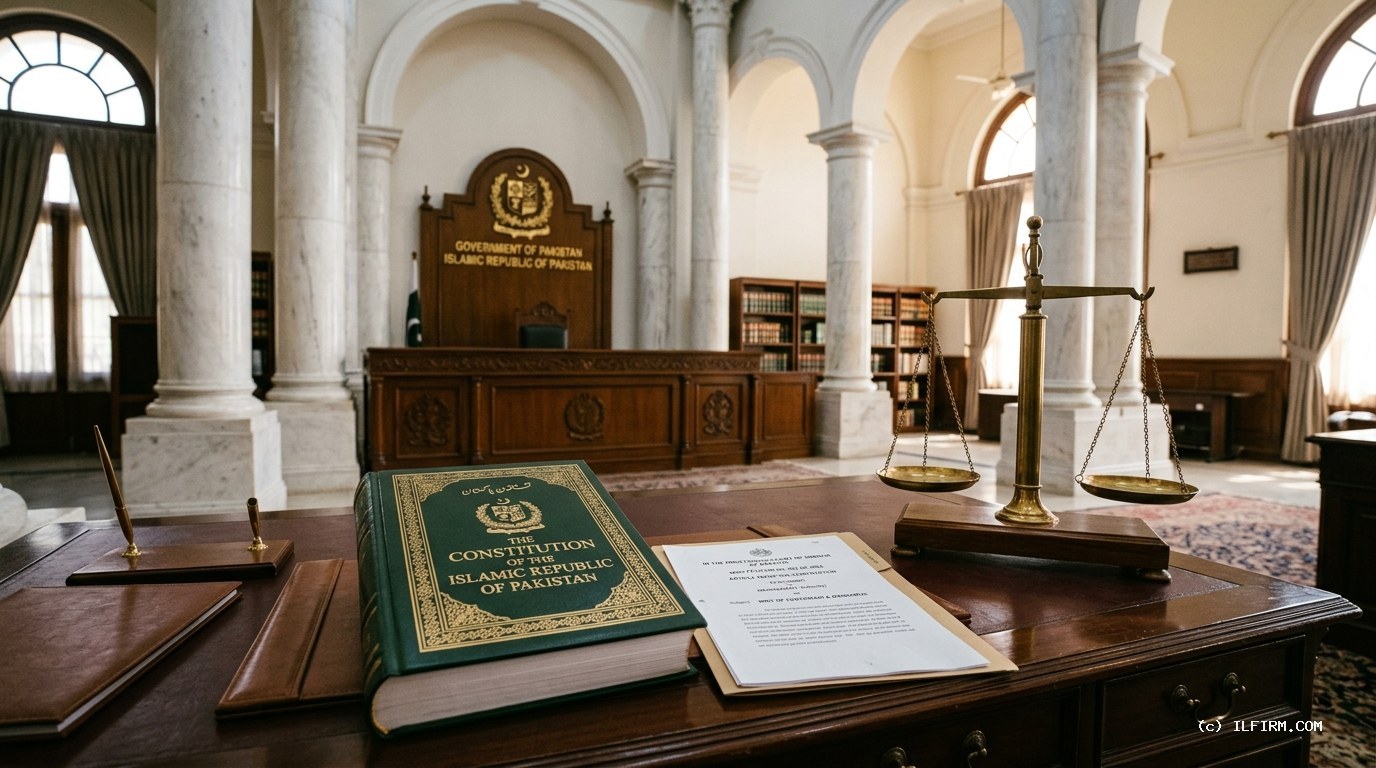
Constitutional Writs & High Court Litigation
Authoritative constitutional writ advocacy under Article 199 before the Peshawar High Court (Dar-ul-Qaza Mingora Bench Swat). Urgent stay orders, Habeas Corpus, Mandamus, Certiorari, and civil service protection.
Comprehensive Legal Representation & Strategy
Constitutional Jurisdiction under Article 199 of the Constitution of Pakistan
The constitutional writ jurisdiction of the High Court under Article 199 of the Constitution of the Islamic Republic of Pakistan, 1973 stands as the ultimate bulwark against executive tyranny, statutory overreach, administrative high-handedness, and violations of fundamental rights. At International Law Firm, our senior constitutional advocates possess decades of specialized trial and appellate experience before the Peshawar High Court (Dar-ul-Qaza Mingora Bench Swat), safeguarding citizens, civil servants, landowners, and commercial enterprises across Swat, Malakand, Buner, Dir, Shangla, Chitral, and Bajaur.
When an administrative authority, public corporation, municipal department, or tribunal passes an order without lawful authority, in excess of statutory jurisdiction, or in flagrant breach of the principles of natural justice, ordinary civil court remedies often prove inadequate or procedurally protracted. The extraordinary supervisory jurisdiction of the High Court provides a swift, high-authority mechanism to quash arbitrary decisions, enforce non-discretionary statutory obligations, and maintain constitutional supremacy.
The Five Prerogative Constitutional Writs
Our constitutional litigation desk formulates, files, and argues all five traditional classifications of constitutional writs tailored to emergency client objectives:
- Writ of Certiorari (Article 199(1)(a)(ii)): Quashing illegal orders, void-ab-initio administrative findings, or corrupt tribunal decrees passed without lawful jurisdiction or in violation of the sacred rule Audi Alteram Partem (no person shall be condemned unheard).
- Writ of Mandamus (Article 199(1)(a)(i)): Compelling statutory authorities, government secretaries, commissioners, universities, or police officials to perform mandatory statutory duties that they have unlawfully neglected or refused to discharge.
- Writ of Prohibition (Article 199(1)(a)(i)): Restraining lower tribunals, revenue boards, or departmental officers from proceeding in matters where they manifestly lack legal jurisdiction or where their constitution is inherently defective.
- Writ of Habeas Corpus (Article 199(1)(b)(i) & Section 491 CrPC): Producing individuals subjected to unlawful detention, secret police confinement, or private hostage situations before the High Court for unconditional liberation.
- Writ of Quo Warranto (Article 199(1)(b)(ii)): Challenging the lawful entitlement of individuals illegally occupying public offices without meeting statutory qualifications or through flawed appointment processes.
Urgent Interim Relief: Securing Stay Orders at Motion Hearing (Katcha Peshi)
In high-stakes constitutional litigation, securing an immediate interim injunction (stay order) on the very first day of hearing (Katcha Peshi) is crucial to freezing the ground reality. Our advocates prepare comprehensive emergency stay applications establishing the three cardinal tests recognized by the Supreme Court of Pakistan: (1) a strong prima facie case, (2) the balance of convenience tilting decisively in the petitioner’s favor, and (3) irreparable loss that cannot be compensated through monetary damages.
Whether challenging the unlawful cancellation of a government license, staying an illegal departmental demolition, freezing arbitrary revenue recovery notices, or restraining premature transfer orders of civil servants, our immediate presence at the gates of Dar-ul-Qaza ensures that urgent petitions can be moved and heard within hours of filing.
Civil Servants, Service Matters & Departmental Writs
Government servants and public sector employees across Khyber Pakhtunkhwa frequently face arbitrary disciplinary proceedings, tainted inquiry reports under the KPK Efficiency & Discipline (E&D) Rules 2011, denial of legitimate promotions, and contractual non-regularization. While exclusive terms and conditions fall within the purview of the Service Tribunal under Article 212 of the Constitution, our firm leverages Article 199 writ jurisdiction in matters involving unconstitutional disqualifications, discriminatory recruitment rules, and non-payment of pensionary entitlements.
Specialized High Court & Constitutional Divisions
Explore our specialized sub-practice teams operating across Dar-ul-Qaza Mingora Bench and High Court registries:
Remote Constitutional Relief for Overseas Pakistanis
Overseas Pakistani expatriates living in the United Arab Emirates, Saudi Arabia, the United Kingdom, and the United States often discover that government authorities or local land syndicates have passed ex-parte orders against their properties during their absence abroad. Through verified digital NADRA Powers of Attorney and consular certifications, our firm institutes Article 199 writ petitions, obtaining High Court orders to set aside void administrative acts and protect expatriate assets without requiring overseas travel.
Key Representation Scopes & Deliverables
Request Case Assessment
Direct matter evaluation by High Court Advocates within 24 hours.
Frequently Asked Legal Questions
Essential information regarding court timelines, documentation, and client representation.
What is the primary requirement for filing an Article 199 writ petition?
The petitioner must demonstrate that an authority performing functions in connection with the affairs of the Federation or Province has acted in violation of law or fundamental rights, and that no other adequate, efficacious remedy is provided by law.
How fast can a stay order be obtained at Dar-ul-Qaza Mingora Bench?
For urgent matters, petitions filed before the morning registry deadline are listed on the very next morning's motion list, or on the same day in cases of imminent demolition or unlawful arrest.
Can an overseas Pakistani file a High Court writ petition remotely?
Yes. By executing a digital NADRA Power of Attorney or consular-attested PoA, our firm files, signs, and argues the writ petition in the High Court without requiring your physical presence in Pakistan.
Can the High Court review judgments of the District Judge in writ jurisdiction?
Generally, the High Court exercises revisional jurisdiction under Section 115 CPC for civil court decrees. However, where lower courts act completely without jurisdiction, or in family/rent matters where second appeals are barred by statute, Article 199 writ petitions are fully maintainable.