

Suit for Partition of Joint Immovable Property in Pakistan: Partition Act 1893, Revenue Demarcation & Superior Court Precedents (دعویٰ تقسیمِ جائیدادِ غیر منقولہ مشترکہ: پارٹیشن ایکٹ 1893، ریونیو حد براری اور اعلیٰ عدالتی نظائر)
1. Executive Summary & Jurisprudential Foundations (تعارفی خلاصہ و بنیادی قانونی محرکات)
In the constitutional and civil jurisprudence of the Islamic Republic of Pakistan, immovable property represents the quintessential bedrock of familial wealth, generational security, and commercial stability. However, the demise of a property owner inevitably triggers the devolution of proprietary title upon legal heirs as co-sharers (شریک کھاتہ داران / حصہ داران). Under Islamic jurisprudence (Shariah) as codified and administered across Pakistani superior courts, proprietary title vests automatically, immediately, and irrevocably in all legal heirs the exact moment the propositus passes away. There is no concept of an estate in abeyance; every heir becomes an undivided tenant-in-common holding a determinate ideal share in every square foot, inch, and parcel of the estate.
Notwithstanding this theoretical certainty of title, joint ownership of unpartitioned real estate is inherently pregnant with civil conflict. Co-heirs frequently encounter severe systemic obstacles: domineering siblings who usurp physical possession of prime commercial frontages, recalcitrant co-owners who erect unauthorized permanent structures, fraudulent alienations to unscrupulous third-party land grabbers, and the systematic economic deprivation of female heirs and overseas family members. Under Pakistani law, no citizen can be condemned to remain trapped in the friction, discord, and vulnerability of perpetual joint tenancy. The fundamental maxim nemo in communione invitus detineri potest—no co-owner can be compelled to remain in joint ownership against their will—is the foundational cornerstone of the Suit for Partition of Immovable Property (دعویٰ تقسیمِ جائیدادِ غیر منقولہ).
A suit for partition is the authoritative substantive and procedural mechanism through which an undivided, common, or joint title is judicially severed, dissolved, and converted into exclusive, demarcated, and severable ownership. It transforms an abstract fraction reflected in the Register Haqdaran Zameen (رجسٹر حقدارانِ زمین / جمع بندی) or title deed into a defined, physically bounded parcel of real estate demarcated on the ground with an independent cadastral boundary (Tatimma / Aks Shajra). The partition of immovable property in Pakistan is governed by a dual statutory framework: the Partition Act 1893 (ایکٹ تقسیمِ جائیداد 1893) read with the Code of Civil Procedure 1908 (مجموعہ ضابطہ دیوانی 1908) for urban, residential, and commercial properties, and the West Pakistan Land Revenue Act 1967 (ویسٹ پاکستان لینڈ ریونیو ایکٹ 1967) for agricultural lands assessed to land revenue.
For litigants, commercial entities, and particularly Overseas Pakistanis (تارکینِ وطن) residing in the United Arab Emirates, Saudi Arabia, the United Kingdom, Europe, and North America, instituting and successfully prosecuting a partition suit requires acute strategic foresight. Litigants must navigate complex procedural gateways, including defeating pleas of oral partition, countering claims of adverse possession, obtaining urgent interlocutory injunctions under Order 39 Rules 1 and 2 CPC, navigating the critical bifurcation between a Preliminary Decree (ابتدائی ڈگری) and a Final Decree (حتمی ڈگری) under Order 20 Rule 18 CPC, and directing the execution of judicial auctions when physical division is commercially or physically impossible. This treatise provides an exhaustive, bench-grade analysis of partition jurisprudence tailored for superior court litigation.
2. Statutory Architecture & Dual Jurisdictional Divide (قانونی و ضابطہ جاتی ڈھانچہ اور دائرہ اختیار کی تقسیم)
The substantive and procedural law governing partition in Pakistan does not reside within a single code; rather, it is anchored across multiple substantive enactments, procedural codes, and provincial revenue statutes. Comprehending the jurisdictional boundary between the Subordinate Civil Courts (دیوانی عدالتیں) and the Revenue Hierarchy (محکمہ مال / ریونیو افسران) is the initial jurisdictional imperative in any partition controversy.
A. The Code of Civil Procedure 1908 (Order 20 Rule 18 & Section 54 CPC)
The general procedural machinery for partition suits before the Civil Court is codified under Order 20 Rule 18 of the Code of Civil Procedure 1908 (ضابطہ دیوانی آرڈر 20 رول 18). This rule establishes a mandatory statutory dichotomy depending upon the nature of the immovable property under adjudication:
- Order 20 Rule 18(1) read with Section 54 CPC: Where the suit relates to the partition of an undivided estate assessed to the payment of revenue to the Government (i.e., purely agricultural land), the Civil Court’s jurisdiction is confined to passing a Preliminary Decree (ابتدائی ڈگری) declaring the rights, titles, and exact mathematical proportions of the respective claimants. Once this declaratory threshold is crossed, Section 54 mandates that the actual physical separation, metes-and-bounds demarcation, and delivery of possession must be executed by the Collector (ڈسٹرکٹ کلیکٹر / ڈپٹی کمشنر) or any gazetted subordinate revenue officer deputed by him, strictly in accordance with the revenue laws.
- Order 20 Rule 18(2) CPC: Where the suit relates to urban immovable property, residential houses, commercial plazas, industrial estates, plots in approved housing schemes, or agricultural land situated within municipal limits that has lost its purely agrarian character, the Civil Court retains absolute, unfettered jurisdiction over the entire lifecycle of the litigation. The Civil Court passes the Preliminary Decree declaring the shares, appoints a Local Commissioner (مقامی کمیشن) under Order 26 Rule 13 CPC to inspect the premises and prepare lots, adjudicates objections to the commissioner’s report, and executes the Final Decree (حتمی ڈگری) by delivering actual physical possession or ordering a judicial sale.
B. The Partition Act 1893 (ایکٹ تقسیمِ جائیداد 1893)
Where immovable property consists of a built-up residential dwelling, a commercial warehouse, or a small urban plot that cannot be physically partitioned without destroying its intrinsic utility, structural stability, or commercial value, the Partition Act 1893 (Act IV of 1893) provides specialized remedies designed to prevent economic destruction:
- Section 2 (Power to Order Sale Instead of Division): Whenever in any suit for partition, it appears to the court that, by reason of the nature of the property, the number of shareholders, or any other circumstance, a division of the property cannot reasonably or conveniently be made, and that a sale of the property and distribution of proceeds would be more beneficial for all shareholders, the court may, on the application of any interested shareholder owning at least a one-half (50%) share, direct a judicial sale of the property.
- Section 3 (Procedure When Shareholder Undertakes to Buy at Valuation): To protect family heritage from public liquidation, if any shareholder applies for a sale under Section 2, any other shareholder may apply to the court for leave to buy the share of the party moving for sale. The court must then order a professional valuation of the share and offer it to the applying shareholder at that judicially ascertained price, providing an indispensable statutory mechanism for family buy-outs.
- Section 4 (Partition Suit by Stranger Purchaser of Share in Dwelling-House): This is one of the most formidable statutory protections in Pakistani property law. Where a share of a dwelling-house belonging to an undivided family has been transferred to a person who is not a member of such family, and such transferee-stranger institutes or seeks partition, the court shall—if any member of the family being a shareholder undertakes to buy the share of such transferee—order a valuation of such share and direct its transfer to the family shareholder. This statutory right of pre-emption firmly bars external land speculators and strangers from forcing their way into the ancestral domestic hearth of an undivided Pakistani family.
C. The West Pakistan Land Revenue Act 1967 (Sections 135 to 150)
For agricultural estates recorded in the revenue record, Chapter XI (Sections 135 to 150) of the West Pakistan Land Revenue Act 1967 (ایکٹ ریونیو 1967) creates an exclusive statutory forum before the Assistant Collector 1st Grade / Tehsildar (تحصیلدار / اسسٹنٹ کلیکٹر درجہ اول). Any recorded joint owner holding an unpartitioned share in a Khata may submit an application for partition. However, the jurisdiction of the Revenue Officer is strictly conditional upon the absence of a dispute as to title:
- Section 141 (Disposal of Questions as to Title in Property to be Divided): If any objection is raised during revenue partition proceedings that involves a Question of Title (تنازعہٴ ملکیت و حقیت)—such as an allegation that a co-sharer’s mutation was obtained through fraud, that a gift deed is forged, or that a family settlement partitioned the land decades ago—the Revenue Officer has two statutory alternatives: (1) He may decline to proceed with partition until the question has been determined by a competent Civil Court, staying proceedings; or (2) He may constitute himself into a Civil Court and try the question of title following the procedure of the Code of Civil Procedure. In practice, superior courts have held that complicated questions of fraud and title must be remitted to the plenary jurisdiction of the Civil Court.
D. Constitutional Guarantees (Articles 23 & 24 of the Constitution 1973)
The right of an owner to separate their property from recalcitrant co-owners is further elevated to a constitutional command under Articles 23 and 24 of the Constitution of the Islamic Republic of Pakistan 1973 (آئینِ پاکستان 1973 آرٹیکل 23 و 24). Article 23 guarantees every citizen the fundamental right to acquire, hold, and dispose of property, while Article 24 protects citizens from being deprived of their property save in accordance with law. Denying a legitimate co-sharer their demarcated physical share directly impairs their constitutional right to enjoy and dispose of their private property.
3. Evidentiary Rigour & Documentary Proof of Co-Ownership (ثبوتی ضوابط، شواہد کی جانچ اور ریونیو ریکارڈ کی اہمیت)
The outcome of a partition suit hinges entirely upon evidentiary precision under the Qanun-e-Shahadat Order 1984 (قانونِ شہادت آرڈر 1984). Unlike ordinary contractual disputes where verbal assertions may hold sway, partition litigation demands unimpeachable documentary proof of joint title, accurate genealogical succession, and exact cadastral demarcations.
A. Primary Title Documents & Revenue Record Verification
To maintain a suit for partition, the plaintiff must place on record certified copies of the foundational revenue and registration records. The essential evidentiary instruments comprise:
- Register Haqdaran Zameen / Jamabandi (رجسٹر حقدارانِ زمین / جمع بندی): The primary quadriennial record of rights showing the joint ownership khata, the total land area, the nature of tenancy, and the specific fractional share (Hisas) recorded in the name of each co-sharer. Under Section 52 of the Land Revenue Act 1967, an entry in the record of rights carries a legal presumption of truth (Qanooni Qayas-e-Sadaqat), although this presumption is rebuttable upon proof of fraud or clerical error.
- Inheritance Mutation (انتقالِ وراثت – Inteqal-e-Wirasat): The certified revenue entry evidencing the sanction of inheritance following the death of the ancestor. Advocates must ensure the mutation is attested by the Revenue Officer in an open Jalsa-e-Aam in compliance with Section 42 of the Land Revenue Act 1967.
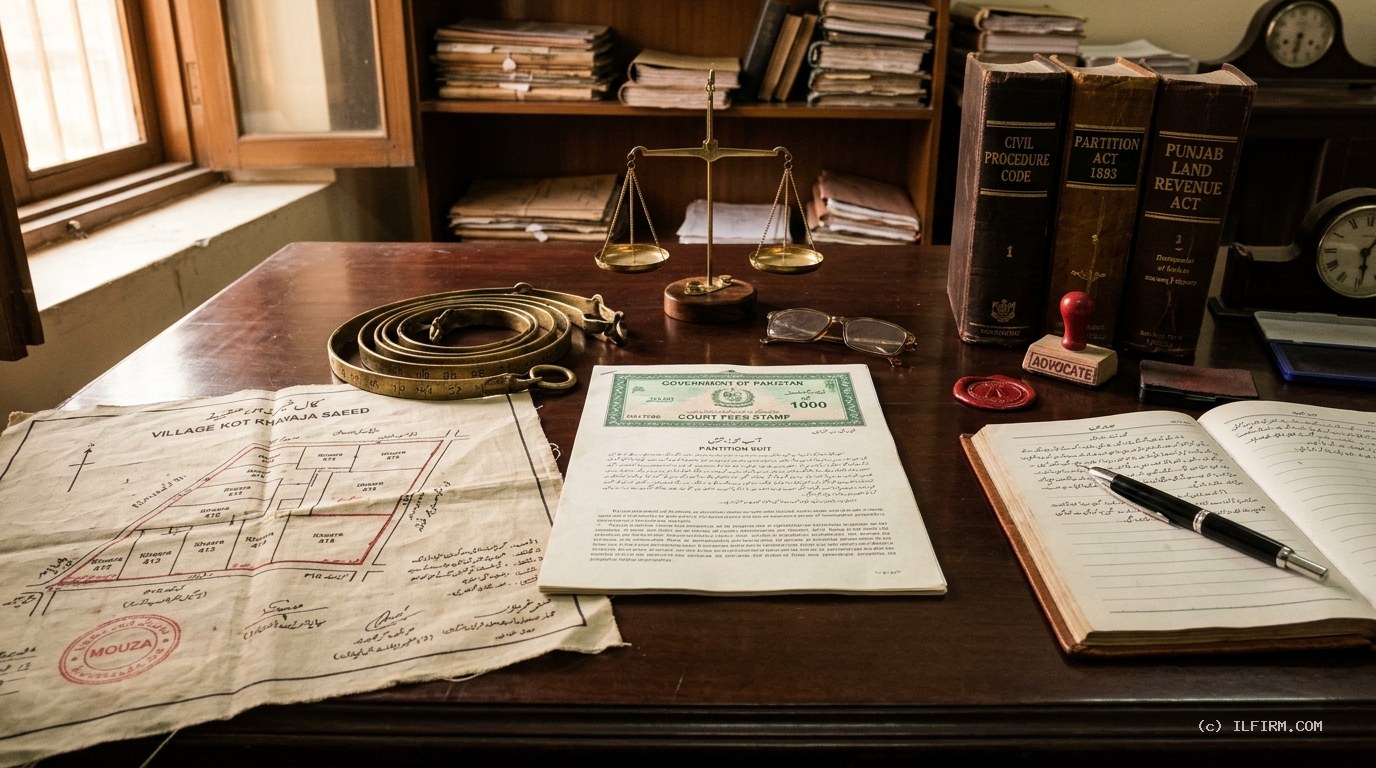
- Aks Shajra & Cadastral Maps (عکس شجرہ و نقشہ بندوبست): The official cloth or paper map depicting the layout of the village (Mauza), showing the exact boundaries of every Khasra Number (خسرہ نمبر), water courses, pathways, and adjoining properties.
- Khasra Girdawari (خسرہ گرداوری): The harvest inspection register prepared biannually by the Patwari, which proves who has been in actual cultivating or physical possession of specific portions of the joint estate.
- Registered Title Deeds (رجسٹرڈ بیع نامہ / ہبہ نامہ): For urban properties, certified copies of the registered sale deed, gift deed, or lease agreement registered with the Sub-Registrar under the Registration Act 1908, accompanied by municipal assessment records and utility bills.
B. Proving Succession: Family Registration Certificate & Pedigree Tables
In partition suits arising out of ancestral inheritance, the plaintiff must prove the precise genealogical tree of the family. Under Article 117 of the Qanun-e-Shahadat Order 1984, the legal burden rests squarely upon the plaintiff to establish that all legal heirs have been properly impleaded:
- NADRA Family Registration Certificate (FRC): The digital genealogical certificate issued by NADRA showing the parentage and direct descendants of the deceased propositus.
- Shajra-e-Nasab (شجرہ نسب / پٹوار شجرہ): The traditional genealogical pedigree maintained in the revenue record room, certified by the Revenue Patwari and Revenue Officer.
- Succession Certificate / Letter of Administration (جانشینی سرٹیفکیٹ): Issued under the Succession Act 1925 or through the digital NADRA succession regime, establishing the recognized legal status of the heirs.
C. Inadmissibility of Adverse Possession between Co-Sharers
A chronic defense raised by contesting defendants who have enjoyed exclusive physical occupation of a joint property is the plea of Adverse Possession (حقِ قبضہ مخالفانہ) under Article 144 of the Limitation Act 1908. Under entrenched Pakistani jurisprudence, this defense is statutorily and legally untenable. The landmark evidentiary maxim governing co-heirship is that the possession of one co-sharer is, in the eye of the law, the possession of all co-sharers (ایک شریک کھاتہ دار کا قبضہ تمام شریک کھاتہ داران کا قبضہ تصور ہوتا ہے).
To establish adverse possession against a fellow co-owner, the law requires proof of an open, unequivocal, hostile, and notorious Ouster (اخراج / بیدخلی), brought to the direct knowledge of the excluded co-sharer for a continuous period of at least twelve years. Mere non-participation in profits, prolonged permissive residence, or payment of property taxes by one co-sharer cannot, under any circumstances, ripen into adverse possession against co-heirs.
4. Binding Superior Court Precedents & Jurisprudential Ratios (اعلیٰ عدالتی نظائر اور سپریم کورٹ کے اصول)
The jurisprudence of partition has been thoroughly refined by the superior courts of Pakistan, establishing authoritative benchmarks that bind all subordinate trial courts under Article 189 (Supreme Court) and Article 201 (High Court) of the Constitution. Senior advocates must ground their pleadings in the following binding precedents:
1. PLD 2020 Supreme Court 456 — The Absolute & Continuing Right to Seek Partition
Bench: Full Bench of the Supreme Court of Pakistan
Ratio Decidendi: The Supreme Court authoritatively settled that the right of a co-owner to demand partition is a continuous and recurring cause of action. As long as the property remains joint and unpartitioned in the revenue records or title registers, no statute of limitation can extinguish the right to seek partition. The apex court ruled that the doctrine of laches or delay has no application to a suit for partition, as every moment of joint holding gives rise to a renewed cause of action. Any agreement or covenant completely barring a co-sharer from ever seeking partition is void against public policy.
2. 2019 SCMR 1709 — Strict Prohibition against Partial Partition (عذرِ عدمِ شمولیتِ کل جائیداد)
Bench: Division Bench of the Supreme Court of Pakistan
Ratio Decidendi: The apex court held that a suit for partition must embrace the entirety of the joint estate owned by the parties. A plaintiff cannot selectively institute a suit for partition regarding high-value commercial parcels while excluding low-value, remote, or encumbered joint properties. The doctrine of partial partition (juzwi taqseem) is strictly prohibited because it causes multi-fold litigation and prejudices equitable adjustment of shares. The only recognized exceptions are: (1) where properties are situated in distinct territorial jurisdictions, or (2) where certain parcels are admitted by all parties to have already been partitioned by mutual consent.
3. PLD 2017 Supreme Court 733 — Sanctity of the Undivided Family Dwelling-House (Section 4 Partition Act)
Bench: Three-Member Bench of the Supreme Court of Pakistan
Ratio Decidendi: The Supreme Court affirmed that Section 4 of the Partition Act 1893 is a liberal statutory shield designed to preserve the domestic privacy, cultural sanctity, and peace of an undivided family dwelling-house against intrusion by external purchasers. If an outside stranger purchases an undivided share from an errant family member and files a suit for partition, the indigenous family members have an absolute, unconditional right to buy out the stranger’s share at a fair market valuation determined by the court. The court clarified that the term “family” must be construed liberally to include all descendants and relations living together or sharing ancestral ownership.
4. 2021 SCMR 1318 — Exclusive Domain of Civil Court over Complex Questions of Title (Section 141 Land Revenue Act)
Bench: Supreme Court of Pakistan
Ratio Decidendi: Where an application for partition is pending before a Revenue Officer under the Land Revenue Act 1967 and an adverse party raises a substantial question of title challenging the validity of a mutation, will, or gift on grounds of fraud, collusion, or misrepresentation, the Revenue Officer possesses no summary authority to brush aside such objections. Under Section 141, the Revenue Officer must stay proceedings and direct the parties to seek adjudication before the Civil Court, or convert himself into a Civil Court and try the issue strictly under the CPC. Failure to follow this procedure renders any subsequent revenue partition null and void in the eyes of law.
5. 2022 SCMR 1215 — Joint Possession Maxim & Protection of Excluded Female Heirs
Bench: Supreme Court of Pakistan
Ratio Decidendi: The Supreme Court delivered a landmark ruling protecting female heirs who had been systematically excluded from joint family property by their brothers for over three decades. The court ruled that male co-heirs holding physical possession hold it as trustees on behalf of their sisters and female co-sharers. The passage of thirty or forty years does not extinguish a female heir’s entitlement. Any purported “relinquishment deed” (Dastbardari) or oral waiver executed by a female heir in favor of male siblings without substantial financial consideration must be viewed with extreme judicial suspicion and is void ab initio.
6. 2016 CLC 1420 (Peshawar High Court, Mingora Bench Dar-ul-Qaza Swat) — Partition Custom & Metes-and-Bounds Demarcation in Swat
Bench: Peshawar High Court (Dar-ul-Qaza Mingora Swat Bench)
Ratio Decidendi: In the Provincially Administered Tribal Areas (PATA) and Malakand Division (Swat), the High Court ruled that while customary family divisions (Riwaj) are acknowledged, they cannot prevail over statutory partition decrees unless supported by unbroken, registered instruments or unequivocal revenue entries. When a formal suit for partition is instituted, the trial court must ensure that the local commissioner prepares a meticulous Khurra-bandi (lotting map) taking into account road access, water rights (Haq-e-Aabpashi), and land terrain to ensure absolute equity among the co-heirs.
7. 2023 SCMR 890 — The Finality and Appealability of the Preliminary Decree (Order 20 Rule 18 CPC)
Bench: Supreme Court of Pakistan
Ratio Decidendi: The Supreme Court reiterated the fundamental distinction between a preliminary decree and a final decree. A preliminary decree under Order 20 Rule 18 CPC is a formal adjudication that conclusively determines the rights and shares of the parties. If an aggrieved party fails to challenge the preliminary decree through a regular first appeal under Section 96 CPC, they are statutorily barred under Section 97 CPC from disputing the correctness of those shares at the stage of the final decree. The proceedings following a preliminary decree are strictly ministerial and execution-oriented.
5. Procedural Roadmap — From Plaint to Final Execution & Physical Demarcation (مرحلہ وار عدالتی طریقہ کار: دعویٰ سے ڈگری اور نفاذ تک)
Successfully prosecuting a suit for partition requires methodical navigation through structured judicial phases. The litigation flows through ten distinct statutory stages before the Civil Court or Revenue Authority:
Pre-Litigation Legal Notice & Demand for Partition (قانونی نوٹس برائے تقسیم)
Prior to approaching the court, it is strategically advisable for a co-owner to dispatch a formal legal notice through a High Court advocate to all recorded co-sharers, demanding private partition by mutual consent within 15 to 30 days. This notice formally establishes the refusal of co-sharers to partition amicably, solidifying the plaintiff’s cause of action and justifying costs of suit.
Drafting & Filing Plaint before Senior Civil Judge (عرضی دعویٰ تقسیمِ جائیداد)
The plaint is drafted under Order 7 CPC, specifically detailing: (a) precise description of all joint properties (urban and rural); (b) complete genealogical tree (Shajra Nasab); (c) mathematical fractional shares claimed by each party; (d) certified copies of Jamabandi, Fard, and Aks Shajra; and (e) valuation of suit for court fee and jurisdiction under the Suits Valuation Act 1887.
Securing Emergency Interim Injunction (حکمِ امتناعی عارضی زیر آرڈر 39 رول 1 و 2)
Simultaneously with the plaint, the plaintiff must file an urgent application under Order 39 Rules 1 and 2 read with Section 151 CPC seeking an interim restraining order. The court issues a status quo or restraining injunction preventing the defendants from: (i) raising unauthorized construction; (ii) alienating, selling, or creating third-party charges over specific portions; and (iii) changing the nature or character of the joint property pendente lite.
Service of Summons & Written Statement (تعمیلِ سمنات و جواب دعویٰ)
Summons are served under Order 5 CPC through registered post, courier, and proclamation in leading newspapers. Contesting defendants file their Written Statement (جواب دعویٰ) under Order 8 CPC, setting forth preliminary legal objections (e.g., partial partition, prior oral settlement) and responding to factual averments regarding ownership proportions.
Framing of Issues & Recording of Evidence (تنقیحات و شہادتِ فریقین)
The trial judge frames formal issues under Order 14 CPC regarding title, co-ownership shares, and maintainability. Parties produce oral and documentary evidence under the Qanun-e-Shahadat Order 1984. Revenue Patwaris and record keepers are summoned under Order 16 CPC to produce original revenue registers, mutations, and field maps.
Pronouncement of Preliminary Decree (صدورِ ابتدائی ڈگری زیر آرڈر 20 رول 18)
Upon evaluating the evidence, the Civil Court pronounces judgment and passes a Preliminary Decree (ابتدائی ڈگری) conclusively determining the exact legal shares of the plaintiff and all defendants. This decree is a formal decree of the court; if not challenged in appeal under Section 96 CPC within the statutory limitation period (30 days to District Court), it attains unshakeable finality.
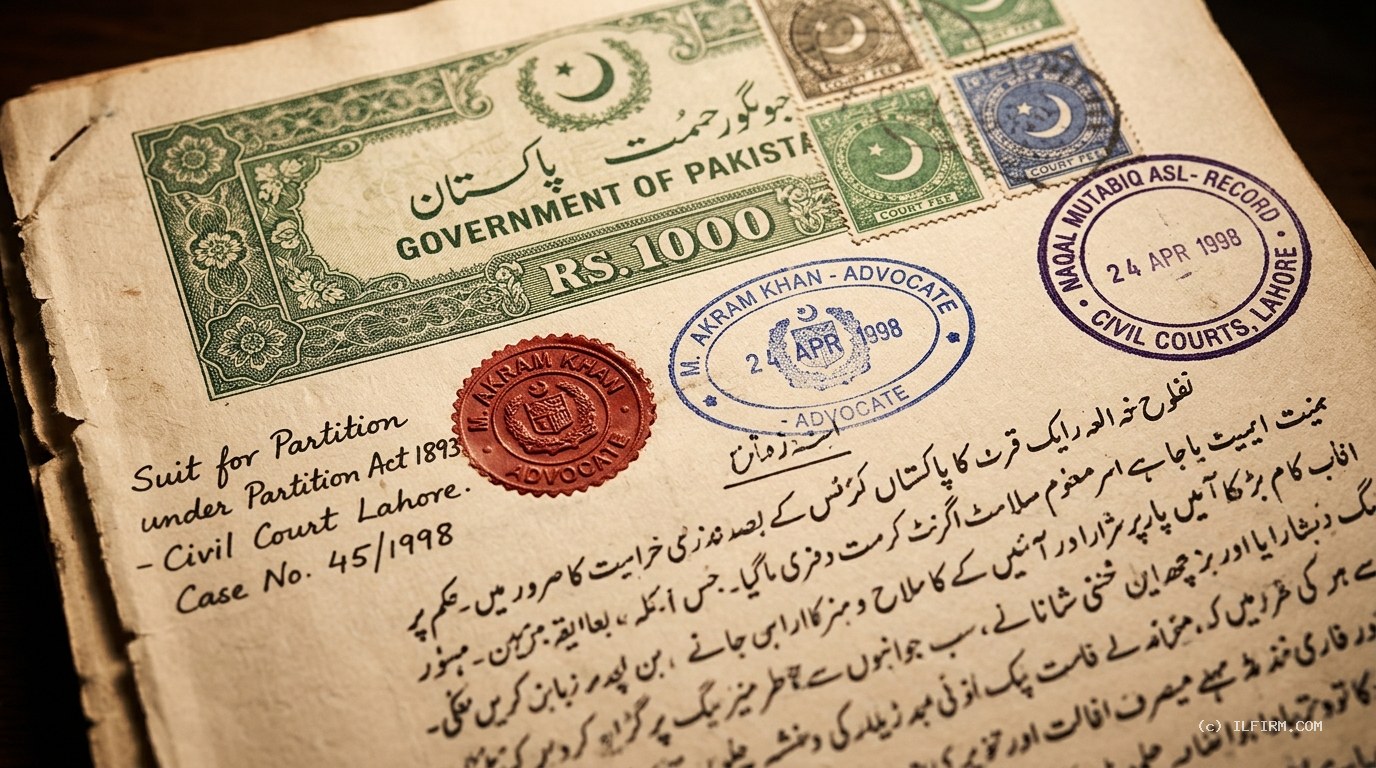
Judicial Stamp Paper, Record Room Certified Copy Endorsement (Naqal Mutabiq Asl) & Advocate Vakalatnama Seals in Partition Proceedings (عدالتی اسٹامپ پیپر، نقل مطابق اصل مہر اور وکالت نامہ برائے دعویٰ تقسیمِ جائیداد)
Appointment of Local Commissioner for Metes-and-Bounds Division (تقرریِ مقامی کمیشن برائے کھُرہ بندی)
Under Order 26 Rule 13 CPC, the Civil Court appoints an experienced advocate or senior revenue official as Local Commissioner. The commissioner visits the spot in the presence of the parties, takes measurements with a revenue chain (Jarib), prepares a site plan, and drafts separate proposed lots (Khurras) ensuring that high-value frontages, thoroughfares, and utilities are distributed with mathematical equity.
Invoking Partition Act 1893: Judicial Auction & Inter-Se Bidding (نیلامی بروئے ایکٹ 1893)
If the Local Commissioner reports that the property (e.g., a 5-marla residential home or commercial shop) cannot be physically divided without destroying its utility, the court invokes Sections 2 and 3 of the Partition Act 1893. The court orders a certified professional valuation by an approved evaluator. Co-owners are invited to participate in internal inter-se bidding to buy out each other’s shares. If no family member purchases, the court conducts an open public auction and distributes the proceeds pro rata according to the preliminary decree.
Passing of Final Decree (صدورِ قطعی ڈگری)
After adjudicating objections filed by any party against the Local Commissioner’s report or concluding the auction/buy-out proceedings, the Civil Court confirms the lots and draws up the Final Decree (حتمی ڈگری) on non-judicial stamp paper bearing requisite stamp duty as prescribed by the Stamp Act 1899.
Execution Proceedings & Actual Physical Delivery of Possession (نفاذِ ڈگری زیر آرڈر 21)
The decree-holder files an Execution Petition under Order 21 Rule 35 CPC. The executing court issues a Warrant of Possession (وارنٹِ دخل). A court bailiff, accompanied by the revenue staff (Halqa Patwari and Girdawar) and necessary police force under Section 151 CPC, visits the site, erects boundary pillars or boundary walls, dispossesses obstructing judgment-debtors, and hands over peaceful, vacant, demarcated physical possession to the decree-holder, concluding in a formal Dakhal Dihani report.
6. Formidable Strategic Defenses & Litigation Pitfalls (قانونی دفاع، مخالفانہ حکمتِ عملی اور عدالتی باریکیاں)
In partition litigation, both plaintiffs and defendants must anticipate aggressive statutory defenses. A senior advocate must construct robust pleadings to either deploy or dismantle these strategic legal hurdles:
1. The Absolute Bar of Partial Partition (عذرِ عدمِ شمولیتِ کل مشترکہ جائیداد)
The Defense: The defendant pleads that the suit is bad for partial partition because the plaintiff deliberately omitted other ancestral properties, bank accounts, or commercial entities situated in other mauzas or cities.
Counter-Strategy: Under Order 6 Rule 17 CPC, the plaintiff should immediately seek amendment of the plaint to incorporate all omitted parcels, or demonstrate through certified revenue extracts that the excluded parcels were already partitioned through an acknowledged family settlement or are situated outside the territorial jurisdiction of the provincial court.
2. Defense of Prior Oral Partition & Family Settlement (عذرِ تصفیہٴ خانگی و زبانی تقسیم)
The Defense: Contesting defendants frequently plead that the property was verbally divided by ancestors 20 or 30 years ago through a private family arrangement (Khangi Faisla / Zabani Taqseem), and that parties have constructed houses on their respective parcels.
Counter-Strategy: Superior courts hold that the burden of proving an oral partition rests heavily upon the party asserting it. If the revenue records still reflect joint ownership (Mushtarka Khata) and no mutation of partition (Inteqal Taqseem) was ever sanctioned under Section 135 of the Land Revenue Act, the presumption of jointness remains intact. An unverified family paper written on plain paper without registration or revenue recognition cannot defeat a statutory suit for partition.
3. Strategic Pre-emption of Stranger Purchasers under Section 4 Partition Act (حقِ شفع اندرونِ مکان)
The Defense / Counter-Attack: Where an errant co-sharer has sold their undivided share to a hostile third-party speculator, indigenous family members can immediately invoke Section 4 of the Partition Act 1893. By filing an undertaking expressing willingness to buy out the transferee’s share at a court-determined price, the family can permanently freeze the stranger out of the ancestral property and compel the court to execute a statutory conveyance in their favor.
4. Claims for Cost of Improvements & Construction (دعویٰ خرچہٴ تعمیرات و اصلاحات)
The Defense: A co-sharer who has spent substantial funds constructing a building on joint land asserts that other co-sharers cannot claim a share in the structure without reimbursing construction expenses.
Counter-Strategy: The equitable doctrine of partition dictates that where a co-owner constructs on joint land without the written consent of other co-sharers, he does so at his own peril. However, equity dictates that during the preparation of lots (Khurras), the court or local commissioner will endeavor, as far as practicable, to allot the improved portion to the co-owner who erected the building, adjusting the value against his fractional share or requiring him to pay cash compensation (Owelty) to the other co-heirs.
5. Tactical Protection for Overseas Pakistanis
Overseas Pakistanis are prime targets for fraudulent ex-parte partition decrees orchestrated through bogus postal service in Pakistan. To protect expatriate clients, senior advocates must institute a verified Special Power of Attorney (مختار نامہ خاص) attested by the Pakistani Embassy or Consulate in Dubai, Riyadh, London, or Washington, registered with the Ministry of Foreign Affairs (MOFA) in Islamabad. Advocates must proactively enter appearances, inspect revenue record rooms, lodge caveats, and file applications under Section 12(2) CPC to vacate any fraudulent ex-parte partition decrees obtained behind the overseas co-sharer’s back.
7. Comparative Practice Matrices (تقابلی مشقتی جدول)
To enable practitioners and litigants to instantly evaluate procedural options, the following comparative matrices delineate statutory forums, fiscal liabilities, and documentary prerequisites:
Table 1: Primary Judicial Remedy vs. Alternative Statutory Pathways
| Judicial Remedy (قانونی چارہ جوئی) | Statutory Authority (قانونی اختیار) | Competent Forum (مجاز عدالت / ادارہ) | Applicability (اطلاق و نوعیت) | Key Advantages & Limitations |
|---|---|---|---|---|
| Civil Suit for Partition (دعویٰ تقسیمِ جائیداد) | Order 20 Rule 18 CPC & Partition Act 1893 | Senior Civil Judge / District Court | Urban properties, residential buildings, commercial plazas, mixed estates | Conclusive adjudication of title; power to order auction or family buy-out; full injunctive relief under Order 39 CPC. |
| Revenue Partition (ریونیو تقسیمِ زرعی اراضی) | Sections 135–150 Land Revenue Act 1967 | Assistant Collector 1st Grade / Tehsildar | Purely agricultural land assessed to land revenue | Faster administrative execution by field staff; automatically barred if any genuine question of title is agitated. |
| Private Family Settlement Deed (رجسٹرڈ تصفیہٴ خانگی) | Registration Act 1908 & Transfer of Property Act 1882 | Sub-Registrar & Revenue Officer (Inteqal) | Mutual consensus among 100% of legal co-sharers | Zero court delay; cost-effective; requires complete unanimity; a single dissenting heir completely collapses the deed. |
| Illegal Dispossession Complaint (استغاثہ بیدخلیِ ناجائز) | Illegal Dispossession Act 2005 (IDA) | Court of Session / Sessions Judge | Dispossession of co-owner by property grabbers or violent ouster | Speedy criminal trial and restoration of possession; cannot determine mathematical shares or partition the estate. |
Table 2: Limitation Periods, Court Fees & Jurisdictional Valuation Matrix
| Procedural Element (ضابطہ جاتی عنصر) | Governing Statute (متعلقہ قانون) | Statutory Threshold / Value | Legal Application & Exceptions |
|---|---|---|---|
| Limitation for Instituting Suit | Article 120 Limitation Act 1908 | Continuous / Recurring Cause of Action | No limitation period as long as property remains joint in records; continuous right recognized in PLD 2020 SC 456. |
| Court Fee (Plaintiff in Joint Possession) | Court Fees Act 1870, Schedule II, Art. 17(vi) | Fixed Court Fee (Rs. 50 to Rs. 200) | Applies when plaintiff is in constructive or joint physical possession; ad valorem court fee is NOT required. |
| Court Fee (Plaintiff Completely Ousted) | Court Fees Act 1870, Section 7(iv)(b) & 7(v) | Ad Valorem (7.5% subject to provincial caps) | Mandatory where plaintiff admits total physical dispossession and seeks restoration of separate possession. |
| Jurisdictional Pecuniary Valuation | Suits Valuation Act 1887 & Civil Courts Ordinance 1962 | Market Value of Plaintiff’s Specific Share | Determines pecuniary tier: Civil Judge 1st Class (unlimited) vs Senior Civil Judge; appeal forum (District Judge vs High Court). |
| Appeal Limitation (Section 96 CPC) | Limitation Act 1908, Articles 152 & 156 | 30 Days (District Court) / 90 Days (High Court) | Must be calculated strictly from date of Preliminary Decree; failure to appeal bars challenging shares later (Section 97 CPC). |
Table 3: Mandatory Evidentiary Document Checklist
| Document Name (دستاویز کا نام) | Issuing Authority (جاری کنندہ ادارہ) | Evidentiary Purpose (ثبوتی مقصد) | Legal Mandate under Qanun-e-Shahadat 1984 |
|---|---|---|---|
| Register Haqdaran Zameen (Jamabandi) | Land Revenue Department / Patwari / Arazi Record Center | Establishes co-ownership, joint khata, and exact fractional shares | Presumption of truth under Section 52 Land Revenue Act 1967. Certified copy admissible under Article 87 QSO. |
| Aks Shajra / Cadastral Field Map | Tehsil Office / Revenue Record Room | Demarcates khasra parcel numbers, layout, roads, and natural features | Essential for Local Commission to draft Khurra-bandi (Order 26 Rule 13 CPC). |
| NADRA Family Registration Certificate (FRC) | NADRA (National Database & Registration Authority) | Proves legal heirship, lineage, and parentage of the deceased propositus | Official digital record proving impleadment of all necessary parties under Order 1 Rule 10 CPC. |
| Inheritance Mutation (Inteqal-e-Wirasat) | Revenue Circle / Tehsildar | Evidences fiscal sanction of inheritance transfer upon legal heirs | Public document under Article 85 QSO; corroborates genealogical devolution. |
| Embassy-Attested Power of Attorney | Pakistani Embassy / Consulate & MOFA Islamabad | Authorizes advocate/representative for Overseas Pakistani co-heir | Presumption of due execution under Article 95 QSO; shields expatriate rights without travel to Pakistan. |
8. Frequently Asked Questions (اکثر پوچھے جانے والے عملی و قانونی سوالات)
Q1: Can one co-sharer sell a specific physical portion of an unpartitioned joint property?
Answer: Under settled law of the Supreme Court of Pakistan (2014 SCMR 1007), a co-sharer in joint unpartitioned property can only sell his undivided fractional share (Hisas); he has no legal authority to sell a specific physical parcel, corner, or khasra by metes and bounds to the exclusion of other co-sharers. Any sale deed purporting to convey a specific portion operates in law merely as an alienation of an undivided share, and the purchaser simply steps into the shoes of the vendor co-sharer, subject to the outcome of a regular partition suit.
Q2: What happens if an ancestral house cannot be physically partitioned among heirs?
Answer: Where an immovable property (such as a 5-marla residential home or commercial shop) cannot be physically divided without destroying its value, the court applies Sections 2 and 3 of the Partition Act 1893. The court orders an independent market valuation. The co-heirs are given the first right to purchase each other’s shares through an internal bidding process. If none of the heirs exercises this buy-out option, the court orders a public judicial auction, sells the property, and distributes the monetary sale proceeds pro rata among all heirs.
Q3: What is the difference between a Preliminary Decree and a Final Decree in partition?
Answer: Under Order 20 Rule 18 CPC, a partition suit is bifurcated into two distinct adjudicatory stages: The Preliminary Decree conclusively determines the rights, titles, and mathematical percentages of all co-heirs. Once passed, it must be challenged via regular first appeal if disputed. The Final Decree is passed after appointing a Local Commissioner who carries out actual physical demarcation, prepares distinct lots (Khurras), or conducts an auction. The final decree formalizes the metes-and-bounds division on stamp paper.
Q4: Can a co-sharer claim adverse possession against other family members who live overseas?
Answer: Absolutely not. Under settled Pakistani superior court jurisprudence (2022 SCMR 1215), the possession of one co-sharer is legally considered the possession of all co-sharers. A family member living in Pakistan cannot claim adverse possession against overseas brothers, sisters, or female heirs, no matter how many decades have elapsed. To establish adverse possession, the occupying party must prove an open, hostile, and notorious ouster with explicit notice, which is virtually impossible among co-heirs.
Q5: How can Overseas Pakistanis file a partition suit without travelling to Pakistan?
Answer: Overseas Pakistanis residing in the UAE, Saudi Arabia, the UK, or the USA can execute a Special Power of Attorney (Vakalatnama / Mukhtar Nama Khas) before the Pakistani Embassy or Consulate in their host country. Once attested by the foreign diplomatic mission, the power of attorney is transmitted to Pakistan, countersigned by the Ministry of Foreign Affairs (MOFA), and registered. The appointed advocate or attorney can then institute the partition suit, secure stay orders, and represent the overseas client through to the final decree and execution.
Q6: What is the limitation period for filing a partition suit in Pakistan?
Answer: Under Article 120 of the Limitation Act 1908 and binding Supreme Court precedent (PLD 2020 SC 456), the right to seek partition of joint property is a continuing and recurring cause of action. There is no limitation period barring a co-owner from filing a partition suit as long as the property remains recorded as joint in the revenue records or title deeds. Every day the property remains unpartitioned gives rise to a fresh right to demand separation.
9. Chambers Consultation & Superior Court Representation (چیمبرز مشاورت و قانونی نمائندگی)
Superior Court Chambers Advocacy // High Court & Supreme Court of Pakistan
Resolve Complex Partition & Land Disputes with International Law Firm
Securing your rightful inheritance, partitioning commercial complexes, or defending against predatory co-sharers demands bench-grade litigation mastery. The senior property advocates at International Law Firm (ILF) represent domestic clients and Overseas Pakistanis across Peshawar High Court (Mingora Bench Dar-ul-Qaza Swat), Lahore High Court, Islamabad High Court, and the Supreme Court of Pakistan.
- Civil Suits for Partition & Stay Orders: Property & Land Title Litigation
- Criminal Defense Against Land Grabbers: Illegal Dispossession & Criminal Defense
- High Court Constitutional Remedies: Constitutional Writ Petitions
- Expat Remote Representation & Consular PoA: Overseas Pakistanis Legal Aid Desk