

Private Complaint under Section 200 CrPC in Pakistan (استغاثہ دائر کرنے کا طریقہ کار)
When police refuse to lodge an FIR or conduct a biased inquiry, victims of crime are not without statutory recourse. Under Pakistani criminal jurisprudence, filing a private complaint under section 200 crpc pakistan—known locally as an Istighasa (استغاثہ)—provides a direct judicial avenue to bring offenders before a criminal court without relying on police discretion.
Quick Answer: What Is a Private Complaint under Section 200 CrPC?
A private complaint under section 200 crpc pakistan is a formal criminal petition filed directly before a competent Judicial Magistrate (علاقہ مجسٹریٹ) under Chapter XVI of the Code of Criminal Procedure 1898. The Magistrate examines the complainant upon oath, evaluates preliminary evidence under Section 202, and issues summons or warrants under Section 204 to initiate a criminal trial.
What the Law Says: Statutory Scheme under Sections 200 to 204 CrPC
The statutory foundation of a private criminal complaint is codified under Chapter XVI of the Code of Criminal Procedure, 1898 (Act V of 1898), available on Pakistan Code. While police cases begin with an FIR under Section 154 CrPC, a private complaint empowers citizens to invoke the criminal justice machinery directly before the court of first instance.
Under Section 4(1)(h) CrPC, a “complaint” means an allegation made orally or in writing to a Magistrate, with a view to their taking judicial action, that some person has committed an offence. It explicitly excludes a police report. A Judicial Magistrate takes cognizance upon the complaint under Section 190(1)(a) CrPC. Five key sections govern this procedure:
- Section 200 CrPC (Examination of Complainant): The Magistrate must immediately record the Statement on Oath (بیان زیر حلف) of the complainant and attending witnesses. This mandatory oath prevents vexatious litigation.
- Section 201 CrPC (Procedure by Incompetent Magistrate): If the Magistrate lacks territorial or subject-matter jurisdiction, the complaint is returned for presentation before the proper court.
- Section 202 CrPC (Postponement of Process and Preliminary Inquiry): The Magistrate may postpone issuing process and conduct a Preliminary Inquiry (ابتدائی انکوائری) personally, or direct an inquiry by a police officer or referee.
- Section 203 CrPC (Dismissal of Complaint): If no sufficient ground for proceeding is disclosed, the Magistrate orders the Dismissal of Complaint (خارجی استغاثہ) with recorded reasons.
- Section 204 CrPC (Issue of Process): Upon finding a prima facie case, the Magistrate directs the Summoning of Accused (طلبئ ملزمان) via court summons or arrest warrants.
Step-by-Step Procedure: Private Complaint under Section 200 CrPC Pakistan
Pursuing a private criminal complaint requires disciplined procedural steps from initial drafting through final judgment:
- Drafting the Complaint (Days 1–3): An advocate drafts the petition specifying the date, time, and sequence of the offence, accused particulars, relevant Pakistan Penal Code (PPC) sections, witness names, and supporting documents.
- Filing before Judicial Magistrate (Day 4): The petition is presented before the Judicial Magistrate having territorial jurisdiction over the police station limits where the offence occurred.
- Recording Statement under Section 200 (Days 5–10): The complainant appears in person and records their statement under oath. The judge signs and certifies the deposition.
- Preliminary Evidence under Section 202 (Weeks 2–5): The complainant examines their primary eyewitnesses in court. The Magistrate may also call for a field inquiry report from police or revenue officials.
- Issue of Process under Section 204 (Weeks 6–8): If the preliminary evidence discloses a prima facie case, the court issues summons or warrants compelling the accused to appear.
- Trial and Judgment (Months 3–12): Following formal framing of charge, witness cross-examination, and final arguments, the trial court delivers a judgment of conviction or acquittal.
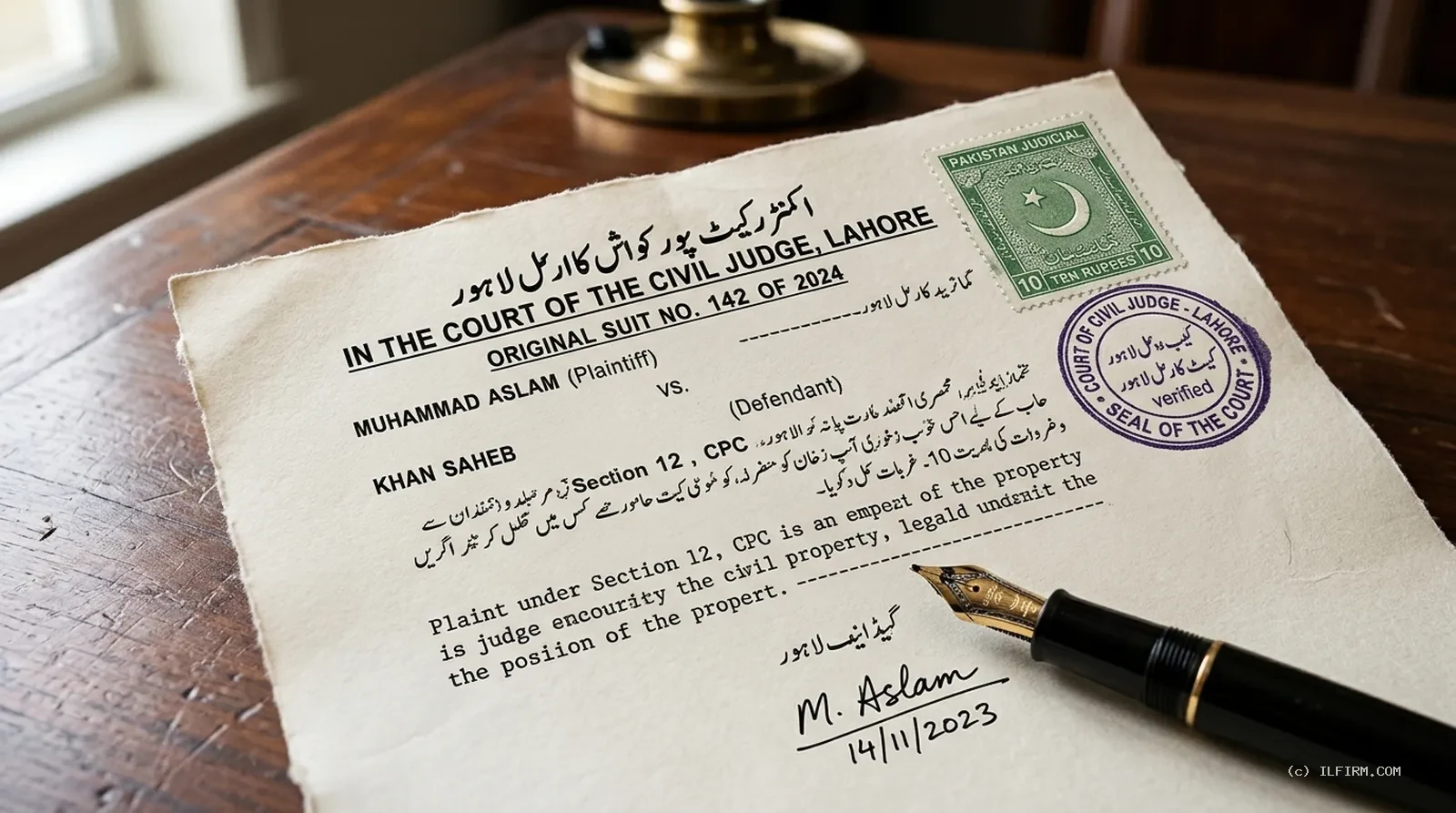
Certified petition docket and official verification stamp for a private criminal complaint in Pakistan (عدالتی استغاثہ اور دفتری تصدیق)
Essential Evidence and Documents You Need to File a Complaint
Because the state does not investigate a private complaint, the complainant bears the entire burden of producing credible evidence. Litigants should assemble the following documentation:
- Proof of Police Inaction: Copies of written complaints submitted to the police station or supervisory officers (DSP/DPO) to demonstrate institutional inaction.
- Witness Calendar (Fard Pata Gawahān): A detailed list of private eyewitnesses, including CNIC numbers, residential addresses, and expected testimony.
- Medical Reports: Certified Medico-Legal Reports (MLR) and hospital discharge slips in cases involving physical hurt or assault.
- Documentary Instruments: Original dishonored cheques, bank return memos, and postal receipts for offences such as dishonored cheques trial under Section 489-F PPC.
- Digital Evidence: Preserved CCTV footage, call detail records, or electronic messages with requisite authentication.
- Special Power of Attorney: A registered and consular-attested Special Power of Attorney (مختار نامہ خاص) if the complainant resides overseas.
Key Superior Court Judgments on Private Complaints
The following binding precedents from the Supreme Court of Pakistan and the High Courts govern private complaint trials:
1. Noor Elahi v. The State (PLD 1966 SC 708)
The Supreme Court established that when an FIR challan and a private complaint coexist regarding the same occurrence, the private complaint must be taken up and tried first to protect the complainant’s independent narrative from prejudice.
2. Mst. Sughran Bibi v. The State (PLD 2018 SC 595)
A larger bench of the Supreme Court held that only one FIR can be registered for a single occurrence. Any rival Cross-Version (مخالف یا متضاد مؤقف) must be pursued through a private complaint under Section 200 CrPC.
3. Fahid Ullah v. Mst. Dil Pazir Jan (Peshawar High Court)
The Peshawar High Court reaffirmed that examining the complainant on oath under Section 200 is mandatory. Omitting the oath renders subsequent summoning orders illegal and void ab initio.
4. Muhammad Riaz v. The State (2021 PCrLJ 1120 Peshawar)
The High Court held that dismissal under Section 203 CrPC requires recording clear judicial reasons showing proper evaluation of preliminary evidence.
Practical Litigation Strategy and Common Mistakes
Navigating an Istighasa requires strategic foresight for both prosecuting complainants and defending accused:
Complainant Strategy
- Explain Any Delay: Unexplained delay creates suspicion of concoction. Provide clear justifications for late filing.
- Ensure Witness Consistency: Depositions under Sections 200 and 202 must match the written complaint precisely.
- Specify Individual Roles: Avoid vague omnibus allegations against an entire family.
- Urgent Remedies: If unlawful detention occurs, seek immediate relief via habeas corpus petitions under Article 199.
Accused Defense
- Seek Pre-Arrest Bail: If arrest warrants are issued under Section 204, apply promptly for pre-arrest bail under Section 498.
- Challenge Malicious Complaints: If the complaint is a retaliatory counterblast, petition the High Court for quashment of FIR and criminal proceedings under Section 561-A.
- Highlight Civil Disputes: If the dispute concerns land boundaries or inheritance, demonstrate that it is civil in nature. For illegal land grabbing, remedies lie under the eviction of land grabbers under Illegal Dispossession Act 2005.
In Swat & Khyber Pakhtunkhwa: Local Jurisdiction and Overseas Litigants
In Swat and Malakand Division, private complaints are instituted before the Senior Civil Judge (Judicial) / Judicial Magistrate at Saidu Sharif, Swat, and sub-divisional courts in Kabal, Matta, Khwazakhela, and Bahrain. Supervisory revisions lie with the District & Sessions Courts Swat, while quashment petitions are adjudicated by the Peshawar High Court, Mingora Bench (Dar-ul-Qaza Swat).
Overseas Pakistanis in the UAE, Saudi Arabia, the UK, or the USA can institute an Istighasa through a Special Power of Attorney attested by the Pakistan consulate and MOFA. For recording trial evidence, KPK courts routinely allow depositions and cross-examination via secure video-link or judicial commission under Section 503 CrPC, sparing clients unnecessary international travel.
Comparison Table: Police FIR vs. Private Complaint (Istighasa) in Pakistan
| Legal Dimension (قانونی جہت) | Police FIR (ایف آئی آر) | Private Complaint / Istighasa (استغاثہ) |
|---|---|---|
| Governing Statute (متعلقہ قانون) | Section 154 CrPC, 1898 | Sections 200–204 CrPC, 1898 |
| Forum of Institution (مجاز فورم) | Local Police Station | Court of Judicial Magistrate / Sessions Judge |
| Investigation Agency (تفتیش کار) | Police IO under Section 156 | Court directly, or inquiry referee under Section 202 |
| Prosecution Burden (بارِ ثبوت) | Conducted by State Prosecutor | Borne by private complainant’s advocate |
| Prescribed Court Fee (عدالتی فیس) | Nil (Free) | Nominal court fee stamps (Rs. 2–50) |
| Typical Timeline (متوقع دورانیہ) | Challan submitted within 14 days | Summoning 4–8 weeks; trial 6–18 months |
Frequently Asked Questions (FAQ)
What is the difference between an FIR and a private complaint (Istighasa) in Pakistan?
An FIR is registered at a police station under Section 154 CrPC, where police investigate and the state prosecutes. A private complaint is filed directly before a Judicial Magistrate under Section 200 CrPC, bypassing police inaction, with the complainant bearing the responsibility of producing evidence and private legal representation.
Can a private complaint be filed if the police refuse to register an FIR?
Yes. Filing a private complaint under Section 200 CrPC is the primary judicial remedy when police refuse to register an FIR or when the complainant is dissatisfied with police partiality. Furthermore, under the Supreme Court ruling in *Sughran Bibi* (PLD 2018 SC 595), any cross-version to an existing FIR must be pursued via private complaint.
What happens during the examination of the complainant under Section 200 CrPC?
Upon taking cognizance, the Magistrate administers a mandatory oath to the complainant, questions them regarding the criminal allegations, records the statement in writing, and obtains signatures. This preliminary statement serves as the foundation for the court to evaluate whether to dismiss the petition or issue process against the accused.
Can an overseas Pakistani file a private complaint in Pakistan without being physically present?
Yes. An overseas Pakistani residing abroad can institute a private complaint through a lawfully attested Special Power of Attorney executed before a Pakistani consulate. For recording evidence and cross-examination during trial, trial courts routinely grant permission to examine overseas complainants via secure video-link facilities or judicial commissions.
What is the remedy if a Judicial Magistrate dismisses a private complaint under Section 203 CrPC?
If a Magistrate dismisses an Istighasa under Section 203 CrPC for lack of sufficient grounds, the dismissal does not operate as an acquittal. The complainant can file a Criminal Revision under Section 435/439-A CrPC before the Sessions Court or invoke High Court revisional jurisdiction to challenge the dismissal.
Schedule a Strategic Criminal Defense & Istighasa Consultation
Whether you are an aggrieved victim seeking justice through a private complaint after police inaction, or an individual facing a fabricated criminal indictment, timely legal representation is critical. Our senior criminal advocates represent clients before Judicial Magistrates, Sessions Courts, and the Peshawar High Court (Mingora Bench / Dar-ul-Qaza Swat).
Disclaimer: The legal information contained in this guide is published for educational purposes only and does not constitute formal legal advice. Judicial outcomes depend entirely upon the specific facts and records of each dispute. Reviewed by Senior Advocate, Peshawar High Court & Supreme Court of Pakistan, October 2026.