

Talaq Notice Section 7 MFLO Procedure in Pakistan (طلاق نوٹس کا طریقہ کار)
1. Quick Answer
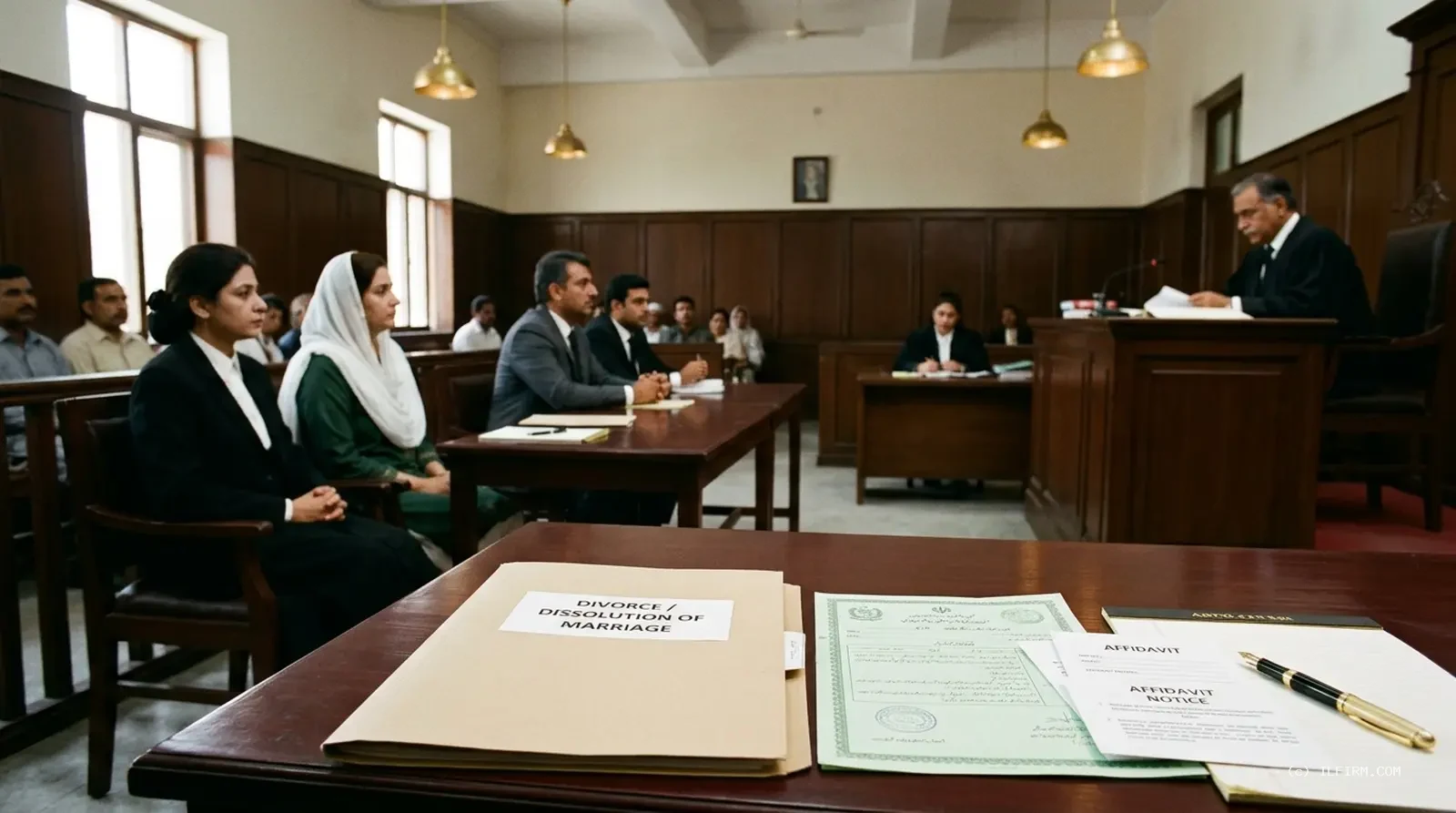
Under Pakistani law, the statutory talaq notice section 7 muslim family laws ordinance procedure requires a husband pronouncing divorce to deliver written notice to the Union Council Chairman, copying his wife. The divorce remains suspended during a mandatory 90-day reconciliation period before an Arbitration Council. Upon failure of reconciliation, the Chairman issues an official Certificate of Effectiveness, enabling issuance of a computerized NADRA Divorce Registration Certificate.
2. What the Law Says: Statutory Framework under MFLO 1961
The dissolution of Muslim marriages in Pakistan is regulated by the Muslim Family Laws Ordinance, 1961 (Ordinance VIII of 1961). Under Section 7(1) of the Ordinance, any man who pronounces Talaq in any form whatsoever must immediately give written notice of having done so to the Chairman of the competent Union Council, and must supply a copy thereof to his wife.
A verbal pronouncement or an unnotified private deed does not legally dissolve a marriage. Under Section 7(3), a Talaq does not become effective until the expiration of ninety days from the date the statutory Notice of Talaq (نوٹس طلاق) is received by the Chairman. Failure to deliver this notice is an offence under Section 7(2), punishable by imprisonment up to one year, or a fine [VERIFY: KPK position], or both.
Where the wife holds delegated divorce under Clause 18 of the Nikahnama—known as Delegated Divorce (طلاقِ تفویض)—or where separation occurs by mutual consent (Mubarat), Section 8 mandates adherence to this same notice procedure. Unlike judicial Khula and dissolution of marriage procedure in Family Court, Section 7 is an administrative statutory process. Jurisdiction is determined by Rule 3(b) of the West Pakistan Rules under MFLO 1961 (the council where the wife resides, or if abroad, where the spouses last cohabited in Pakistan). Statutes are accessible via the Pakistan Code federal statutory repository.
3. Step-by-Step Talaq Notice Section 7 Muslim Family Laws Ordinance Procedure
Parties must execute statutory registration through five distinct procedural phases to ensure validity before NADRA and superior courts:
- Execution of Talaqnama (Days 1–3): The husband executes a formal Talaqnama on green stamp paper, stating marital particulars, CNICs, and unequivocal pronouncement before two adult male witnesses.
- Notice to Chairman and Wife (Days 3–7): Written notice with an attested Talaqnama copy is served upon the Chairman. An identical copy is dispatched to the wife via Pakistan Post Registered A.D. Postal slips must be preserved.
- Constitution of Arbitration Council (Days 7–30): Under Section 7(4), the Chairman constitutes an Arbitration Council (ثالثی کونسل) within thirty days, summoning both parties to nominate representatives.
- Reconciliation & Statutory Window (Days 30–90): The Council convenes for Statutory Reconciliation (قانونی صلح صفائی). If revoked by the husband in writing or by cohabitation, proceedings terminate. Otherwise, the statutory ninety days must fully expire. If pregnant, effectiveness is suspended until delivery.
- Certificate of Effectiveness & NADRA Issuance (Days 90–105): Upon expiry of ninety days without reconciliation, the Chairman issues the formal Certificate of Effectiveness (مؤثر ہونے کا سرٹیفکیٹ). Either party then presents this certificate to NADRA to obtain the computerized Divorce Registration Certificate (نادرا طلاق رجسٹریشن سرٹیفکیٹ).
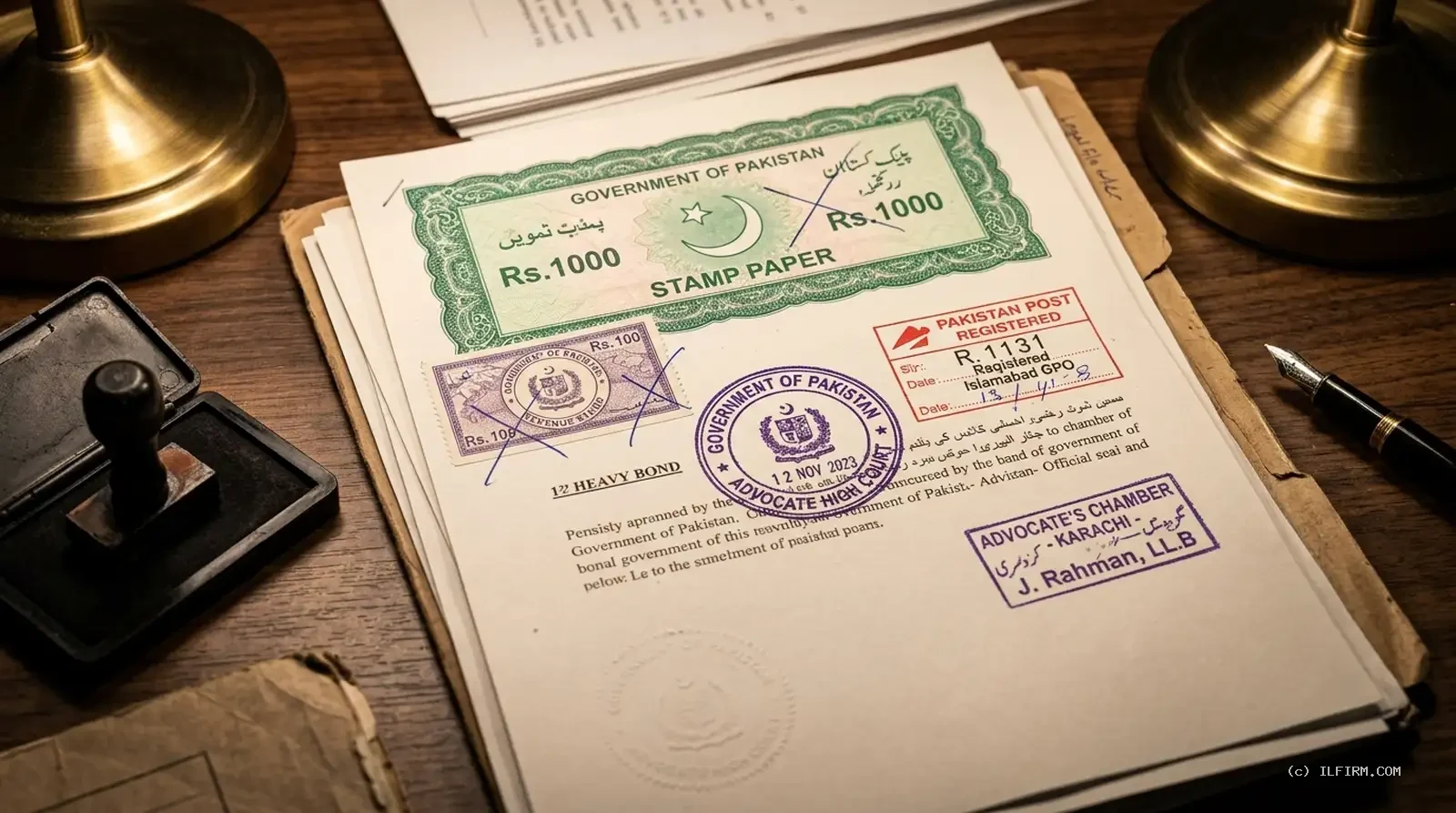
Statutory notice of Talaq on Pakistani stamp paper with registered postal receipts and verification seals for Union Council arbitration (سرکاری اسٹامپ پیپر پر طلاق نوٹس اور ڈاک کی تصدیقی رسیدات)
4. Evidence & Documents You Need
Submitting a complete file ensures prompt processing without administrative rejection. Required documents include:
- Original Talaqnama: Executed on stamp paper, signed by the husband, and attested by two witnesses and an Oath Commissioner.
- Nikahnama & Marriage Certificate: Copy of the original Nikahnama and NADRA Marriage Registration Certificate (MRC).
- CNIC / NICOP Copies: Valid identity cards of husband and wife (or affidavit if wife’s card is withheld).
- Postal Registration Receipts: Original Pakistan Post Registered A.D. receipts evidencing delivery to the wife.
- Nomination Letter: Formal written nomination of the representative for the Arbitration Council.
- Special Power of Attorney (if abroad): An attested Special Power of Attorney (مختار نامہ خاص) executed before a Pakistani Embassy/Consulate and verified by MOFA.
5. Key Court Judgments & Superior Precedents
Pakistani superior courts have established binding precedents governing Section 7 MFLO notices:
- Syed Ali Nawaz Gardezi v. Lt. Col. Muhammad Yusuf (PLD 1963 Supreme Court 51): Supreme Court held that Talaq does not take effect immediately upon private pronouncement; statutory written notice to the Chairman is mandatory for legal dissolution of marriage.
- Mst. Kaneez Fatimah v. Wali Muhammad (PLD 1993 Supreme Court 901): Supreme Court (Full Bench) held that failure to deliver statutory notice prevents state recognition of divorce, thereby safeguarding the wife’s maintenance, iddat, and inheritance entitlements.
- Mst. Rashida Begum v. Chairman Union Council (PLD 2007 Supreme Court 583): Supreme Court ruled that the Chairman performs administrative reconciliation duties and cannot adjudicate the validity or merits of Talaq. Once ninety days elapse without reconciliation, he must issue the effectiveness certificate.
- Muhammad Naseer v. Chairman Union Council (2020 CLC 1782 Peshawar): Peshawar High Court held that upon expiry of ninety days from receipt of notice under Section 7(1), the Chairman cannot withhold the Certificate of Effectiveness, and refusal warrants a Writ of Mandamus (رٹ پٹیشن برائے حصولِ انصاف) under Article 199. Check recent authorities on Peshawar High Court reported family law judgments.
6. Practical Strategy & Common Litigation Mistakes
Matrimonial disputes often involve collateral proceedings under the child custody and guardianship under the Guardian and Wards Act 1890, dower, and maintenance. Parties must manage proceedings carefully:
Strategy for the Husband
- • Immediately dispatch registered notices to both Chairman and wife; oral divorce alone leaves marriage legally active.
- • Send notice to wife’s verified residential address under Rule 3(b) to bar claims of defective service.
- • Attend reconciliation hearings or send an authorized representative with formal power of attorney.
- • Never remarry before obtaining the NADRA Divorce Certificate to prevent prosecution under Section 494 PPC.
Strategy for the Wife
- • You retain full legal entitlement to maintenance for yourself and minor children throughout the 90-day period.
- • Nominate a representative to state your position if reconciliation is viable or to place claims on record.
- • If husband conceals notice to keep your legal status hostage, petition the council or Family Court to verify status.
- • Issuance of divorce certificate does not cancel independent claims for unpaid Haq Mehr or recovery of dowry.
7. In Swat & KPK: Local Practice & Overseas Protocol
In Khyber Pakhtunkhwa, local administration functions through Village Councils and Neighbourhood Councils. In Swat (including Mingora, Saidu Sharif, Barikot, and Matta) and Malakand Division, the Chairman’s powers under MFLO 1961 are exercised by designated Council Secretaries or officers notified by the Deputy Commissioner.
If a Secretary or Chairman unlawfully refuses to accept a notice, demands extra-statutory payments, or delays issuing the Certificate of Effectiveness beyond ninety days, the aggrieved spouse can approach the High Court through Constitutional Writ Petitions under Article 199 at Dar-ul-Qaza Mingora Swat Bench for a writ of mandamus compelling performance.
For overseas Pakistanis in the UAE, UK, Saudi Arabia, or USA, physical attendance in Pakistan is not mandatory. Expatriates can utilize remote Power of Attorney and NADRA digital attestation for overseas Pakistanis. By executing an embassy-attested Special Power of Attorney counter-attested by MOFA, an appointed attorney in Swat can lodge the notice, nominate a council representative, and collect the computerized NADRA certificate. Alternatively, designated officers in Pakistani diplomatic missions abroad may act as Chairman where both spouses reside within that consular jurisdiction.
8. Comparison Table: Matrimonial Dissolution Remedies
This table outlines key differences between matrimonial dissolution remedies in Pakistan:
| Legal Remedy (قانونی چارہ جوئی) | Competent Forum (مجاز فورم) | Limitation / Clock (میعاد سماعت) | Court / Admin Fee (سرکاری فیس) | Typical Timeline (تخمینہ وقت) |
|---|---|---|---|---|
| Talaq Notice (Section 7 MFLO) | Chairman Union / Village Council | Mandatory 90 days from notice delivery | Nominal council fee [VERIFY: KPK position] | 90 to 120 days total |
| Khula Suit by Wife | Family Court (Family Judge) | No limitation during subsistence | Nominal court fee stamp (Rs. 15 to 50) | 3 to 6 months in Family Court |
| Delegated Divorce (Talaq-e-Tafweez) | Chairman Union Council via Clause 18 | Mandatory 90 days from notice delivery | Nominal council processing fee | 90 to 110 days total |
| Writ of Mandamus (Article 199) | Peshawar High Court / Dar-ul-Qaza Swat | Reasonable time after 90 days elapse | High Court writ stamp fee [VERIFY: KPK rules] | 2 to 8 weeks for judicial direction |
9. Frequently Asked Questions
Does a verbal talaq automatically dissolve a marriage legally in Pakistan?
No, verbal Talaq does not dissolve a marriage legally in Pakistan. Section 7 of the Muslim Family Laws Ordinance 1961 requires written notice to the Union Council Chairman. State recognition and legal termination occur only after the mandatory ninety-day reconciliation period concludes.
What happens if a husband does not send a written Talaq notice to the Union Council Chairman?
Failing to send written notice is a criminal offence under Section 7(2) MFLO, punishable by imprisonment up to one year or fine. The marriage legally subsists in state and NADRA records, preserving the wife’s maintenance and inheritance rights, while exposing the husband to bigamy prosecution.
How is the 90-day reconciliation period calculated under Section 7 MFLO?
The ninety-day statutory clock begins on the date the written notice is officially delivered to and received by the Chairman of the competent Union Council, not when pronounced. If the wife is pregnant, the effectiveness period extends until delivery.
Can an overseas Pakistani send a Talaq notice and obtain a NADRA divorce certificate from abroad?
Yes, overseas Pakistanis in UAE, UK, Saudi Arabia, or USA can appoint an attorney via an embassy-attested Special Power of Attorney to submit notice, represent them before the Arbitration Council, and collect the computerized NADRA Divorce Registration Certificate.
What legal remedy is available if the Chairman Union Council refuses to issue the Talaq Effectiveness Certificate?
If the Chairman unlawfully refuses or delays issuing the Certificate of Effectiveness after ninety days have expired without reconciliation, the aggrieved spouse can file a Constitutional Writ Petition under Article 199 before the High Court or Dar-ul-Qaza Mingora Swat Bench for a Writ of Mandamus.
Consult an Experienced Family Law Advocate in Swat & KPK
Whether instituting a Section 7 notice, defending an unlawful divorce, or securing remote NADRA registration from abroad, our advocates provide full representation across District Courts and the Peshawar High Court Mingora Bench Dar-ul-Qaza Swat.
Disclaimer: This guide is published for educational purposes and does not constitute legal counsel for a specific case. Procedural rules depend on judicial discretion and provincial amendments. Reviewed by Senior Advocate High Court, International Law Firm, Saidu Sharif, Swat, November 2026.