

Section 489-F PPC Dishonest Issuance of Cheques: Criminal Trial, Bail & Defense Strategies in Pakistan
1. Executive Summary & The Anatomy of Cheque Bounce Disputes in Pakistan (تعارفی خلاصہ و چیک باؤنس کے تنازعات)
In the commercial and financial landscape of Pakistan, the promulgation of Section 489-F of the Pakistan Penal Code, 1860 (دفعہ 489-ایف تعزیراتِ پاکستان)—introduced through the Criminal Law (Amendment) Ordinance, 2002 (Ordinance LXXXVI of 2002)—marked a profound structural transformation in the administration of business transactions, banking operations, and negotiable instruments. Historically, the dishonour of a cheque was treated exclusively as a civil wrong (دیوانی معاملہ), redressable solely through summary recovery suits under Order XXXVII of the Code of Civil Procedure, 1908 (خلاصہ دعویٰ برائے وصولی رقم آرڈر 37 ضابطہ دیوانی) or regular civil lawsuits. However, the pervasive proliferation of fraudulent trade dealings, bad-faith commercial default, and systemic financial defaults compelled the federal legislature to introduce a punitive criminal deterrent.
Notwithstanding the legislative objective to protect commercial sanctity, Section 489-F PPC has frequently become a weapon of choice for predatory creditors, business rivals, and aggressive litigants seeking to bypass civil adjudication and enforce coercive financial recovery through police custody and arrest. In response, the superior judiciary of Pakistan—principally the Supreme Court of Pakistan (عدالتِ عظمیٰ پاکستان) and the provincial High Courts, including the Peshawar High Court (پشاور ہائی کورٹ بشمول دارالقضاء سوات) and Lahore High Court—has developed an extensive body of binding jurisprudence strictly circumscribing the invocation of the criminal justice system in commercial disputes.
For corporate counsel, advocates, and litigants across Pakistan, understanding the precise boundary between a bona fide commercial failure and criminal culpability is of paramount importance. Section 489-F PPC is not an automatic recovery agency for financial debt, nor is it an inevitable consequence of every unpaid banking instrument. The statutory threshold requires proof beyond reasonable doubt of mens rea (مجرمانہ ارادہ یا بدنیتی), dishonest intention at inception, and an existing legally enforceable liability or debt. This authoritative legal treatise provides a practitioner-grade roadmap through the substantive, procedural, and evidentiary dimensions of Section 489-F PPC litigation, synthesizing statutory rules, criminal trial procedures, bail jurisprudence, and battle-tested defense strategies.
Mere Dishonour Does Not Constitute an Offence (محض چیک باؤنس ہونا جرم نہیں)
Under settled Pakistani superior court jurisprudence reaffirmed in multiple landmark Supreme Court judgments, including Mian Allah Ditta v. The State (2013 SCMR 51) and Muhammad Sultan v. The State (2020 SCMR 482), mere dishonour of a cheque upon banking presentation does not constitute an offence under Section 489-F PPC. The prosecution bears the indispensable legal burden of establishing dishonest intent (بدنیتی) alongside an existing legally enforceable debt or obligation. Cheques issued merely as security, guarantee (سیکیورٹی یا گارنٹی چیک), or in unliquidated commercial partnerships fall squarely outside the ambit of criminal culpability.
2. Statutory Architecture: The Three Inviolable Ingredients of Section 489-F PPC (دفعہ 489-ایف کے تین لازمی اجزائے ترکیبی)
To evaluate criminal liability or construct an unshakeable legal defense, an advocate must dissect the exact statutory text of Section 489-F of the Pakistan Penal Code, 1860, which reads verbatim:
“489-F. Dishonestly issuing a cheque: Whoever dishonestly issues a cheque towards repayment of a loan or fulfillment of an obligation which is dishonoured on presentation, shall be punishable with imprisonment which may extend to three years, or with fine, or with both, unless he can establish, for reasons to be recorded by the court, that he had made arrangements with his bank to ensure that the cheque would be honoured and that the bank was at fault in not honouring the cheque.”
A critical syntactic and juridical deconstruction of Section 489-F reveals three mandatory constitutive ingredients that must coalesce simultaneously. The failure of the prosecution or complainant to establish any single element is fatal to the charge and entitles the accused to immediate pre-trial acquittal under Section 249-A of the Code of Criminal Procedure, 1898 (بریت کی درخواست زیر دفعہ 249-اے ضابطہ فوجداری).
A. Ingredient I: Dishonest Intention & Mens Rea (بدنیتی اور مجرمانہ ارادہ)
The opening adverb “dishonestly” governs the entire statutory enactment. Under Section 24 of the Pakistan Penal Code (دفعہ 24 تعزیراتِ پاکستان), an act is done “dishonestly” when it is performed with the intention of causing wrongful gain (ناجائز فائدہ) to one person or wrongful loss (ناجائز نقصان) to another person. Consequently, dishonest intent cannot be inferred retrospectively merely because a bank account lacked sufficient funds on the date of presentment. The dishonest state of mind must exist at the precise moment the instrument is drawn, signed, and delivered to the payee.
Where an accused issues a post-dated cheque (مستقبل کی تاریخ کا چیک) with the bona fide expectation of expected receivables, seasonal trade turnover, or credit realization, but suffers sudden commercial insolvency, business devastation, or unexpected bank account freezing, dishonest intention is completely negated. The superior courts have consistently held that financial hardship, business insolvency, or breach of contract does not equate to criminal dishonesty.
B. Ingredient II: Towards Repayment of a Loan or Fulfillment of an Obligation (قرض کی واپسی یا قانونی ذمہ داری کی تکمیل)
The statutory phrase “towards repayment of a loan or fulfillment of an obligation” imposes a strict legal constraint on the character of the underlying transaction. The cheque must have been issued to extinguish an existing, legally enforceable liability. This creates two vital defense corridors:
- Exclusion of Security and Guarantee Instruments (سیکیورٹی اور ضمانتی چیک کا استثناء): Where a cheque is issued as collateral, conditional security, performance guarantee, or earnest money in an ongoing, unliquidated commercial contract, it is not issued towards the immediate repayment of a crystallized loan or obligation. If the transaction has not matured into an admitted debt, Section 489-F PPC cannot be triggered.
- Illegality or Void Nature of Underlying Transaction (باطل و غیر قانونی معاہدات): Under Section 23 of the Contract Act, 1872 (معاہدہ ایکٹ کی دفعہ 23), an agreement founded on unlawful consideration or contrary to public policy (such as gambling debts, speculative betting, or corrupt gratuities) is void ab initio. A cheque issued in furtherance of a void or illegal transaction cannot form the basis of a lawful “obligation” under Section 489-F PPC.
C. Ingredient III: Dishonour on Presentation & The Bank Memo (بینک میں پیشی اور ڈس آنر میمو)
The instrument must be duly presented to the drawee banking institution within its lawful validity period and dishonoured upon presentation. Under banking conventions and Section 84 of the Negotiable Instruments Act, 1881 (نیگوشی ایبل انسٹرومنٹس ایکٹ کی دفعہ 84), a cheque is valid for presentation within six months from its stated date. Presentation after the statutory expiry of six months renders the instrument stale (زائد المیعاد چیک) and deprives the complainant of any criminal cause of action under Section 489-F PPC.
Moreover, the dishonour must be evidenced by an authentic, officially stamped Bank Return Memo (بینک ڈس آنر سلپ یا میمو) specifying the exact clearing reason, such as “Insufficient Funds” (عدم فنڈز), “Account Closed” (کھاتہ بند), or “Drawers Signature Differs” (دستخط میں فرق). In the absence of an authenticated bank memo signed by an authorized banking officer, the formal evidentiary chain remains incomplete.
D. The Statutory Proviso: The Bank Fault Defense (بینک کی تکنیکی غلطی کا قانونی استثناء)
The concluding clause of Section 489-F incorporates a statutory exception: if the accused demonstrates that they had made bona fide arrangements with the drawee bank—such as maintaining an approved overdraft facility (اوور ڈرافٹ کی سہولت), executing a credit line agreement, or depositing funds that were improperly credited or delayed due to bank processing errors—the penal consequence is entirely avoided. While the evidentiary burden of proving this exception rests upon the accused under Article 119 of the Qanun-e-Shahadat Order, 1984 (قانونِ شہادت آرڈر 1984ء کا آرٹیکل 119), the standard of proof required is merely a balance of probabilities, not proof beyond reasonable doubt.
3. Binding Superior Court Precedents: Supreme Court & High Court Jurisprudence (سپریم کورٹ و ہائی کورٹ کے مستند عدالتی نظائر)
Litigating a Section 489-F PPC dispute in Pakistan requires anchoring every bail application, quashment petition, and trial argument in binding precedents reported in Pakistan Legal Decisions (PLD), Supreme Court Monthly Review (SCMR), and Pakistan Criminal Law Journal (PCrLJ). The following landmark judgments form the bedrock of superior court jurisprudence:
A. The Foundational Trilogy: Mian Allah Ditta v. The State (2013 SCMR 51)
In 2013 SCMR 51, the Supreme Court of Pakistan authoritatively delineated the three indispensable conditions precedent for the constitution of an offence under Section 489-F PPC. The apex court ruled:
- Mandatory Ingredients (لازمی اجزاء): The prosecution must establish: (1) issuance of the cheque with dishonest intent; (2) issuance towards repayment of a loan or fulfillment of a preexisting obligation; and (3) actual dishonour upon banking presentation.
- Rejection of Criminal Recovery (فوجداری ریکوری کی ممانعت): The apex bench firmly laid down that the state machinery and police apparatus cannot be utilized as a coercive debt collection agency (قرض کی ریکوری ایجنسی) for ordinary commercial transactions.
- Strict Burden of Proof (بارِ ثبوت): The absence of mens rea or failure to prove the original loan agreement entitles the accused to an outright acquittal.
B. Civil Nature of Commercial Accounts: Sheikh Muhammad Rizwan v. The State (PLD 2014 SC 183)
In PLD 2014 SC 183, the Supreme Court firmly deprecated the practice of lodging criminal FIRs under Section 489-F PPC in transactions that are fundamentally civil in character:
- Where financial accounts between business partners or traders remain unsettled (غیر تصفیہ شدہ کھاتہ جات), a criminal court cannot usurp the functions of a civil court to determine unliquidated liabilities.
- If the dispute originates from a partnership deed, joint venture, or business contracts, the dispute warrants civil adjudication under the Code of Civil Procedure (ضابطہ دیوانی) rather than criminal incarceration.
C. The Security Cheque Doctrine: Khalil Ahmed v. The State (2014 SCMR 649)
In 2014 SCMR 649, the Supreme Court established the definitive doctrine protecting commercial guarantees and security instruments:
- Cheques issued merely as collateral, security, or guarantee (سیکیورٹی یا گارنٹی کے طور پر دیے گئے چیک) in commercial contracts cannot attract criminal liability under Section 489-F PPC.
- When an instrument is handed over as advance security for prospective performance rather than against an existing, crystallized debt, the constitutive ingredients of “repayment of a loan” or “fulfillment of an obligation” are visibly absent.
D. Rebuttal of Presumptions in Business Dealings: Muhammad Sultan v. The State (2020 SCMR 482)
In 2020 SCMR 482, the apex bench reiterated that the mere physical possession of a dishonoured cheque by the complainant does not relieve the prosecution of proving the foundational transaction:
- If the accused demonstrates a plausible defense showing that the instrument was obtained under duress, given as advance security, or misused in breach of trust, the statutory presumption under the Negotiable Instruments Act is fully displaced.
- Criminal liability cannot be established upon speculative assumptions or uncorroborated oral assertions of the complainant.
E. Bail as a Matter of Right: Zafar Iqbal v. The State (2019 SCMR 1445) & Tariq Bashir (PLD 1995 SC 34)
In 2019 SCMR 1445, the Supreme Court reinforced the constitutional sanctity of personal liberty in cheque bounce prosecutions:
- Non-Prohibitory Clause (غیر ممنوعہ شق): Because the maximum statutory sentence under Section 489-F PPC is three years imprisonment, the offence falls strictly outside the prohibitory clause of Section 497(1) Cr.P.C. (ضابطہ فوجداری کی دفعہ 497 کی ممنوعہ شق).
- Grant of Bail is the Rule (ضمانت منظور کرنا عام قاعدہ ہے): Following the venerable rule in Tariq Bashir v. The State (PLD 1995 SC 34), in offences falling outside the prohibitory clause, the grant of bail is the rule and refusal is an extraordinary exception. Bail cannot be withheld as a measure of advance punishment (قبل از وقت سزا).
F. Quashment of Frivolous FIRs: Mst. Shamim Akhtar v. The State (2007 SCMR 1204)
In 2007 SCMR 1204, the Supreme Court affirmed that High Courts possess plenary inherent jurisdiction under Section 561-A Cr.P.C. (دفعہ 561-اے ضابطہ فوجداری) and Article 199 of the Constitution (آئین کا آرٹیکل 199) to quash an FIR where the criminal proceedings represent an abuse of judicial process designed to extort money in a civil transaction.
4. Procedural Roadmap: Step-by-Step Criminal Trial Mechanics (فوجداری ٹرائل کا تفصیلی روڈ میپ اور ضابطہ کار)
From the instant an instrument is dishonoured at a banking counter to the certified conclusion of trial, the litigation follows a disciplined statutory journey governed by the Code of Criminal Procedure, 1898. Practitioners and litigants must master each procedural stage:
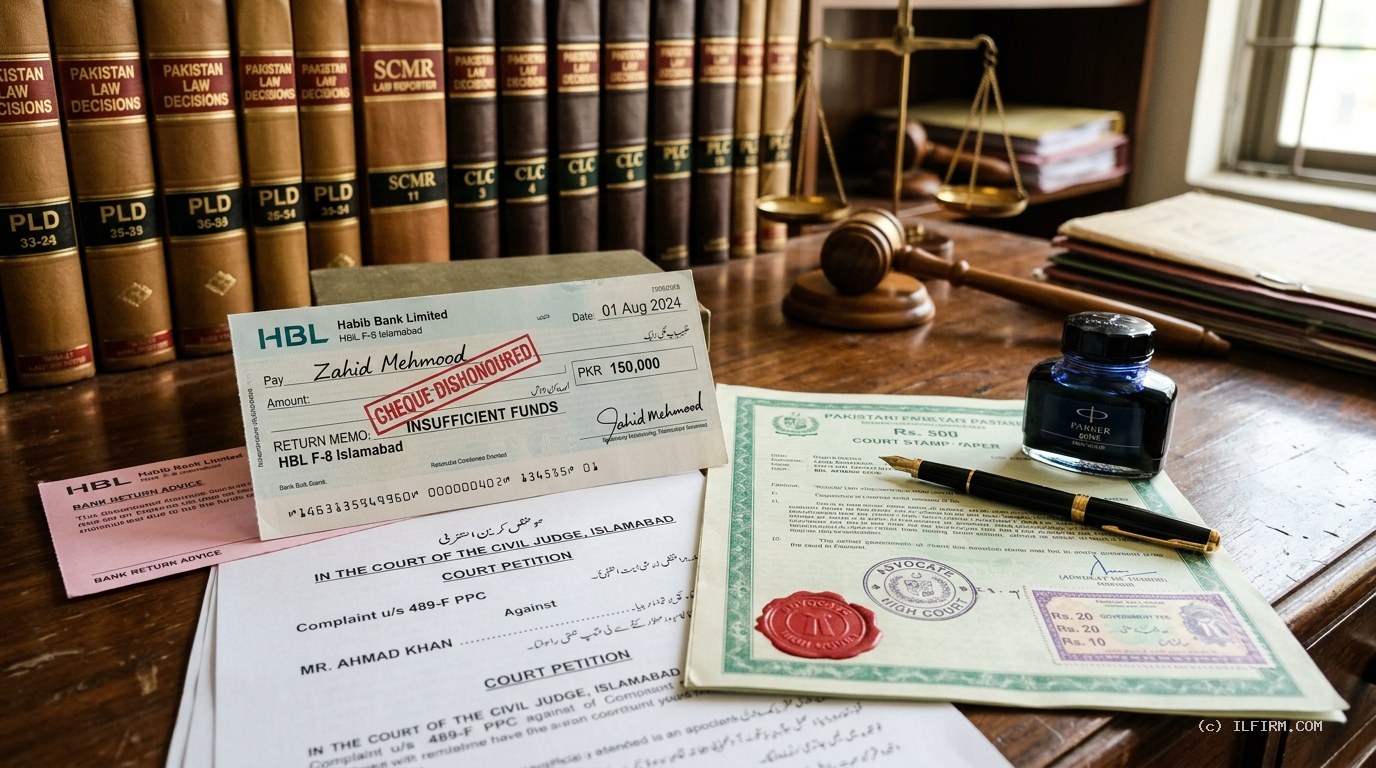
Figure 1: Authentic certified legal record: Dishonoured instrument return memo (بینک ڈس آنر میمو), formal Section 489-F PPC court petitions (فوجداری پٹیشن), and superior court law reporter volumes in Pakistan.
Phase 1: Banking Presentation & Return Memo Generation (بینک میں پیشی اور میمو کا حصول)
The holder in due course presents the cheque to the drawee bank branch within six months of its issuance. Upon verification of insufficient balances or technical impediment, the bank returns the instrument along with a formal Bank Dishonour Slip/Memo (بینک ڈس آنر سلپ یا میمو). Counsel must verify that the memo is dated within six months of the cheque date and bears the signatures and operational stamp of the bank official.
Phase 2: Statutory Demand Notice & Evidentiary Foundation (قانونی نوٹس کی ترسیل)
Although Section 489-F PPC does not explicitly mandate a prior statutory legal notice, prudent legal practice demands the dispatch of a formal legal notice via registered postal service (acknowledgment due / رجسٹری اے ڈی) and courier. Giving the drawer 14 to 30 days to clear the outstanding sum establishes solid documentary evidence of bad faith and refusal to pay.
Phase 3: Lodging the FIR under Section 154 Cr.P.C. vs. Section 22-A / 22-B Petitions (اندراجِ مقدمہ ایف آئی آر یا 22-اے کی کارروائی)
The complainant approaches the police station having territorial jurisdiction over the drawee bank. If the Station House Officer (SHO / ایس ایچ او) refuses to register an FIR under Section 154 Cr.P.C. (ایف آئی آر دفعہ 154) on grounds of a “civil dispute”, the complainant files a petition under Section 22-A and 22-B Cr.P.C. (کارروائی جسٹس آف پیس زیر دفعہ 22-اے و 22-بی ضابطہ فوجداری) before the Ex-Officio Justice of Peace (سیشن جج / ایڈیشنل سیشن جج), seeking a judicial direction to register the criminal case. Alternatively, a direct criminal complaint (استغاثہ زیر دفعہ 200 ضابطہ فوجداری) can be filed before the Judicial Magistrate.
Phase 4: Securing Pre-Arrest Bail under Section 498 Cr.P.C. (ضمانت قبل از گرفتاری)
Upon learning of the FIR registration or police inquiry, the accused must immediately petition the Court of Session for pre-arrest bail under Section 498 Cr.P.C. (ضمانت قبل از گرفتاری دفعہ 498 ضابطہ فوجداری). Counsel must draft comprehensive grounds demonstrating: (a) absence of dishonest intention; (b) the purely commercial or civil nature of the transaction; (c) that the cheque was handed over as collateral or security; (d) mala fides (بدنیتی), ulterior motives, and harassment by the complainant; and (e) the petitioner’s readiness to join investigation. The Sessions Court grants ad-interim pre-arrest bail (عبوری ضمانت) upon personal surety bonds, ordering the petitioner to join the police investigation.
Phase 5: Police Investigation & Submission of Challan under Section 173 Cr.P.C. (پولیس تفتیش اور چالان)
The Investigating Officer (IO / تفتیشی افسر) records statements under Section 161 Cr.P.C., takes custody of the original dishonoured cheque, bank memo, and ledger extracts, and interrogates the accused. If the IO determines that the matter is purely civil, they may recommend discharge or place the accused in column No. 2 of the final report. However, in most instances, a formal Challan / Charge Sheet (چالان دفعہ 173 ضابطہ فوجداری) is submitted to the competent Judicial Magistrate of the First Class (جوڈیشل مجسٹریٹ درجہ اول).
Phase 6: Supply of Copies & Framing of Charge under Sections 241-A & 242 Cr.P.C. (فردِ جرم کا عائد ہونا)
The Magistrate provides the accused with certified copies of all prosecution documents, witness statements, and expert reports under Section 241-A Cr.P.C. (نقول کی فراہمی دفعہ 241-اے) free of cost. Thereafter, the formal charge is framed under Section 242 Cr.P.C. (فردِ جرم دفعہ 242 ضابطہ فوجداری). The accused enters a formal plea of not guilty and claims trial (صحتِ جرم سے انکار اور ٹرائل کی استدعا).
Phase 7: Pre-Trial Acquittal Application under Section 249-A Cr.P.C. (قبل از وقت بریت کی درخواست دفعہ 249-اے)
Defense counsel can file an application under Section 249-A Cr.P.C. (درخواست برائے بریت دفعہ 249-اے) at any stage of the proceedings, even before evidence is recorded, arguing that the charge is groundless and there is no probability of the accused being convicted. If the defense demonstrates that the cheque was a security instrument, that no loan existed, or that the dispute is subject to pending civil litigation, the Magistrate possesses statutory power to record an immediate acquittal (فوری بریت کا حکم).
Phase 8: Trial Evidence, Cross-Examination & Section 340(2) Testimony on Oath (شہادتِ استغاثہ، جرح اور ملزم کا حلفیہ بیان)
If the application under Section 249-A is dismissed, the trial proceeds. The prosecution examines the complainant and the bank manager. Defense counsel conducts exhaustive cross-examination (جرح), focusing on the absence of bank balance receipts, tax returns reflecting the alleged loan, and contradictions regarding the delivery of the cheque. Following the prosecution evidence, the accused is examined under Section 342 Cr.P.C. and may choose to appear in the witness box under Section 340(2) Cr.P.C. (ملزم کا کٹہرے میں حلفیہ بیان زیر دفعہ 340(2) ضابطہ فوجداری) on oath to produce defense ledgers, contracts, and partnership deeds.
Phase 9: Final Judgment & Statutory Appeals under Section 408 Cr.P.C. (حتمی فیصلہ اور اپیل کا حق)
The Magistrate pronounces final judgment. If convicted, the accused is sentenced to simple or rigorous imprisonment (up to three years) and/or fine. An appeal lies against conviction before the Court of Session under Section 408 Cr.P.C. (اپیل سیشن کورٹ دفعہ 408) within 30 days. If the trial ends in acquittal, the complainant may file an appeal against acquittal before the High Court under Section 417(2-A) Cr.P.C. (اپیل برائے بریت ہائی کورٹ دفعہ 417).
5. Formidable Defense Strategies for Accused Persons (ملزم کے لیے موثر قانونی دفاعی حکمتِ عملی)
When defending a client charged under Section 489-F PPC, criminal advocates must move beyond general denials and implement specific jurisprudential defenses recognized by superior courts:
Absence of Immediate Crystallized Debt (فوری واجب الادا قرض کا فقدان)
Demonstrate through written commercial agreements, email correspondences, WhatsApp messages, or delivery invoices that the cheque was handed over as collateral for prospective supply of goods, equipment leasing, or dealership deposits. Under Khalil Ahmed (2014 SCMR 649), a security cheque cannot trigger criminal culpability because no crystallized debt existed when issued.
Shattering Consideration through Tax Records & Bank Flows (انکم ٹیکس اور بینک ذرائع کا چیلنج)
Section 118 of the Negotiable Instruments Act creates a rebuttable presumption that an instrument was drawn for consideration. However, cross-examination demonstrating that the complainant lacked the financial liquidity or declared income tax status with the Federal Board of Revenue (FBR) to advance a cash loan effectively shatters the statutory presumption.
Forensic Handwriting & Ink Analysis (فرانزک لیب برائے معائنہ تحریر و سیاہی)
If the complainant filled in unauthorized amounts or inserted a fictitious date on a pre-signed blank cheque, invoke Section 87 of the Negotiable Instruments Act, 1881. Any material alteration of a negotiable instrument without the drawer’s consent renders the instrument void. Seek forensic examination of the handwriting through the Punjab Forensic Science Agency (PFSA / فرانزک لیب) or provincial forensics bureau.
Inherent Jurisdiction under Section 561-A Cr.P.C. & Article 199 (دفعہ 561-اے اور آئینی رٹ)
Where the FIR is manifestly frivolous, malicious, or designed to preempt civil arbitration, approach the High Court under Section 561-A Cr.P.C. or Article 199 of the Constitution of Pakistan, 1973 for quashment of the criminal proceedings. Superior courts will quash proceedings to prevent abuse of the court process.
6. Comparative Analysis & Comprehensive Legal Matrices (جامع تقابلی جائزہ و قانونی جدول)
To provide clear strategic perspective, the following structured comparative tables evaluate the differences between criminal proceedings and civil summary recovery, limitation periods, and mandatory trial checklists.
Table 1: Criminal Prosecution (Section 489-F PPC) vs. Civil Summary Suit (Order XXXVII CPC) (فوجداری مقدمہ بمقابلہ دیوانی خلاصہ دعویٰ)
| Jurisdictional Parameter (قانونی پہلو) | Criminal Prosecution (Section 489-F PPC / فوجداری مقدمہ) | Civil Summary Suit (Order XXXVII CPC / دیوانی دعویٰ آرڈر 37) |
|---|---|---|
| Primary Objective (بنیادی مقصد) | Penal deterrence, criminal punishment (imprisonment up to 3 years or fine / قید یا جرمانہ). | Direct financial recovery of principal amount and bank markup (رقم اور منافع کی ڈگری). |
| Competent Forum (مجاز عدالت) | Judicial Magistrate of the 1st Class (جوڈیشل مجسٹریٹ درجہ اول). | District Judge / Additional District Judge / Civil Court (ڈسٹرکٹ جج یا سول کورٹ). |
| Standard of Proof (معیارِ ثبوت) | Proof beyond reasonable doubt (Mens rea / بدنیتی شک و شبہے سے بالاتر ثابت کرنا لازمی). | Preponderance of probabilities (امکانات کا توازن؛ دستخط تسلیم ہونا کافی). |
| Defense Leave Requirement (دفاع کی اجازت) | Right to defense is automatic; no leave needed (دفاع کا حق خودکار ہے). | Defendant must file Leave to Defend within 10 days of summons (10 دن کے اندر اجازت نامہ). |
| Direct Monetary Decree (رقم کی ڈگری) | No automatic decree of amount (compensation under 545 CrPC is discretionary). | Direct executable monetary decree under Order XXXVII Rule 2 CPC. |
| Simultaneous Remedies (بیک وقت کارروائی) | Both remedies can be pursued concurrently without legal bar (بیک وقت دونوں جائز ہیں). | Pendency of criminal case does not stay civil summary proceedings. |
Table 2: Limitation Periods, Statutory Forums & Bail Jurisprudence Matrix (میعادِ سماعت، مجاز عدالتیں اور ضمانت کا جدول)
| Legal Action (قانونی کارروائی) | Governing Statute & Section (متعلقہ قانون و دفعہ) | Prescribed Limitation (مقررہ میعاد) | Jurisdictional Forum (مجاز عدالت یا فورم) |
|---|---|---|---|
| Banking Presentation (بینک میں پیشی) | Section 84 Negotiable Instruments Act 1881 | 6 Months from date on cheque (چیک کی تاریخ سے 6 ماہ) | Drawee Bank Clearing House |
| Criminal FIR / Complaint (ایف آئی آر / استغاثہ) | Section 154 / 200 Cr.P.C. & 489-F PPC | No criminal limitation (unreasonable delay creates doubt) | Police Station / Judicial Magistrate |
| Pre-Arrest Bail (ضمانت قبل از گرفتاری) | Section 498 Cr.P.C. | Immediate upon registration of FIR / imminent threat | Sessions Court / High Court |
| Post-Arrest Bail (ضمانت بعد از گرفتاری) | Section 497 Cr.P.C. | Any time following judicial remand | Judicial Magistrate / Sessions Court |
| Civil Summary Suit (خلاصہ دعویٰ آرڈر 37) | Order XXXVII CPC & Art. 64-A Limitation Act | 3 Years from date of dishonour / maturity (3 سال) | Civil Court / District Court |
| Leave to Defend (دفاع کی اجازت کی درخواست) | Order XXXVII Rule 3 CPC | Strict 10 Days from date of summons service (10 دن) | Trial Civil Court |
Table 3: Mandatory Document Checklist for Prosecution vs. Defense (دستاویزی ثبوتوں کی چیک لسٹ)
| Category (دستاویز کی قسم) | Complainant / Prosecution Documents (مدعی / استغاثہ کے کاغذات) | Accused / Defense Documents (ملزم / دفاع کے کاغذات) |
|---|---|---|
| Instrument & Banking (بینکاری کاغذات) | Original Cheque, Bank Return Memo with official stamp, Bank branch statement. | Account ledger, Overdraft sanction letter, Bank counterfoils showing security issue. |
| Contractual & Loan (معاہداتی و قرض کے ثبوت) | Loan agreement, Promissory note, Receipt of payment, Delivery challans, Invoices. | Partnership deed, Unliquidated accounts, Security clause in agreement, Breach notice. |
| Pre-Litigation Notice (قانونی نوٹس) | Copy of legal demand notice, Postal registry receipts, Courier tracking confirmation. | Reply to legal notice denying debt, Stop-payment letter issued to bank prior to bounce. |
| Forensic & Procedural (عدالتی و فرانزک) | Witness affidavits, Police 161 CrPC statements, Challan report under 173 CrPC. | Application for PFSA handwriting verification, Certified copies of civil suit pleadings. |
7. Frequently Asked Questions (اکثر پوچھے جانے والے ضروری قانونی سوالات)
1. Is Section 489-F PPC a bailable or non-bailable offence under Pakistani law? (کیا دفعہ 489-ایف قابلِ ضمانت ہے یا ناقابلِ ضمانت؟)
Under the Code of Criminal Procedure, 1898, Section 489-F PPC is classified as non-bailable in the police schedule. However, because the maximum statutory sentence is three years imprisonment, it falls strictly outside the prohibitory clause of Section 497(1) Cr.P.C. As ruled by the Supreme Court of Pakistan in Zafar Iqbal v. The State (2019 SCMR 1445) and Tariq Bashir v. The State (PLD 1995 SC 34), grant of bail in non-prohibitory offences is a matter of ordinary right, and refusal is an exceptional deviation.
2. Can an accused be convicted if the dishonoured cheque was issued solely as security? (اگر چیک بطورِ سیکیورٹی یا ضمانت دیا گیا ہو تو کیا سزا ہو سکتی ہے؟)
No. The Supreme Court in Khalil Ahmed v. The State (2014 SCMR 649) and Muhammad Sultan v. The State (2020 SCMR 482) firmly established that a cheque handed over as collateral or security for prospective performance does not satisfy the statutory ingredient of “repayment of a loan or fulfillment of an obligation”. If the defense establishes that the instrument was a guarantee, the criminal charge fails and the accused is entitled to acquittal.
3. What is the statutory time limit for presenting a cheque and lodging an FIR? (چیک بینک میں پیش کرنے اور ایف آئی آر درج کروانے کی قانونی میعاد کیا ہے؟)
Under banking practice and Section 84 of the Negotiable Instruments Act, 1881, a cheque must be presented to the bank within six months from its date. If presented after six months, the bank marks it “stale” and no offence under Section 489-F PPC is made out. Regarding the FIR, criminal law has no rigid limitation period, but unreasonable, unexplained delay (e.g., waiting a year after dishonour without justification) raises strong judicial doubt regarding mala fides.
4. Can a complainant initiate both a criminal FIR and a civil summary recovery suit simultaneously? (کیا فوجداری ایف آئی آر اور دیوانی ریکوری سوٹ بیک وقت چل سکتے ہیں؟)
Yes. The Supreme Court of Pakistan has repeatedly held that criminal proceedings under Section 489-F PPC and civil proceedings under Order XXXVII CPC operate in separate spheres. The criminal action punishes dishonest conduct, while the civil suit secures financial recovery. Both remedies can be pursued concurrently without violating the rule against double jeopardy under Article 13 of the Constitution.
5. What legal remedies exist if the local police refuse to register an FIR under Section 489-F PPC? (اگر پولیس ایف آئی آر درج کرنے سے انکار کرے تو کیا قانونی راستہ ہے؟)
If the police station declines to register an FIR under Section 154 Cr.P.C., the aggrieved complainant has two effective statutory remedies: (1) File a petition under Section 22-A and 22-B Cr.P.C. before the Ex-Officio Justice of Peace (Sessions Court) seeking a judicial direction for FIR registration; or (2) File a Direct Criminal Complaint (Istaghasa / استغاثہ) under Section 200 Cr.P.C. directly before the Judicial Magistrate.
6. What happens if a blank signed cheque was stolen or filled out with an unauthorized amount? (اگر سائن شدہ خالی چیک چوری ہو گیا ہو یا اس پر جعلی رقم لکھ دی گئی ہو؟)
Under Section 87 of the Negotiable Instruments Act, 1881, any material alteration of a negotiable instrument without the drawer’s consent renders it void. The drawer should immediately notify the bank with a formal “Stop Payment” instruction citing theft or loss and lodge an entry with the police. In trial, defense counsel can apply for forensic ink and handwriting analysis through the Forensic Science Agency (PFSA) to establish that the text was inserted subsequently.
Facing a Section 489-F PPC Cheque Bounce FIR or Summary Recovery Suit in Pakistan? (چیک باؤنس کے مقدمے، ضمانت یا قانونی نوٹس کا سامنا ہے؟)
Our senior Advocates of the High Court and Supreme Court of Pakistan provide aggressive, practitioner-grade representation in Section 489-F criminal trials, urgent pre-arrest bail (ضمانت قبل از گرفتاری), quashment petitions before the High Court, and parallel Order XXXVII civil summary recovery defense for domestic and overseas Pakistani clients. Schedule an urgent chambers review with our senior criminal defense partners today.