

Habeas Corpus Petition under Article 199 in Pakistan: High Court Procedure, Bailiff Raids & Legal Remedies for Illegal Police Detention (پاکستان میں حبسِ بے جا کی رٹ پٹیشن – آئین کا آرٹیکل 199)

1. Executive Summary & Constitutional Foundations: The Great Writ of Liberty (تعارفی خلاصہ و بنیادی آئینی مبادیات: پروانہ حبسِ بے جا)
In the constitutional and criminal jurisprudence of the Islamic Republic of Pakistan, no prerogative power exercised by the superior judiciary is more sacred, urgent, or indispensable to human dignity than the issuance of the Writ of Habeas Corpus (پروانہ حبسِ بے جا / رٹ پٹیشن برائے بازیابی محبوس). Derived from the ancient Latin maxim meaning “that you have the body,” this extraordinary constitutional remedy represents the ultimate bulwark against executive tyranny, arbitrary arrests, unauthorized police detention, unrecorded lockups, enforced disappearances, and private illegal bondage. Under Article 199(1)(b)(i) of the Constitution of the Islamic Republic of Pakistan, 1973 (آئینِ پاکستان 1973ء), the High Courts are constitutionally commanded to satisfy themselves that no person within their territorial jurisdiction is being held in custody without lawful authority or in an unlawful manner.
The foundational premise of Pakistani constitutional democracy is that individual personal liberty is not a gratuitous concession granted by the state, but an inalienable, non-negotiable fundamental human right. Article 4 of the Constitution (شہریوں کا حق برائے سلوک مطابقِ قانون) establishes the absolute injunction that to enjoy the protection of law and to be treated in accordance with law is the inalienable right of every citizen, and that no action detrimental to the life, liberty, body, or property of any person shall be taken except in accordance with law. This is reinforced by Article 9 (تحفظِ زندگی و ذاتی آزادی), which dictates that no person shall be deprived of life or liberty save in accordance with law; Article 10 (گرفتاری اور نظر بندی کے خلاف تحفظ), which mandates that every arrested person must be informed of the grounds of arrest, granted the right to consult legal counsel, and produced before a Judicial Magistrate within twenty-four hours; Article 10-A (منصفانہ ٹرائل کا حق), guaranteeing due process; and Article 14 (حرمتِ انسانیت), which elevates the dignity of man and the privacy of home to an inviolable constitutional status, expressly prohibiting torture for extracting confessions.
In the practical reality of Pakistan’s criminal justice system, police stations (تھانہ کلچر) frequently become venues of grave constitutional transgression. Citizens are subjected to Informal / Unrecorded Detention (غیر دستاویزی و غیر قانونی تھانہ حراست), kept behind bars without the registration of a First Information Report (FIR / ایف آئی آر), denied entry into the mandatory police Daily Diary (Roznamcha / روزنامچہ), tortured in clandestine private interrogation centers (سی آئی اے ٹارچر سیل و نجی عقوبت خانے), or used as leverage to extort bribes and settle civil property disputes. Simultaneously, private feudal lords and brick-kiln owners hold vulnerable families in Bonded Labour & Private Confinement (جبری مشقت و نجی قید). Against such lawlessness, the High Court exercises summary, prompt, and coercive authority—dispensing with conventional procedural delays to dispatch a Judicial Court Bailiff (عدالتی بیلف) on an unannounced raid to break open locks, inspect registers, rescue the detainee, and summon offending police officers to face criminal indictment.
No Police Custody is Lawful Outside Express Statutory Command (قانون کے احکامات سے باہر کوئی حراست جائز نہیں)
A universal maxim of Pakistani administrative and criminal law is that while a private citizen is free to do anything not expressly prohibited by law, a public servant—especially a police officer—can do nothing except that which is expressly authorized by law. Therefore, every single minute of detention of a citizen must be justified on the basis of a lawful statutory power. If an individual is confined in a police station without an active FIR, without a formal Daily Diary arrest entry under Rule 22.48 of the Police Rules, 1934 (پولیس رولز 1934ء), without an unexpired order of physical remand granted by a Judicial Magistrate under Section 167 of the Code of Criminal Procedure, 1898 (CrPC) (جسمانی ریمانڈ مجسٹریٹ), or beyond the statutory 24-hour limit stipulated by Section 61 CrPC (چوبیس گھنٹے کی قانونی حد), such confinement constitutes a heinous crime of Wrongful Confinement (حبسِ بے جا) punishable under substantive criminal law.
The superior courts of Pakistan have established that the High Court’s jurisdiction under Article 199(1)(b)(i) is not contingent upon establishing malicious intent on the part of the detaining authority. The inquiry is purely objective: Is the detention backed by valid legal authority, and is it being conducted in a lawful manner? If either condition fails, the High Court must order immediate liberty. As the Supreme Court of Pakistan has repeatedly observed, an unlawful arrest strikes at the very root of constitutional order, and procedural shortcuts by law enforcement agencies cannot be condoned under any pretext of crime investigation.
2. Statutory & Regulatory Framework: Constitution, CrPC, PPC & Police Rules (قانونی و ضابطہ جاتی فریم ورک)
The legal battle against illegal confinement in Pakistan relies upon a robust convergence of constitutional mandates, criminal procedural safeguards, penal sanctions, and specialized statutory enactments. Counsel prosecuting a Habeas Corpus petition must master the operational synergy between these enactments:
Article 199(1)(b)(i) of the Constitution of Pakistan, 1973 (آئینِ پاکستان کا آرٹیکل 199: ہائی کورٹ کا دائرہ اختیار)
Under Article 199(1)(b)(i) of the Constitution, a High Court may, if it is satisfied that no other adequate remedy is provided by law, on the application of any person, make an order directing that a person in custody within the territorial jurisdiction of the Court be brought before it so that the Court may satisfy itself that he is not being held in custody without lawful authority or in an unlawful manner. Crucially, the words “on the application of any person” confer universal Locus Standi (حقِ دعویٰ / استحقاقِ سائل). Unlike conventional civil litigation where only an aggrieved party can sue, any relative, friend, advocate, public-spirited citizen, or social worker can move the High Court on behalf of a helpless detainee who is physically barred from accessing a court of law.
Relevant Provisions of the Code of Criminal Procedure, 1898 (CrPC) (مجموعہ ضابطہ فوجداری 1898ء)
- Section 491 CrPC (پاور برائے اجراء حکم حبسِ بے جا): Confers concurrent summary jurisdiction upon the High Court and Sessions Courts to issue directions in the nature of a Habeas Corpus. While Sessions Courts exercise this power locally, the High Court exercises both Section 491 CrPC powers and plenary constitutional writ powers under Article 199.
- Section 54 CrPC (بغیر وارنٹ گرفتاری کے سخت قانونی حدود): Authorizes police officers to arrest without warrant only under nine specific, rigorously defined circumstances (such as being concerned in a cognizable offense or against whom a reasonable complaint has been made or credible information received). Superior courts have ruled that vague suspicion or mere presence at a crime scene does not fulfill Section 54 thresholds.
- Section 61 CrPC (چوبیس گھنٹے میں مجسٹریٹ کے روبرو پیشی): Mandates that no police officer shall detain in custody a person arrested without warrant for a longer period than under all the circumstances of the case is reasonable, and such period shall not, in the absence of a special order of a Magistrate under Section 167, exceed twenty-four hours (exclusive of travel time).
- Section 167 CrPC (جسمانی ریمانڈ کے سخت ضوابط): Requires that whenever an investigation cannot be completed within 24 hours, the Station House Officer (SHO) must transmit the accused to the nearest Judicial Magistrate with a copy of the case diary (چالان نقل روزنامچہ). Remand to police custody cannot be granted mechanically; the Magistrate must record concrete judicial reasons in writing.
- Section 100 CrPC (مجسٹریٹ کا سرچ وارنٹ برائے محبوس شخص): Empowers a Judicial Magistrate of the First Class to issue a search warrant if there is reason to believe that any person is confined under such circumstances that the confinement amounts to an offense.
Penal Sanctions under the Pakistan Penal Code, 1860 (PPC) (تعزیراتِ پاکستان کے تحت سزائیں)
When a police officer or private citizen detains an individual illegally, they commit serious cognizable criminal offenses under the PPC:
- Section 342 PPC (سزا برائے حبسِ بے جا): Imposes imprisonment of either description for a term up to one year, or fine up to three thousand rupees, or both, for wrongfully confining any person.
- Section 348 PPC (اعترافِ جرم یا مال برآمدگی کے لیے حبسِ بے جا): Prescribes imprisonment up to three years and fine for wrongfully confining any person for the purpose of extorting a confession or information, or compelling the restoration of property.
- Section 220 PPC (بدنیتی سے گرفتاری یا قید میں رکھنے والے پبلک سرونٹ کی سزا): A severe penal provision stating that whoever, being an officer with legal authority to commit persons to custody, corruptly or maliciously commits any person to confinement in exercise of that authority, knowing that he is acting contrary to law, shall be punished with imprisonment up to seven years, or with fine, or with both.
- Section 166 PPC (سرکاری ملازم کی جانب سے قانون کی نافرمانی): Punishes public servants who disobey express directions of law with intent to cause injury to any person.
Police Rules, 1934 (Chapter 22) & Police Order, 2002 (پولیس رولز اور روزنامچہ کی قانونی حیثیت)
Under Chapter 22 of the Police Rules, 1934, every police station is legally required to maintain Register No. II (Station Diary / Roznamcha). Rule 22.48 (روزنامچے میں گرفتاری کا فوری اندراج) dictates that the exact minute, hour, name, parentage, reason for apprehension, names of arresting officers, and full inventory of personal belongings recovered from an arrested person must be entered immediately upon arrival at the police station. Rule 22.49 further mandates that every movement of a prisoner into and out of the lockup (حوالات) must be contemporaneously logged. If a person is physically found inside a police station or lockup and their name does not appear in Register No. II, the law presumes conclusively that the confinement is illegal, unauthorized, and criminal.
Bonded Labour System (Abolition) Act, 1992 (جبری مشقت اور نجی قید کا خاتمہ)
In cases of feudal oppression, brick-kiln workers (بھٹہ خشت مزدور), and agricultural tenants (ہاری), unrecorded advances (پیشنگی / Peshgi) are unconstitutionally deployed to hold entire families in chained or armed private confinement. Under Section 3 and 4 of the Bonded Labour System (Abolition) Act, 1992, all forms of bonded labor and customary debt-servitude stand permanently abolished, and any agreement or debt sustaining such servitude is void ab initio. The High Court regularly dispatches bailiffs to brick kilns to liberate men, women, and infants held by armed guards, invalidating fictitious employer ledgers on the spot.
3. Evidentiary Rigour, Roznamcha Scrutiny & Forensic Verification (معیارِ شہادت، روزنامچہ پڑتال اور فرانزک معائنہ)
In Habeas Corpus proceedings before the High Court, the determination of unlawful detention turns upon strict statutory evidentiary principles under the Qanun-e-Shahadat Order, 1984 (QSO) (قانونِ شہادت 1984ء). The rules governing the burden of proof, documentary records, and digital forensics are ruthlessly enforced against law enforcement agencies.
Shifting of the Burden of Proof under Article 122 QSO (بارِ ثبوت کی منتقلی: آرٹیکل 122 قانونِ شہادت)
Under normal evidentiary rules (Articles 117 and 118 QSO), the petitioner must establish their case. However, in Habeas Corpus petitions, once the petitioner submits a sworn affidavit and preliminary corroborative evidence showing that the citizen was picked up by police officers or was last seen in police custody, the burden instantly shifts to the state under Article 122 of the QSO (بارِ ثبوت اس پر جس کے خصوصی علم میں واقعہ ہو). Article 122 dictates that when any fact is especially within the knowledge of any person, the burden of proving that fact is upon him. Because the custody, physical location, and statutory entries concerning a detainee are within the exclusive knowledge and control of the police, the SHO or arresting officer must prove by producing contemporary official records that the detention is fully lawful. Silence, evasive written replies, or blank denials fail as a matter of law.
Demolition of the Presumption of Regularity (آرٹیکل 129 مثال “ای” کے مفروضے کا انہدام)
Under Article 129, Illustration (e) of the QSO, the court may presume that judicial and official acts have been regularly performed. Corrupt police officials frequently seek refuge behind this presumption, asserting that their daily operations are in accordance with law. However, the superior courts have established that this presumption is rebuttable. The moment a Judicial Court Bailiff inspects the police station and discovers discrepancies—such as overwritten timings in the Roznamcha, missing signatures of arresting officers, blank pages in the register, or detainees languishing in lockups without entry—the presumption of regularity completely evaporates, transforming into an adverse presumption under Article 129, Illustration (g) QSO that the police deliberately concealed evidence unfavorable to them.
Digital Forensics: CCTV Footage & Call Detail Records (سی سی ٹی وی فوٹیج اور موبائل لوکیشن کا فرانزک ثبوت)
Modern High Court jurisprudence has embraced advanced digital forensics to dismantle false police narratives:
- Preservation of Police Station Safe City & Private CCTV DVRs: Under modern High Court directions, counsel can request the immediate seizure and forensic cloning of digital video recorders (DVRs) from Safe City cameras, private neighborhood surveillance, and internal police station cameras. The High Court will order the Director General of the Safe City Authority or Forensic Science Agency (such as PFSA Lahore or KP Forensic Science Laboratory) to preserve recordings before police can overwrite or tamper with footage.
- Call Detail Records (CDR) & Cellular Geo-Fencing: To rebut the false police defense that “the detainee was never arrested by us and was picked up by unknown persons,” counsel moves an application directing cellular telecom operators to produce the Call Detail Records (CDR) and tower-location data of the arresting police team’s official and personal mobile numbers alongside the detainee’s phone. If the mobile towers coincide at the victim’s residence at the exact hour of the nocturnal raid, the police’s perjury stands forensically exposed.
Medico-Legal Certificate (MLC) for Custodial Torture (حراستی تشدد اور طبی معائنہ برائے ایم ایل سی)
Under the Torture and Custodial Death (Prevention and Punishment) Act, 2022 read with Article 14 of the Constitution, custodial torture is a severe criminal offense. When the bailiff recovers a detainee exhibiting contusions, swelling, blunt trauma marks, or psychological devastation, the High Court immediately directs the Medical Superintendent of a tertiary government hospital to constitute a Medical Board to conduct an urgent physical examination and issue a certified Medico-Legal Certificate (MLC) (میڈیکو لیگل رپورٹ). This MLC forms conclusive documentary evidence for initiating direct criminal proceedings against the torturers.
4. Binding Superior Court Precedents: Supreme Court & High Courts (سپریم کورٹ و ہائی کورٹس کے پابند عدالتی نظائر)
Under Article 189 and Article 201 of the Constitution of Pakistan, the judgments of the Supreme Court and High Courts provide binding statutory interpretation that no police officer or trial court dare defy. The following landmark authorities form the foundation of Habeas Corpus litigation:
PLD 2022 Supreme Court 548 (حراستی تشدد اور غیر قانونی حراست پر ازخود نوٹس و تاریخی فیصلہ)
Supreme Court of Pakistan | Custodial Torture & Unlawful Detention:
The Supreme Court authoritatively held that illegal detention by police personnel constitutes a direct assault upon the constitutional architecture of the state. The apex court laid down mandatory nationwide guidelines: Any police officer who detains a citizen without a recorded entry in the daily diary or outside the four corners of CrPC shall be immediately suspended, subjected to departmental dismissal, and prosecuted under Sections 220 and 342 PPC. The court affirmed that superior officers (DPOs / SSPs) bear vicarious command responsibility for unrecorded lockups within their territorial jurisdiction.
2021 SCMR 1150 (آرٹیکل 199 کا دائرہ اختیار اور سائل کا استحقاقِ دعویٰ)
Supreme Court of Pakistan | Scope of Article 199(1)(b)(i) & Universal Locus Standi:
The apex court clarified the distinction between Section 491 CrPC and Article 199 of the Constitution. The Supreme Court held that the constitutional jurisdiction of the High Court under Article 199 is plenary, supervisory, and untrammeled by ordinary procedural statutes. Any citizen possesses locus standi to bring an unlawful detention to the notice of the High Court. The court ruled that the existence of an alternative remedy before a Magistrate or Sessions Court under Section 491 is not an absolute bar to exercising constitutional writ jurisdiction when personal liberty is under immediate peril.
PLD 2018 Lahore 442 (عدالتی بیلف چھاپہ اور پولیس افسران کے خلاف لازمی ایف آئی آر)
Lahore High Court | Bailiff Recovery & Mandatory Criminal Prosecution of Police:
The High Court established that where a Judicial Court Bailiff raids a police station and recovers a citizen whose arrest is not reflected in the Daily Diary (Roznamcha) or against whom no formal FIR exists, the High Court will not stop at mere release. The High Court ordered the immediate registration of a criminal case (FIR) under Section 342 and Section 220 PPC against the Station House Officer (SHO) and the investigating team, directing the District Police Officer to deposit monetary compensation to the victim directly from the delinquent police officers’ personal salaries.
2020 PCrLJ 892 (Peshawar High Court Mingora Bench / Dar-ul-Qaza Swat) (غیر قانونی پولیس حراست اور معاوضہ)
Peshawar High Court, Mingora Bench (Dar-ul-Qaza Swat) | Malicious Detention in Malakand Division:
A landmark regional precedent from Dar-ul-Qaza Swat holding that in the settled and formerly PATA districts of Khyber Pakhtunkhwa, police officials have zero legal authority to detain citizens under the pretext of “informal inquiries,” counter-terrorism profiling, or local administrative pressure without formal statutory compliance. The bench held that detention in a police station without an entry in the Roznamcha is an actionable constitutional tort entitling the aggrieved citizen to exemplary damages and immediate judicial release.
PLD 2016 Sindh 512 (اینٹوں کے بھٹوں سے جبری مشقت کے شکار مزدور خاندانوں کی رہائی)
Sindh High Court | Liberation of Bonded Labourers from Brick Kilns:
The High Court held that the confinement of laborers and their minor children at brick kilns or agricultural estates under the guise of unliquidated advance payments (Peshgi) constitutes criminal wrongful confinement and violates the Bonded Labour System (Abolition) Act, 1992. The court mandated that bailiffs have full authority to break locks at private premises and liberate families without requiring them to pay back alleged monetary debts.
2017 SCMR 1218 (پولیس کے روایتی تحریری انکار پر رٹ کا اخراج سنگین عدالتی غلطی ہے)
Supreme Court of Pakistan | Rejection of Mechanical Written Police Denials:
The Supreme Court deprecated the practice of subordinate courts and High Court single benches dismissing Habeas Corpus petitions merely because the police submitted a boilerplate written comment stating: “The alleged detainee is neither required nor in our custody.” The apex court held that such denials are routine camouflage. The court is under a constitutional duty to investigate, summon responsible officers, order independent raids, or scrutinize cellular data before disposing of a petition involving human liberty.
5. Procedural Roadmap in the High Court: Step-by-Step From Drafting to Bailiff Raid (ہائی کورٹ میں کارروائی کا تفصیلی عملی لائحہ عمل)
Executing a successful Habeas Corpus petition requires surgical precision and rapid tactical mobilization. In illegal detention cases, every hour of delay increases the risk that police will fabricate a back-dated FIR, plant contraband (narcotics/unlicensed firearms), or torture the victim into signing blank stamp papers. The High Court trial procedure unfolds across six rapid phases:
- Phase 1: Gathering Emergency Intelligence & Eye-Witness Affidavits (ہنگامی معلومات و بیاناتِ حلفی):
Counsel immediately interviews eye-witnesses to the arrest. Detailed sworn affidavits are executed describing the exact date, time, location, vehicles used (e.g., unmarked private vehicles or police mobiles), names and ranks of raiding officers, and the precise police station or private interrogation center where the detainee is suspected to be locked up. - Phase 2: Drafting the Article 199 Writ Petition & Array of Respondents (تسویدِ رٹ پٹیشن و تعینِ فریقین):
The petition is drafted under Article 199(1)(b)(i) of the Constitution read with Section 491 CrPC. The array of respondents is crucial: It must include the Province through the Secretary Home Department (صوبائی ہوم سیکرٹری), the Inspector General of Police (IGP) (انسپکٹر جنرل پولیس), the Regional / Capital City Police Officer (RPO / CCPO), the District Police Officer (DPO / SSP), the Sub-Divisional Police Officer (SDPO / DSP), the Station House Officer (SHO) (ایس ایچ او تھانہ), and the specific Investigating Officer (IO) or private respondents. A formal application for dispensing with advance notice to respondents is attached to prevent advance tipping-off. - Phase 3: Urgent Listing on the Daily Roster (ارجنٹ فارم کے ذریعے اسی روز فوری سماعت):
Counsel files the petition accompanied by a red Urgent Form (ارجنٹ فارم) and an affidavit of urgency before the High Court Deputy Registrar (Judicial). In matters of unlawful detention, High Court practice rules mandate that the petition must be placed before a sitting judge on the very same morning, even if the regular motion roster has closed. - Phase 4: Ex-Parte Judicial Order Appointing Court Bailiff (یکطرفہ عدالتی حکم اور تقرری بیلف):
Upon urgent oral arguments, senior counsel persuades the High Court Judge that life and liberty are under imminent peril. The judge issues an immediate Ex-Parte Order (یکطرفہ حکم نامہ) appointing an authorized Judicial Court Bailiff (عدالتی بیلف). The court order empowers the bailiff to proceed forthwith without notice, enter any police station or private premises, break open locks if obstructed, seize Register No. II (Roznamcha), inspect the lockup (حوالات), take the detainee into official protective custody, and produce him before the High Court. Counsel deposits the official bailiff fee at the High Court treasury counter within minutes. - Phase 5: Surprise Surprise-Raid on Police Station Lockup (تھانے پر سرپرائز چھاپہ و برآمدگی):
The court bailiff, accompanied by the petitioner or counsel’s representative, travels directly to the target location without utilizing police wireless communications. Upon storming the police station, the bailiff immediately secures the Daily Diary (Roznamcha) to freeze entries, marches into the lockups and interrogation rooms, identifies the detainee, and prepares a contemporaneous written Bailiff Recovery Report (رپورٹ بیلف) signed by the duty officer, documenting the absence of lawful entries. - Phase 6: In-Camera Chamber Statement, Immediate Liberty & Penal Directions (عدالت میں پیشی و رہائی):
On the subsequent morning (or immediately if the court is in session), the bailiff produces the recovered citizen before the High Court Bench. The judge frequently conducts an in-camera interview in judicial chambers to allow the victim to speak without fear of police intimidation. If the detention is confirmed to be unauthorized, the High Court passes a binding order:- The detainee is set at liberty forthwith with full police protective escort to his home.
- Directions are issued to the DPO / Sessions Judge to register an FIR under Section 342 and Section 220 PPC against the delinquent SHO and police team.
- Departmental inquiries are instituted, and financial compensation is awarded to the victim.
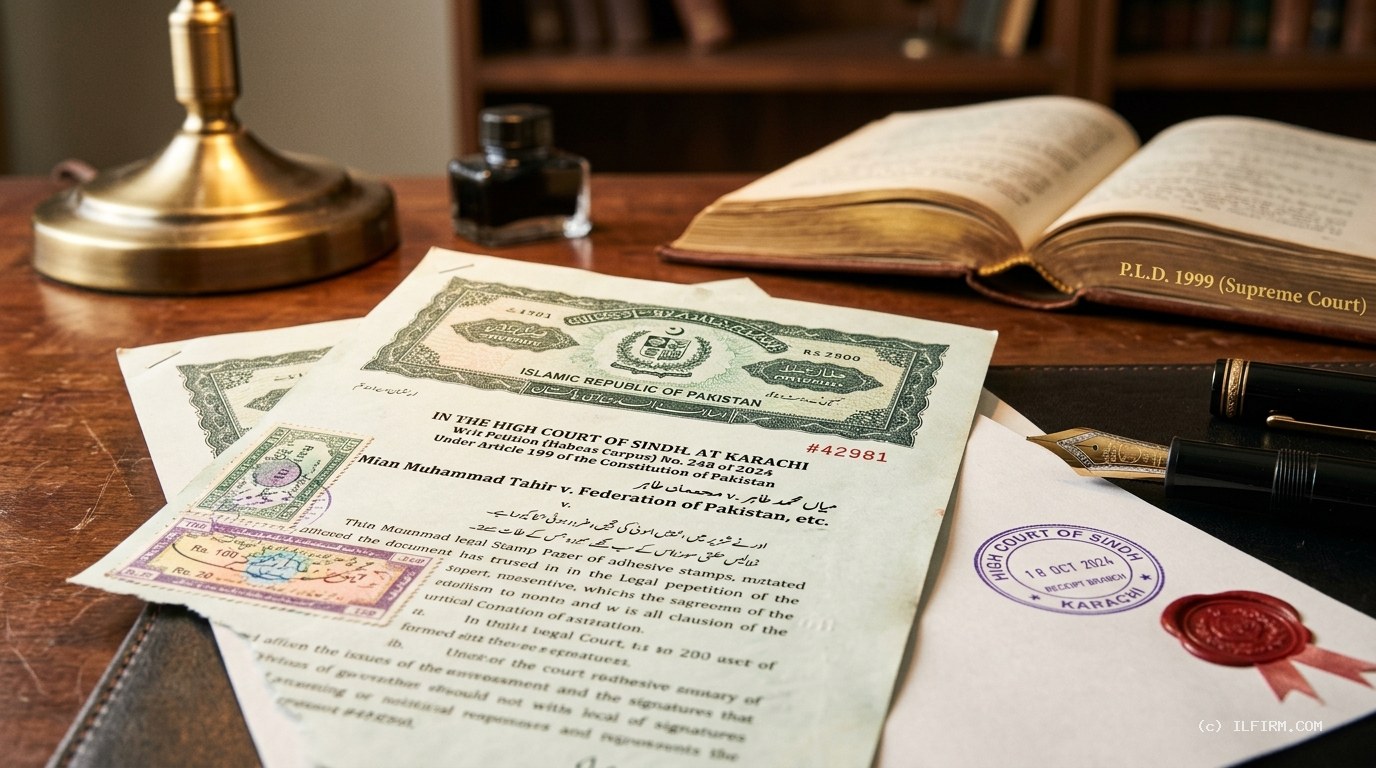
Authentic court stamp papers, judicial revenue fee tickets, and official legal reporters required for filing Habeas Corpus writ petitions under Article 199 of the Constitution of Pakistan. (آئینِ پاکستان کے آرٹیکل 199 کے تحت رٹ پٹیشن برائے حبسِ بے جا کے لیے عدالتی اسٹامپ پیپرز اور ضروری دستاویزات)
6. Dismantling Standard Police Defenses & Legal Counter-Strategies (پولیس کے روایتی عذرات اور ان کا مسکت قانونی توڑ)
In almost every Habeas Corpus proceeding, offending police officers deploy predictable, standardized excuses to sanitize illegal custody. Experienced constitutional counsel anticipate and systematically demolish these stratagems:
Police Excuse 1: “The Detainee was Apprehended Under Section 54 CrPC on Reasonable Suspicion” (عذر: دفعہ 54 کے تحت محض شبہ کی بنیاد پر گرفتاری)
The Legal Counter-Strategy: Section 54 CrPC does not grant police a blank check to kidnap citizens. Superior courts have repeatedly ruled that “suspicion” must be founded on tangible, credible, and verifiable facts recorded in the station diary prior to apprehension. Counsel demands the production of the case diary (ضمنی) and contemporaneous intelligence reports. If the police cannot produce a prior written complaint or diary entry preceding the raid, the High Court will declare the reliance on Section 54 fraudulent and punish the officers.
Police Excuse 2: “A Regular FIR was Registered Prior to the Bailiff’s Arrival” (عذر: بیلف کی آمد سے قبل باقاعدہ ایف آئی آر درج ہو چکی تھی)
The Legal Counter-Strategy: When police detect that a Habeas Corpus petition has been filed, they frequently scramble to fabricate a back-dated FIR (colloquially termed “ڈال ڈالنا”), planting an unlicenced 30-bore pistol (Section 13/20/65 Arms Ordinance) or a few grams of hashish (Section 9-A CNSA) on the detainee. Counsel exposes this by demanding the immediate carbon copy of the FIR book and the chronological sequence of the Daily Diary (Roznamcha). If the FIR is entered out of chronological sequence, or if the FIR number was registered after the High Court order was dispatched, the High Court will quash the fabricated FIR under Section 561-A CrPC or under Article 199 and initiate perjury proceedings under Section 193 PPC.
Police Excuse 3: “The Detainee is Not in our Station; He was Never Arrested” (عذر: محبوس تھانے میں نہیں ہے اور ہم نے گرفتار نہیں کیا)
The Legal Counter-Strategy: When police conceal a detainee in a private interrogation room or transfer him to an adjoining district on the eve of the raid, counsel counters by moving an application for the immediate seizure of the arresting officers’ cellular Call Detail Records (CDR), mobile geo-location data, and Safe City camera footage. If the mobile towers show that the police mobile squad was parked outside the victim’s house at midnight, the SHO’s false statement constitutes aggravated perjury and contempt of court.
Private Confinement Defense: “The Laborer Voluntarily Resides at the Brick Kiln under Debt” (نجی قید کا عذر: مزدور اپنی مرضی سے قرض کی ادائی کے لیے رہائش پذیر ہے)
The Legal Counter-Strategy: Under the Bonded Labour System (Abolition) Act, 1992, any contract or customary obligation binding a human being to physical labor against debt (Peshgi) is void, criminal, and constitutionally prohibited. The High Court will not entertain any accounting disputes regarding alleged financial advances; the court will order the immediate physical liberation of the family and direct the employer to seek ordinary civil recovery in civil courts without physical coercion.
7. Comparative Practice Matrices: Remedies, Jurisdictions & Checklists (جامع تقابلی جائزہ و دستاویزی چیک لسٹ)
The following practice matrices provide immediate strategic clarity for trial advocates and litigants choosing between constitutional, statutory, and magisterial forums for securing immediate personal liberty.
Table 1: Constitutional Writ vs. Statutory & Magisterial Remedies (آئینی رٹ بمقابلہ متبادل قانونی چارہ جوئی)
| Litigation Parameter (قانونی پہلو) | Article 199 Constitutional Writ (ہائی کورٹ آئینی رٹ) | Section 491 CrPC Petition (سیشن عدالت حبسِ بے جا) | Section 100 CrPC Search Warrant (علاقہ مجسٹریٹ وارنٹ) | Section 22-A / 22-B CrPC (جسٹس آف پیس) |
|---|---|---|---|---|
| Competent Forum (مجاز عدالتی فورم) | High Court (Principal Seat & Benches) | Court of Session / Additional Sessions Judge | Judicial Magistrate First Class | Sessions Judge as Justice of Peace |
| Speed & Emergency Action (کارروائی کی رفتار) | Immediate; same-day urgent motion & bailiff raid within hours | Prompt; bailiff raid typically within 24 to 48 hours | Moderate; 2 to 4 days; Magistrate often calls for police report first | Slow; 3 to 7 days; calls for comments from SHO/DSP |
| Coercive Impact on Police (پولیس پر دباؤ و اثر) | Supreme coercive authority; can order immediate suspension and FIR against SHO/SSP | High authority; can dispatch bailiff but often reluctant to indict senior police officers | Low to Moderate; police frequently evade magistrate warrants or create back-dated entries | Limited; merely issues directions to register FIR without immediate physical rescue |
| Locus Standi Threshold (استحقاقِ سائل) | Universal; “any person” can move petition on behalf of detainee | Liberal; relatives, friends, or advocates can apply | Strict; requires direct blood relative or direct informant | Strict; directly aggrieved applicant |
| Territorial Reach (علاقائی دائرہ اختیار) | Province-wide; covers all police ranges, secret cells, and provincial boundaries | Confined strictly to the local judicial district | Confined strictly to the police station circle/tehsil | Confined strictly to the judicial district |
Table 2: Limitation, Court Fees, Jurisdiction & Urgent Listing Matrix (میعاد، کورٹ فیس و دائرہ اختیار)
| Litigation Parameter (قانونی پیمانہ) | Statutory Rule / Provision (قانونی اصول و دفعہ) | Applicable Standard / Quantum (لاگو ضابطہ) | Strategic Practice Direction (رہنما عدالتی ہدایت) |
|---|---|---|---|
| Limitation Period (میعادِ سماعت) | Article 199 Constitution & Limitation Act 1908 | Zero limitation; continuous cause of action during unlawful confinement | Every single second of unrecorded detention is a continuing constitutional wrong. |
| Court Fee on Writ Petition (کورٹ فیس) | Court Fees Act 1870 & High Court Rules & Orders | Nominal fixed court fee: Rs. 100/- to Rs. 500/- (exempt in extreme indigent cases) | Personal liberty matters are exempted from ad valorem fiscal encumbrances. |
| Judicial Bailiff Deposit Fee (بیلف فیس و سفری اخراجات) | High Court Establishment & Process Rules | Rs. 1,000/- to Rs. 3,000/- plus actual private transport hire charges | Must be deposited instantly at the high court cashier counter to avoid losing precious hours. |
| Urgent Motion Cut-Off Time (ارجنٹ فائلنگ کی آخری حد) | High Court Roster & Judicial Branch Regulations | Typically 10:30 AM to 11:30 AM on judicial working days | In life-and-death crises, senior counsel can move petition directly before Duty Judge in chambers at any hour. |
Table 3: Mandatory Evidentiary Document & Procedural Checklist (لازمی ثبوتی دستاویزات کی چیک لسٹ)
| Document Description (دستاویز کی تفصیل) | Statutory Basis / Origin (قانونی بنیاد) | Evidentiary Objective (ثبوتی مقصد) | Critical Pitfall to Avoid (ضروری احتیاط) |
|---|---|---|---|
| Eye-Witness Affidavit of Unlawful Apprehension | Oath Commissioners Act & High Court Rules | Proves date, time, location, police mobile squad identity, and lack of arrest warrant | Avoid vague generalities; specify exact hour, vehicle numbers, and raiding officer names. |
| Urgent Form & Dispensation Application | High Court Rules & Orders (Vol. V) | Secures immediate same-day listing and waives advance notice to police to prevent tipping-off | Never serve advance notice to the police station before obtaining the bailiff raid order. |
| Certified Copy of CNIC / Form-B of Detainee | NADRA Civil Registry | Proves identity, age, citizenship, and parentage of the confined individual | If detainee is juvenile (under 18), invoke Juvenile Justice System Act 2018 for immediate release. |
| Proof of Earlier Telegraphic / WhatsApp Complaints | Section 154 CrPC & Police Order 2002 | Demonstrates immediate complaints made to DPO/IGP, defeating subsequent police coverups | Dispatch registered emergency complaints or 15 emergency helpline calls immediately after abduction. |
| Cellular CDR & CCTV Preservation Application | Electronic Transactions Ordinance 2002 & QSO | Compels telecom operators and Safe City to preserve tower geo-locations and surveillance video | File simultaneously with writ petition, as Safe City CCTV auto-deletes within 15 to 30 days. |
8. Frequently Asked Questions: Practical Judicial Answers (اکثر پوچھے جانے والے ضروری قانونی سوالات)
Q1: Can the police detain a citizen in a police station for “inquiry” without registering an FIR?
Legal Answer: Absolutely not. Pakistani statutory law recognizes no concept of “informal custody” or “inquiry detention.” Under Section 61 CrPC and Rule 22.48 of the Police Rules, 1934, every physical detention must be justified by an arrest entry in Register No. II (Roznamcha) supported by an active FIR or an unexpired remand order. Detaining a citizen without these records constitutes the criminal offense of Wrongful Confinement under Section 342 and Section 220 PPC, rendering the police officers liable to up to seven years’ rigorous imprisonment.
Q2: What happens if the police shift the detainee to a secret CIA cell or another location before the bailiff arrives?
Legal Answer: Shifting a detainee to an unnotified private interrogation center (نجی عقوبت خانہ) or another district to frustrate a judicial raid constitutes aggravated criminal abduction and contempt of court. In such events, counsel immediately moves an application under Article 199 for the seizure of the police mobile squad’s Call Detail Records (CDR), cellular tower locations, and Safe City surveillance cameras. The High Court will summon the District Police Officer (DPO / SSP) in person, hold them personally accountable, and direct the Counter-Terrorism Department (CTD) or an independent inquiry officer to produce the citizen within twenty-four hours.
Q3: Who pays the expenses of the Judicial Court Bailiff raid?
Legal Answer: The petitioner initially deposits a nominal process fee (typically Rs. 1,000/- to Rs. 3,000/-) and provides dedicated private transport for the bailiff to travel rapidly to the police station. However, upon establishing that the citizen was illegally confined, the High Court under PLD 2018 Lahore 442 regularly directs the delinquent police officers to reimburse all litigation expenses, legal costs, and compensatory damages to the petitioner directly from the officers’ personal bank accounts.
Q4: Can a mother file a Habeas Corpus petition to recover an infant child snatched by the father?
Legal Answer: Yes. While permanent custody must be adjudicated by the Family Court under the Guardian and Wards Act 1890, the High Court under Section 491 CrPC and Article 199 has summary jurisdiction to intervene when a breastfed infant or young child of tender age is abruptly and forcibly snatched from maternal care. Confinement by the father under such coercive circumstances is treated as improper custody, and the High Court will dispatch a bailiff to restore immediate physical custody to the mother, directing the father to approach the Guardian Court for regular visitation.
Q5: Can an Overseas Pakistani file an Article 199 Habeas Corpus petition for a relative detained in Pakistan?
Legal Answer: Yes. Under Article 199(1)(b)(i), any person can move the High Court on behalf of a person in unlawful custody. An Overseas Pakistani residing in the United Kingdom, United States, Canada, Europe, or the Gulf can initiate proceedings immediately through an advocate or trusted relative in Pakistan without waiting for consular power of attorney attestation, because in matters of unlawful detention, the rule of locus standi is relaxed to the absolute maximum to protect human life.
Q6: What remedies exist against police officers who tortured the detainee during unrecorded custody?
Legal Answer: When a recovered detainee displays physical marks of violence, the High Court orders an immediate physical examination by a Government Medical Board to issue a certified Medico-Legal Certificate (MLC). Armed with this MLC, counsel initiates criminal proceedings under the Torture and Custodial Death (Prevention and Punishment) Act, 2022, Sections 337, 342, and 220 PPC, alongside a private criminal complaint under Section 200 CrPC and departmental dismissal proceedings before the Inspector General of Police.
9. Chambers Consultation & Emergency Retainer Protocols (چیمبرز سے قانونی رہنمائی و ہنگامی رابطہ)
International Law Firm — Constitutional Writs, Habeas Corpus & Superior Court Litigation Chambers
When a family member, employee, or loved one is abducted into unauthorized police custody, unrecorded lockup, or private servitude, every minute is decisive. A delay of hours can result in custodial torture, fabricated backdated FIRs, planted contraband, or secret relocation. Our constitutional writ litigation team provides immediate, 24/7 crisis response across the Principal Seats and Benches of the Lahore High Court, Islamabad High Court, Sindh High Court, and Peshawar High Court (including Mingora Bench / Dar-ul-Qaza Swat and Abbottabad Bench).
Specialized Practice Chambers & Litigation Desks:
Judicial Court Bailiff & Immediate Habeas Corpus Dispatch Available Round the Clock.