

NAB & FIA Inquiries, Investigations and Bail: High Court Jurisdictions & Due Process Safeguards in Pakistan (نیب اور ایف آئی اے انکوائری، جسمانی ریمانڈ اور ہائی کورٹ سے ضمانت)
1. Executive Summary & Jurisprudential Foundations (تعارفی خلاصہ و فقہی و قانونی مبادیات)
In the constitutional and criminal jurisprudence of the Islamic Republic of Pakistan, the investigation and adjudication of white-collar crime occupy a highly complex, aggressive, and contentious domain. Special anti-corruption and economic investigative institutions—most prominently the National Accountability Bureau (قومی احتساب بیورو – نیب) operating under the National Accountability Ordinance, 1999 (قومی احتساب آرڈیننس 1999ء), and the Federal Investigation Agency (وفاقی تحقیقاتی ادارہ – ایف آئی اے) functioning pursuant to the Federal Investigation Agency Act, 1974 (ایف آئی اے ایکٹ 1974ء)—exercise extraordinary statutory powers that frequently collide directly with the sacrosanct fundamental rights guaranteed to citizens under the Constitution of the Islamic Republic of Pakistan, 1973 (آئینِ پاکستان 1973ء).
The operational tension between state anti-corruption enforcement and the individual citizen’s fundamental liberties reaches its zenith during the preliminary stages of criminal process: specifically, the transition from an administrative inquiry (انتظامی انکوائری) into a formal investigation (باقاعدہ فوجداری تفتیش), the issuance of arbitrary call-up notices (طلب نوٹس / کال اپ نوٹس), the mechanical grant of physical remand (جسمانی ریمانڈ) to state custody under Section 167 of the Code of Criminal Procedure, 1898 (دفعہ 167 ضابطہ فوجداری), and the statutory deprivation of bail under restrictive clauses such as Section 9(b) of the NAO 1999 (دفعہ 9-بی قومی احتساب آرڈیننس). While ordinary penal law presumes innocence until guilt is proven beyond reasonable doubt, statutory enactments governing white-collar offenses frequently incorporate severe statutory presumptions and reverse evidentiary burdens that place the liberty, reputation, and commercial livelihood of accused individuals in severe jeopardy.
Anatomy of White-Collar Crime Allegations & Statutory Thresholds (سفید پوش جرائم کی نوعیت و قانونی معیارات)
White-collar offenses under Pakistani law do not mirror conventional street crime or physical offenses against the human body under the Pakistan Penal Code, 1860 (مجموعہ تعزیراتِ پاکستان 1860ء). Instead, white-collar prosecutions are intrinsically documentary, forensic, and transaction-driven. They center upon intricate allegations of misuse of official authority (اختیارات کا ناجائز استعمال), acquisition of assets disproportionate to known sources of income (آمدن سے زائد اثاثہ جات), fraudulent diversion of public revenue, commercial bribery, kickbacks, procurement irregularities, money laundering under the Anti-Money Laundering Act, 2010 (اینٹی منی لانڈرنگ ایکٹ 2010ء), electronic transaction fraud under the Prevention of Electronic Crimes Act, 2016 (پیکا ایکٹ 2016ء), and criminal breach of trust (مجرمانہ خیانتِ امانت) under Sections 405 and 409 of the PPC.
A critical statutory development that transforms contemporary NAB practice is the introduction of legislative amendments under the National Accountability (Amendment) Acts (قومی احتساب ترمیمی قوانین 2022ء و 2023ء). Under the revised statutory scheme, Parliament established an express pecuniary jurisdiction threshold (مالیاتی حدِ اختیار), precluding the National Accountability Bureau from initiating inquiries, investigations, or references regarding matters where the alleged financial gain or loss involves an amount less than Five Hundred Million Rupees (50 کروڑ روپے). Furthermore, the amended law explicitly excludes pure administrative decisions, procedural lapses in regulatory exercises, and bona fide business judgments undertaken in good faith by civil servants and corporate executives from the purview of corruption prosecution. Where an inquiry fails to satisfy this statutory monetary threshold or touches upon excluded matters, the proceedings are void ab initio for want of subject-matter jurisdiction.
Administrative Inquiries vs. Formal Criminal Investigations (انتظامی انکوائری بمقابلہ باقاعدہ فوجداری تفتیش)
A fundamental jurisprudential distinction frequently misunderstood by corporate respondents and litigators alike is the legal cleavage between an inquiry and an investigation. Under both the NAB regulatory architecture and the FIA Inquiry Rules, 2002 (ایف آئی اے انکوائری قواعد 2002ء), the initiation of a complaint undergoes a multi-tiered filtering process:
- Complaint Verification (جانچ پڑتال / شکایت کی تصدیق): A non-intrusive preliminary examination of the complaint’s authenticity to eliminate frivolous, anonymous, or politically motivated petitions.
- Formal Inquiry (باقاعدہ انکوائری): An investigative exploration to determine whether a prima facie cognizable offense has occurred. At this juncture, the individual is merely a respondent or witness, not a formal accused. Investigative agencies possess no statutory authority to effect arrest or seize personal assets during a purely administrative inquiry unless specific statutory preconditions are met.
- Criminal Investigation (فوجداری تفتیش): Initiated only upon the formal approval of the competent authority (e.g., Regional Board under Section 18(c) NAO 1999 or registration of an First Information Report – FIR (پہلی اطلاع رپورٹ – ایف آئی آر) under Section 154 CrPC by the FIA). Only upon entering this formal investigative phase does the agency acquire coercive police powers, including the execution of arrest warrants (وارنٹِ گرفتاری), seizure of banking records, and applications for custodial physical remand (حوالات و جسمانی ریمانڈ).
The Constitutional Prism: Liberty, Due Process & Presumption of Innocence (آئینی تناظر: انفرادی آزادی اور فیئر ٹرائل کا بنیادی حق)
The enforcement of special anti-corruption statutes cannot operate in a legal vacuum detached from constitutional supremacy. The Supreme Court of Pakistan has repeatedly held that every statutory provision empowering NAB and FIA must be construed strictly and harmoniously through the prism of fundamental constitutional guarantees:
- Article 4 of the Constitution (قانون کے مطابق سلوک کا حق): Guarantees that every citizen is entitled to the protection of law and to be treated in accordance with law, forbidding any arbitrary action by state functionaries.
- Article 9 of the Constitution (تحفظِ جان و ذاتی آزادی): Mandates that no person shall be deprived of life or liberty save in accordance with law, rendering pre-trial incarceration without solid incriminating evidence unconstitutional.
- Article 10 of the Constitution (گرفتاری اور حراست کے خلاف آئینی تحفظات): Prescribes mandatory safeguards as to arrest and detention, including the non-negotiable right to be informed immediately of the grounds of arrest, the right to consult and be defended by a legal practitioner of choice, and the mandatory production before a judicial magistrate within twenty-four hours.
- Article 10A of the Constitution (منصفانہ سماعت اور فیئر ٹرائل کا حق): Enshrines the fundamental right to a fair trial and due process, establishing that no person shall be condemned unheard, nor subjected to arbitrary investigative overreach, oppressive bail denial, or prejudicial procedural shortcuts.
2. Statutory Architecture: Relevant Substantive Codes & Procedural Enactments (قانونی ڈھانچہ: بنیادی قوانین و ضابطہ کار)
The prosecution and defense of white-collar crime in Pakistan operate at the crossroads of multiple substantive and procedural enactments. A seasoned advocate must navigate not only specialized anti-corruption statutes but also foundational penal, criminal procedural, evidentiary, and civil relief codes.
National Accountability Ordinance, 1999 (قومی احتساب آرڈیننس 1999ء)
Promulgated to eradicate corruption and corrupt practices, the National Accountability Ordinance, 1999 (NAO 1999) established the Accountability Courts and endowed the NAB Chairman and prosecution with extraordinary investigative powers. Key statutory sections governing defense practice include:
- Section 9 (Offence of Corruption and Corrupt Practices): Enumerates twelve specific categories of corrupt practices, including the acquisition of assets disproportionate to declared legal income, misappropriation of public funds, illegal gratification, and misuse of public office to confer undue financial benefits.
- Section 18 (Cognizance of Offences & Inquiry Process): Prescribes that NAB may take cognizance upon a reference received from the appropriate government, a complaint filed by an aggrieved party, or of its own accord (suo motu). It establishes the formal progression through Complaint Verification, Inquiry, and Investigation under the supervision of the Regional Board.
- Section 19 (Call-Up Notice and Summoning Powers): Empowers the Investigation Officer to summon any person, require production of books of accounts, banking records, and requisition documents from public departments. Superior courts have mandated that a call-up notice must explicitly disclose the subject matter and specific allegations, prohibiting fishing or roving inquiries.
- Section 24 (Arrest and Warrant Authorization): Grants the Chairman NAB the authority to issue warrants of arrest during an inquiry or investigation. The issuance of an arrest warrant is subject to judicial review and cannot be executed arbitrarily without substantial incriminating evidence.
- Section 9(b) (Statutory Bail Prohibition): Contains the notorious non-obstante clause prohibiting Accountability Courts from granting bail. As analyzed below, this statutory bar does not, and cannot, fetter the constitutional jurisdiction of the High Courts under Article 199 of the Constitution (آئینی رٹ کا دائرہ اختیار).
- Section 25 (Voluntary Return & Plea Bargain): Establishes mechanisms for voluntary settlement prior to authorization of investigation (Section 25(a)) or formal plea bargain (پلی بارگین) approved by the Accountability Court post-authorization (Section 25(b)), carrying statutory disqualification from holding public office or obtaining commercial credit.
Federal Investigation Agency Act, 1974 & Scheduled Enactments (ایف آئی اے ایکٹ 1974ء و متعلقہ شیڈول قوانین)
The Federal Investigation Agency operates under the Federal Investigation Agency Act, 1974, serving as Pakistan’s premier federal law enforcement body empowered to investigate offenses listed in the Schedule to the Act. Unlike NAB, whose focus is primarily on public corruption above statutory pecuniary limits, the FIA exercises jurisdiction over offenses touching upon federal departments, banking institutions, foreign exchange, immigration, corporate fraud, and cyber transactions.
- Section 3 & 5 of the FIA Act 1974: Confers upon members of the Agency all the powers, privileges, and liabilities of a police officer under the CrPC across all provinces of Pakistan in relation to scheduled offenses. Under Section 5(5), an FIA officer may summon any person acquainted with the facts of the case.
- Sections 409, 420, 468, 471 & 477-A of the PPC: The foundational substantive penal provisions invoked in FIA white-collar inquiries. Section 409 PPC penalizes criminal breach of trust by a public servant, banker, merchant, or agent (مجرمانہ خیانتِ امانت از طرف ملازمِ سرکار یا بینکار) with imprisonment for life or up to ten years; Section 420 penalizes cheating and dishonestly inducing delivery of property (دھوکہ دہی اور مال حاصل کرنا); Section 468 targets forgery for purpose of cheating (دھوکہ دہی کی غرض سے جعلسازی); and Section 471 penalizes the fraudulent use of a forged document as genuine.
- Prevention of Electronic Crimes Act, 2016 (PECA): Covers electronic fraud, unauthorized electronic fund transfers, identity theft, and corporate cyber forensics under Sections 13, 14, and 16.
- Anti-Money Laundering Act, 2010 (AMLA): Invoked when illicit proceeds generated from predicate white-collar offenses are concealed, transferred, converted, or integrated into the formal economy. It empowers the FIA and designated agencies to obtain Suspicious Transaction Reports – STRs (مشکوک مالیاتی رپورٹس) from the Financial Monitoring Unit – FMU (مالیاتی نگرانی کا یونٹ).
Code of Criminal Procedure, 1898: Remand & Bail Architecture (ضابطہ فوجداری 1898ء: جسمانی ریمانڈ و ضمانت کا ضابطہ)
The Code of Criminal Procedure, 1898 (CrPC) supplies the underlying procedural spine for all criminal proceedings in Pakistan, governing the liberty of the accused from the moment of arrest through final judgment:
- Section 61 CrPC (24-Hour Production Mandate): Prohibits police and federal investigators from detaining an arrested person for a period exceeding twenty-four hours without obtaining a special order from a Magistrate under Section 167.
- Section 167 CrPC (Physical Remand in Police Custody): Governs the judicial remand of an accused to investigative custody. Superior courts have settled that remand is an extraordinary deprivation of liberty. A Judicial Magistrate or Accountability Judge must scrutinize the case diaries (ضمنیات / پولیس ڈائری), demand demonstration of genuine investigative necessity, examine the physical condition of the accused, and record explicit judicial reasons. Mechanical, rubber-stamped remand orders violate constitutional due process.
- Section 344 CrPC (Judicial Custody Pending Investigation): Governs the postponement or adjournment of proceedings and the committal of the accused to judicial lock-up (jail custody) when investigation cannot be completed within statutory remand limits.
- Section 173 CrPC (Final Investigative Report / Challan): Mandates that the investigation officer submit a complete report (Challan) within fourteen days of arrest. Failure to file the Challan creates substantial entitlement to post-arrest bail on grounds of statutory delay.
- Section 497 CrPC (Post-Arrest Bail): Sets forth the criteria for release on bail for non-bailable offenses, incorporating the prohibitory clause (امنائی شق) (offenses punishable with death, imprisonment for life, or ten years). Sub-section (2) establishes the absolute right to bail where the court finds that there are reasonable grounds for believing that the accused has not committed a non-bailable offense, or that the matter requires further inquiry (مزید استفسار / مزید انکوائری).
- Section 498 CrPC (Pre-Arrest Anticipatory Bail): Empowers the High Court and Sessions Court to grant anticipatory pre-arrest bail to protect an innocent citizen from the ignominy, humiliation, and harassment of arrest motivated by mala fides or ulterior motives.
- Section 561-A CrPC (Inherent Powers of the High Court): Grants the High Court comprehensive inherent jurisdiction to make such orders as necessary to give effect to any order under the Code, to prevent abuse of the process of any court (اختیار کا ناجائز استعمال), or otherwise to secure the ends of justice, frequently invoked to quash frivolous FIRs and malicious criminal proceedings.
Civil & Contractual Enactments: Specific Relief Act 1877 & Contract Act 1872 (دیوانی و معاہداتی قوانین کا تقابل)
In countless white-collar investigations initiated by the FIA and NAB, the underlying dispute arises out of a commercial agreement, joint venture, sale of real property, banking loan restructuring, or partnership accounting. Under the Contract Act, 1872 (قانونِ معاہدہ 1872ء), a breach of contract triggers civil remedies—specifically damages under Section 73 or rescission. Similarly, the Specific Relief Act, 1877 (قانونِ دادرسی خاص 1877ء) provides exclusive forums for declaratory suits (Section 42) and permanent injunctions (Section 54) before the Civil Courts under the Code of Civil Procedure, 1908 – CPC (مجموعہ ضابطہ دیوانی 1908ء).
It is a cardinal principle of Pakistani superior court jurisprudence that the criminal law machinery cannot be utilized as a coercive debt-collection agency. Where an investigating agency attempts to convert a purely civil default into a criminal breach of trust under Section 409 PPC or fraud under Section 420 PPC, the superior judiciary will intervene through Writ of Prohibition (حکمِ امتناعی بذریعہ رٹ) under Article 199 of the Constitution or Section 561-A CrPC to strike down the proceedings.
3. Evidentiary Rigour under Qanun-e-Shahadat Order, 1984: Standard of Proof & Digital Forensics (معیارِ شہادت اور ڈیجیٹل فرانزک کا کڑا امتحان)
The trial of white-collar crime is governed strictly by the rules of evidence codified in the Qanun-e-Shahadat Order, 1984 (قانونِ شہادت آرڈر 1984ء). While specialized statutes frequently attempt to dilute evidentiary hurdles for the state, superior court precedents establish that criminal liability cannot rest on assumptions, media trials, or speculative accounting audits.
Burden of Proof & Reversal of Presumptions under Section 14 NAO (بارِ ثبوت اور قانونی مفروضات کا الٹنا)
Under Article 117 of the Qanun-e-Shahadat Order, 1984 (آرٹیکل 117 قانونِ شہادت), the burden of proof (بارِ ثبوت) rests squarely on the party asserting the affirmative of an issue—namely, the prosecution. In ordinary criminal litigation, this burden never shifts. However, under Section 14 of the National Accountability Ordinance, 1999 (دفعہ 14 قومی احتساب آرڈیننس), a statutory exception is introduced in prosecutions for assets disproportionate to known sources of income (Section 9(a)(v)).
The Supreme Court of Pakistan has definitively interpreted this statutory presumption: the burden shifts to the accused only after the prosecution has discharged its initial foundational burden by establishing three essential prerequisites with admissible evidence:
- That the accused is or was a holder of a public office or a person subject to the Ordinance;
- The exact, verified nature, valuation, and extent of the pecuniary resources or property held by the accused or by a benamidar on their behalf; and
- That such property is palpably disproportionate to the accused’s known, documented sources of lawful income.
Until the prosecution establishes these foundational facts beyond reasonable doubt, the statutory presumption under Section 14 NAO never activates. An accused cannot be compelled to prove their innocence in a vacuum of speculative claims.
Bankers’ Books Evidence, Forensic Audits & Chain of Custody (بینکنگ دستاویزات، فارنزک آڈٹ اور شواہد کی حفاظت)
White-collar trials routinely hinge upon financial transaction records, banking ledgers, and forensic accounting dossiers. The admissibility of such records is strictly regulated under the Bankers’ Books Evidence Act, 1891 (قانونِ ثبوتِ بہی کھاتہ جات بینکاران 1891ء) read with Articles 73 to 78 of the Qanun-e-Shahadat Order 1984:
- Certified True Copies: Mere photocopies of bank statements produced by an investigating officer are inadmissible in evidence. They must be accompanied by an authentic statutory certificate under Section 4 of the Bankers’ Books Evidence Act, signed by the principal accountant or branch manager, verifying that the copy is a faithful extract of records maintained in the ordinary course of banking business.
- Chain of Custody (شواہد کی منتقلی اور حفاظت): The prosecution must establish an unbroken chain of custody (تحفظِ شواہد کی کڑی) for all seized physical ledgers, servers, and financial instruments from the moment of confiscation until production in court. Any unexplained gap in the custody log destroys the evidentiary integrity of the record.
- Expert Forensic Auditor Testimony: An audit report compiled by NAB or FIA internal auditors represents merely an opinion under Article 59 of the Qanun-e-Shahadat Order (رائے ماہرِ فن / آڈٹ رائے). The expert witness must step into the witness box, produce the source documents upon which the audit was based, and submit to rigorous, detailed cross-examination by defense counsel.
Electronic Records, Digital Signatures & PECA Forensic Scrutiny (الیکٹرانک شواہد، ڈیجیٹل دستخط اور سائبر فرانزک)
With the digitization of commercial commerce and public administration, investigations under the FIA Cyber Crime Wing and NAB routinely deploy electronic evidence: emails, encrypted chat logs, database dumps, IP address logs, and digital signatures. Under Article 164 of the Qanun-e-Shahadat Order, 1984 (آرٹیکل 164 قانونِ شہادت) and Section 33 of PECA 2016, modern electronic devices and scientific evidence are admissible, subject to stringent procedural safeguards:
- Forensic Mirror Imaging: Physical hard drives and mobile devices must be cloned utilizing write-blocking forensic hardware, generating an immediate cryptographic Hash Value (ہیش ویلیو) (MD5 or SHA-256) at the time of seizure to eliminate any possibility of post-seizure tampering or data planting.
- Forensic Laboratory Accreditation: The forensic analysis must be conducted by an authorized laboratory, accompanied by a certificate demonstrating the integrity and calibration of the analytical software.
Search, Seizure Memos & Witness Attestation Protocols (تلاشی، فرد مقبوضگی اور گواہان کی تصدیق)
Under Section 103 CrPC (دفعہ 103 ضابطہ فوجداری), any search conducted of a premises or office during an investigation must be carried out in the presence of two or more respectable inhabitants of the locality. An authentic Recovery Memo / Seizure Memo (فردِ مقبوضگی) must be drawn up on the spot, itemizing every document, digital storage device, or cash asset confiscated, and duly signed by the recovery witnesses. The chronic practice of investigative agencies utilizing subordinate official staff as stock recovery witnesses has been severely censured by the Supreme Court of Pakistan as a fatal evidentiary defect.
4. Landmark Superior Court Precedents: Supreme Court & High Courts (اعلیٰ عدالتوں کے نظائر و رہنما فیصلے)
The jurisprudence governing white-collar crime defense, remand, and bail in Pakistan is firmly anchored in binding judgments of the Supreme Court of Pakistan and the provincial High Courts. Under Article 189 of the Constitution (آرٹیکل 189 آئین: سپریم کورٹ کے فیصلوں کی پابندی), decisions of the Supreme Court on questions of law are binding on all other courts in Pakistan. Below is an exhaustive analysis of the definitive authorities:
Tallat Ishaq v. National Accountability Bureau (PLD 2020 SC 523 / 2020 SCMR 1228)
Ratio Decidendi: A five-member larger bench of the Supreme Court of Pakistan delivered the definitive ruling on the constitutional power of High Courts to grant bail in NAB cases under Article 199. The apex court held that while Section 9(b) of the NAO 1999 ousts the statutory power of Accountability Courts to grant bail, it cannot eclipse or curtail the extraordinary constitutional writ jurisdiction of the High Courts under Article 199. The court established that bail may be granted where the arrest or continued detention is tainted by mala fides, lacks reasonable grounds to connect the accused with the commission of the alleged offense, where the case requires further inquiry, or where trial delay violates Article 10A due process.
Mian Muhammad Shehbaz Sharif v. National Accountability Bureau (2021 SCMR 445)
Ratio Decidendi: The Supreme Court affirmed the grant of post-arrest bail in multi-billion rupee white-collar allegations regarding assets beyond means and public procurement. The apex court laid down the principle that in documentary white-collar prosecutions where all pertinent financial ledgers, banking records, and procurement files have already been seized by the investigation agency, continued pre-trial incarceration serves no investigative purpose and degenerates into punitive detention. The court reiterated that pre-trial detention cannot be converted into punishment before the pronouncement of guilt.
Khan Asadullah Khan v. Federation of Pakistan (PLD 2016 SC 601)
Ratio Decidendi: The Supreme Court held that the power of the Chairman NAB to issue an arrest warrant under Section 24 of the NAO 1999 is discretionary, quasi-judicial, and structured by law. It cannot be exercised mechanically, whimsically, or as a matter of routine upon the commencement of an inquiry. The Chairman must apply an independent, judicial mind to the tangible incriminating material placed before him to satisfy himself that arrest is unavoidable. Failure to record objective satisfaction vitiates the warrant and justifies constitutional intervention.
Suo Motu Case regarding NAB Investigation Procedures (PLD 2020 SC 703)
Ratio Decidendi: The Supreme Court severely deprecated the practice of investigative agencies orchestrating media leaks, arresting reputable civil servants and businessmen without verified evidence, and subjecting accused persons to public humiliation. The court mandated strict adherence to statutory timelines, transparency in call-up notices, and constitutional accountability for investigative officers who abuse their coercive powers.
Muhammad Bashir v. The State (2019 SCMR 1129)
Ratio Decidendi: The Supreme Court drew a clear, unyielding line between civil liability for breach of contract and criminal culpability for cheating or criminal breach of trust under Sections 406 and 420 PPC. The apex court held that mere inability to perform a contractual promise or failure to return money does not constitute a criminal offense in the absence of dishonest intention existing at the very inception of the transaction. The registration of criminal cases by the FIA or police to enforce commercial debt collection was declared an egregious abuse of judicial process.
Peshawar High Court Jurisprudence on FIA Authority (PLD 2014 Pesh 158 / 2021 PCrLJ 1845)
Ratio Decidendi: The Peshawar High Court repeatedly struck down FIA inquiries initiated against private businessmen and contractors in Khyber Pakhtunkhwa, establishing that the FIA has zero jurisdiction over private contractual or commercial disputes not connected with the federal government or scheduled offenses. The High Court quashed call-up notices and granted pre-arrest protective bail, reaffirming that the agency cannot assume the mantle of a recovery tribunal.
5. Procedural Roadmap: Step-by-Step From Call-Up Notice to Superior Court Bail & Acquittal (مرحلہ وار عدالتی طریقہ کار: نوٹس سے بریت تک کا قانونی سفر)
Navigating a white-collar prosecution requires meticulous tactical execution across every procedural stage. The following ten-step roadmap outlines the precise litigation strategy deployed by seasoned defense counsel:
Step 1: Scrutiny of the Call-Up Notice (طلب نوٹس کا قانونی تجزیہ): Upon receiving a notice under Section 19 NAO or Section 5(5) FIA Act, counsel must immediately examine whether the notice satisfies the statutory mandate: Does it specify the inquiry number, the precise subject matter, the capacity in which the recipient is summoned (witness or accused), and the exact documents demanded? A vague or sweeping notice must be met with a formal written legal response seeking clarification, preserving constitutional objections.
Step 2: Pre-Emptive Protective & Anticipatory Bail (حفاظتی و قبل از گرفتاری ضمانت): Where credible apprehension exists that the agency intends to spring a trap and effect an arrest upon attendance, counsel must immediately approach the High Court under Article 199 of the Constitution (or the Sessions / Special Court under Section 498 CrPC for FIA matters) seeking protective bail (حفاظتی ضمانت) or pre-arrest bail, restraining the agency from arresting the petitioner until the petition is adjudicated on merits.
Step 3: Warrant Scrutiny & First Production (وارنٹ گرفتاری اور عدالت میں پہلی پیشی): If an arrest has been effected, the accused must be produced before the Accountability Court or Judicial Magistrate within twenty-four hours under Article 10 of the Constitution and Section 61 CrPC. Counsel must verify whether the arrest warrant was signed by the competent statutory authority (Chairman NAB or authorized delegate) and whether the arrest memo records the exact timestamp of detention.
Step 4: Fierce Resistance to Physical Remand under Section 167 CrPC (جسمانی ریمانڈ کی مخالفت): When the prosecution requests physical custody, defense counsel must vehemently contest the application. Counsel must demand the production of the case diaries, demonstrate that the allegations are based on documented records already in the agency’s possession, establish that physical custody is sought merely to harass or coerce a confession, and request immediate judicial remand to jail or, at minimum, a medical examination by a government medical board under the Torture and Custodial Death (Prevention and Punishment) Act, 2022 (ٹارچر اور کسٹوڈیئل ڈیتھ ایکٹ 2022ء).

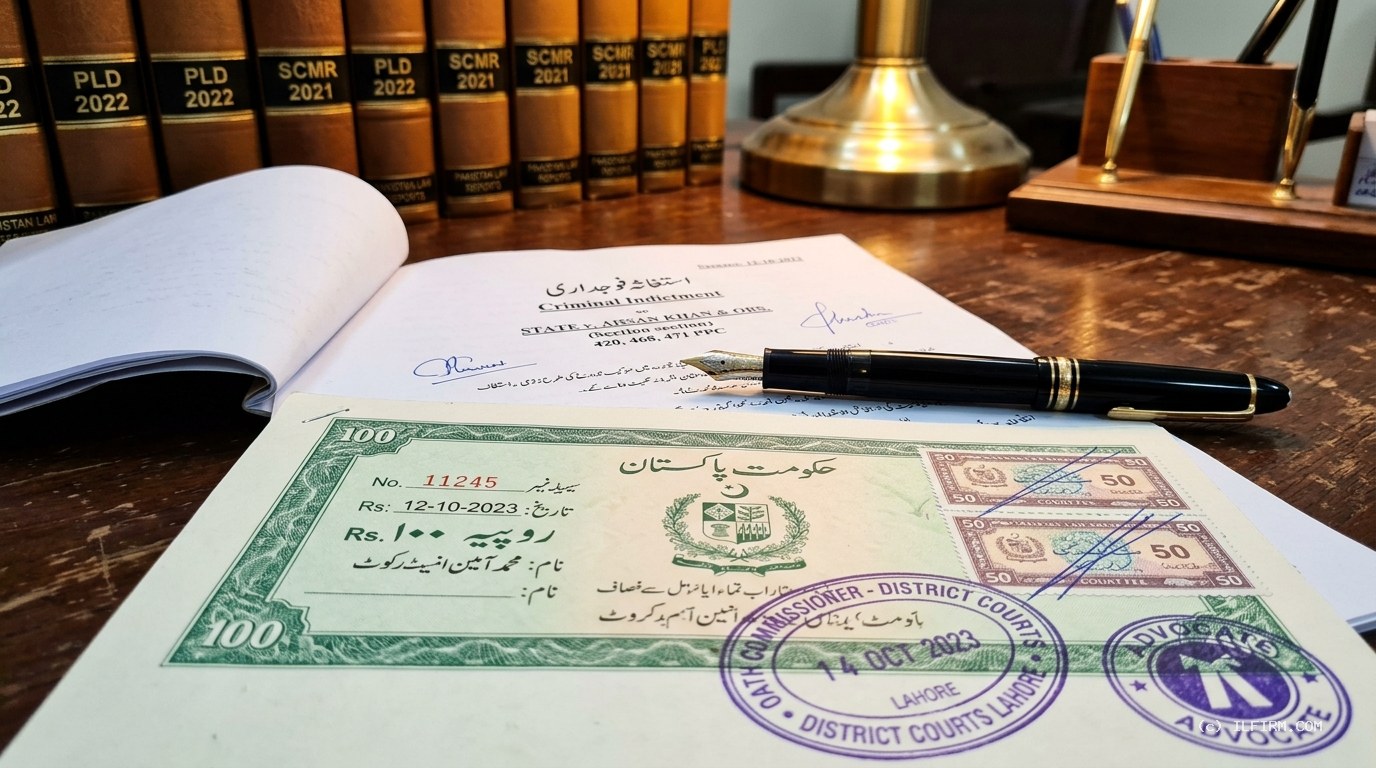
Authentic Pakistani judicial stamp papers, court fee tickets, and legal precedent compendiums utilized in superior court white-collar defense and remand litigation (عدالتی اسٹامپ پیپر، کورٹ فیس ٹکٹ اور قانونی نظائر برائے ضمانت و ریمانڈ مقدمات)
Step 5: Post-Remand Judicial Custody & Statutory Timelines (حوالاتِ جوڈیشل اور چالان کی مدت): Once physical remand expires (statutorily capped at 30 days under recent amendments for NAB, or 14 days under Section 167 CrPC for FIA), the accused is remanded to judicial lock-up. The prosecution must complete its investigation and file the final Reference or Challan under Section 173 CrPC. If the prosecution fails to submit the report within the mandatory statutory window, a substantial ground for bail matures.
Step 6: High Court Post-Arrest Constitutional Bail Petition (ہائی کورٹ میں بعد از گرفتاری ضمانت کی رٹ): For NAB detainees, counsel institutes a Writ Petition under Article 199 of the Constitution before the Division Bench of the High Court. For FIA detainees, an application under Section 497 CrPC is moved before the Special Judge (Central) and, upon dismissal, before the High Court. The petition argues lack of prima facie evidence, absence of pecuniary loss to the exchequer, the documentary nature of the case, medical infirmity, and the unlikelihood of trial completion within a reasonable period.
Step 7: Challenge to Competence & Quashment (اختیارِ سماعت کو چیلنج اور اخراجِ مقدمہ): Concurrently, counsel moves an application under Section 265-K CrPC (before the trial court) or a Writ of Certiorari / Section 561-A CrPC before the High Court seeking quashment of proceedings (اخراجِ مقدمہ / کارروائی کی منسوخی) on grounds of lack of statutory pecuniary jurisdiction (e.g., amount below Rs. 500 million), absence of scheduled offense, or commercial contract dispute.
Step 8: Scrutiny of Reference / Charge Framing (فردِ جرم اور چالان کا معائنہ): When the Reference or Challan is furnished under Section 265-C CrPC, defense counsel scrutinizes every document, witness statement under Section 161 CrPC, and recovery memo. Any contradiction between the FIR/Reference and the documentary record must be exploited at the stage of framing charges.
Step 9: Rigorous Cross-Examination of Prosecution Witnesses (گواہان پر جرح کا کڑا امتحان): In the trial arena, counsel conducts bench-grade cross-examination of the Investigation Officer, forensic accountants, and recovery witnesses, establishing failure to comply with Section 103 CrPC, lack of independent corroboration, and statutory violations in banking records certification.
Step 10: Section 342 CrPC Examination & Final Acquittal (بیانِ ملزم دفعہ 342 اور حتمی بریت): The accused enters a detailed written statement under Section 342 CrPC, submitting certified tax declarations, audit reports, and banking reconciliations to establish bona fides. If the trial court errs, an appeal lies to the High Court under Section 32 of the NAO 1999 or Section 410 CrPC.
6. Formidable Strategic Defenses in White-Collar Crime Litigation (سفید پوش جرائم میں موثر دفاعی حکمتِ عملی)
A formidable defense in white-collar prosecutions does not rely on passive denials; it requires an aggressive, multifaceted strategic attack against the prosecution’s jurisdictional, statutory, and evidentiary vulnerabilities. Below are the six primary pillars of defense utilized by senior advocates:
- Pecuniary & Subject-Matter Jurisdiction Defenses (مالیاتی و موضوعی دائرہ اختیار پر اعتراض): The primary defense in any post-amendment NAB prosecution is a jurisdictional challenge under Section 4 and 5 of the NAO 1999. If the prosecution cannot demonstrate with verified, audited figures that the subject matter exceeds Rs. 500 Million (پچاس کروڑ روپے), the Accountability Court lacks subject-matter jurisdiction, and the case must be transferred to the ordinary courts or closed immediately.
- Civil Transgression Immunity & Commercial Contract Doctrine (دیوانی تنازع کو فوجداری رنگ دینے کا موثر دفاع): Where the dispute stems from a commercial contract, supply agreement, or bank credit facility, the defense must immediately place the contract, civil notices, and arbitral clauses on record. Citing Muhammad Bashir v. State (2019 SCMR 1129), counsel demonstrates that mere failure to fulfill a civil obligation lacks the essential element of mens rea (guilty mind) at the inception of the contract.
- Constitutional Quashment under Article 199 & Section 561-A CrPC (آئینی رٹ اور دفعہ 561-اے کے تحت اخراجِ انکوائری): When the agency acts with patent mala fides, political vendetta, or exceeds its statutory mandate, counsel bypasses the trial court and files a constitutional petition for Certiorari before the High Court to quash the call-up notices, inquiry, or FIR. The High Court will not permit its judicial process to be hijacked for extra-legal extortion or harassment.
- Challenging Mechanical Physical Remand (میکانیکی جسمانی ریمانڈ کے خلاف قانونی رکاوٹ): Remand applications must be combated on the principle that the investigating agency cannot seek physical remand for the purpose of “fishing for evidence” or coercing self-incrimination. Under Article 13 of the Constitution (Protection against double jeopardy and self-incrimination), an accused cannot be compelled to be a witness against himself. Where all relevant records are institutional, physical remand is legally impermissible.
- Financial Paper Trail Reconciliation & Tax Filings (مالیاتی ریکارڈ، ٹیکس گوشوارے اور قانونی ذرائع کی مفصل مطابقت): In assets-beyond-means prosecutions, the most potent defense is an authoritative documentary reconciliation. By producing historical wealth statements filed with the Federal Board of Revenue (FBR), banking remittances from overseas family members, inheritance deeds, and commercial profits, the defense neutralizes the statutory presumption under Section 14 NAO before it ever takes hold.
- Statutory Delay & Constitutional Fair Trial Violations (غیر معمولی تاخیر اور فیئر ٹرائل کی پامالی): Under the 3rd Proviso to Section 497(1) CrPC and Article 10A of the Constitution, an accused whose trial has not concluded within statutory periods without any fault on their part is entitled to bail as of right. Prolonged pre-trial detention while the state struggles to examine dozens of formal witnesses constitutes punitive incarceration, mandating immediate judicial release.
7. Comparative Practice Matrices (جامع تقابلی قانونی چارٹس و جدول)
To provide unambiguous clarity for litigators, in-house counsel, and respondents, the following comparative practice matrices synthesize the statutory frameworks, limitations, forums, and evidentiary requirements governing white-collar crime defense in Pakistan:
Table 1: Primary Remedy vs. Alternative Statutory Remedies (بنیادی قانونی چارہ جوئی بمقابلہ متبادل قانونی راستے)
| Remedy & Enactment (قانونی چارہ جوئی و قانون) | Competent Judicial Forum (مجاز عدالتی فورم) | Jurisprudential Ground & Threshold (بنیادی قانونی جواز) | Strategic Advantages & Impact (تزویراتی فوائد) |
|---|---|---|---|
| Constitutional Writ for Bail (Article 199 Constitution) | High Court (Division Bench / 2-Judge Bench) | Mala fides, lack of incriminating evidence, statutory delay, medical infirmity in NAB cases | Bypasses statutory bar under Section 9(b) NAO; establishes binding constitutional protection |
| Pre-Arrest Bail (Section 498 CrPC / Art. 199) | Special Judge (Central) / High Court | Apprehension of arrest motivated by ulterior motives, civil dispute weaponization in FIA cases | Prevents arrest, custodial humiliation, and physical remand; protects professional reputation |
| Post-Arrest Regular Bail (Section 497 CrPC) | Special Judge (Central) / High Court (Single Bench) | Case of further inquiry under subsection (2); non-applicability of prohibitory clause | Secures release from judicial lock-up once physical remand is concluded; standard criminal remedy |
| Quashment of FIR / Inquiry (Section 561-A CrPC) | High Court (Single or Division Bench) | Glaring abuse of judicial process, non-cognizable matter, absence of ingredients of offense | Permanently terminates criminal proceedings without undergoing the agony of a prolonged trial |
| Acquittal before Charge (Section 265-K CrPC) | Accountability Court / Special Court | No probability of the accused being convicted even if all prosecution evidence is accepted | Immediate exoneration at the initial trial stage prior to recording exhaustive witness evidence |
Table 2: Limitation Periods, Court Fees & Jurisdictional Valuation Matrix (میعادِ سماعت، کورٹ فیس و مالیاتی دائرہ اختیار)
| Procedural Action (عدالتی کارروائی) | Statutory Limitation / Time Limit (قانونی میعاد) | Applicable Court Fee (کورٹ فیس ایکٹ) | Pecuniary Threshold & Jurisdiction (مالیاتی حد و اختیار) |
|---|---|---|---|
| Response to Call-Up Notice | Usually 7 to 14 days as stated in notice | Nil (Administrative Stage) | NAB: Minimum Rs. 500 Million; FIA: Any scheduled financial crime |
| Physical Remand Scrutiny (Sec 167) | NAB: Max 30 days total; FIA: Max 14 days | Nil (Criminal Remand Proceeding) | Accountability Court for NAB; Judicial Magistrate for FIA |
| Constitutional Writ Petition (Art 199) | Promptly upon grievance (No laches) | Fixed nominal fee (Rs. 100 – Rs. 500) | High Court territorial jurisdiction (Islamabad, Lahore, Sindh, PHC, BHC) |
| Appeal against Conviction (Sec 32 NAO) | 10 days from date of judgment/order | Nominal criminal appeal court fee | High Court Division Bench (Two Judges) |
| Criminal Appeal against FIA Conviction | 30 days under Section 410 CrPC | Nominal fee under Court Fees Act 1870 | High Court Appellate Bench |
Table 3: Mandatory Evidentiary Document Checklist (لازمی دستاویزی ثبوتوں کی جامع چیک لسٹ)
| Category of Document (دستاویزات کی قسم) | Specific Mandatory Records (لازمی ریکارڈز و نقول) | Statutory Attestation & Certification (تصدیقی تقاضے) | Litigation Purpose (مقدمے میں اہمیت و استعمال) |
|---|---|---|---|
| Identity & Corporate Dossier | CNIC, Passport, SECP Form 29, Form A, Memorandum & Articles of Association | Certified True Copies from SECP / Notary Public | Establishes legal capacity, corporate veil, and specific operational roles |
| Fiscal & Income Proofs | Annual Income Tax Returns, Wealth Statements filed with FBR, Wealth Reconciliation Statements | IRIS FBR certified verification / Barcode printouts | Refutes assets-beyond-means claims under Section 9(a)(v) & Section 14 NAO |
| Banking & Remittance Records | Bank statement ledgers, Foreign Exchange Remittance Certificates (PRCs), Swift copies | Bankers’ Books Evidence Act 1891 Section 4 Certificate | Proves legitimate banking channel origin; disproves money laundering allegations |
| Contractual & Commercial Records | Original Agreements, MOUs, Board Resolutions, Invoices, Delivery Challans, Civil Notices | Original documents or primary evidence under QSO 1984 | Demonstrates bona fide commercial contract; refutes cheating (PPC 420) & breach of trust (PPC 409) |
| Investigative & Court Filings | Copy of Call-Up Notice, FIR / Reference copy, Remand order sheets, Zimnis, Seizure Memos | Certified copies from Copying Agency of the trial court | Essential annexures for High Court Article 199 writ petition and bail hearings |
8. Frequently Asked Questions: Practical Legal Counsel (اکثر پوچھے جانے والے ضروری قانونی سوالات)
Below are direct, bench-grade answers to six critical questions confronted by individuals and corporate entities facing NAB or FIA white-collar inquiries and remand proceedings in Pakistan:
1. Can an Accountability Court grant bail to an accused person arrested by NAB?
Historically, under Section 9(b) of the National Accountability Ordinance, 1999, the jurisdiction of the Accountability Court to grant bail was completely barred. However, under the National Accountability (Amendment) Acts, the statutory power to grant bail has been partially restored before the trial court. Nonetheless, the primary, authoritative, and standard judicial avenue for securing both pre-arrest and post-arrest bail in NAB matters remains the High Court under Article 199 of the Constitution of Pakistan. As ruled in the landmark Supreme Court judgment Tallat Ishaq v. NAB (PLD 2020 SC 523), the High Court exercises untrammeled constitutional jurisdiction to protect citizens against unlawful arrest, abuse of process, and punitive pre-trial incarceration.
2. What is the maximum duration of physical remand that can be granted in NAB and FIA cases?
Under the general criminal law of Pakistan codified in Section 167 of the CrPC (applicable to FIA investigations), the maximum cumulative period of physical remand in police or agency custody cannot exceed fifteen (15) days in total. For NAB proceedings, the original 1999 Ordinance permitted an oppressive 90 days of physical custody. Through subsequent legislative amendments (2022 and 2023), Parliament reduced this period to 14 days, and under recent legislative adjustments, it is capped at a maximum of thirty (30) days. Crucially, remand cannot be granted in a single order; it must be requested in reasonable intervals (typically 7 to 10 days), and the court must independently scrutinize the case diaries (Zimnis) on each occasion to justify continued physical custody.
3. What should I do immediately upon receiving an official Call-Up Notice from NAB or the FIA?
You must never ignore a Call-Up Notice, as non-appearance can be weaponized by the agency to allege non-cooperation and justify the issuance of arrest warrants. Immediately consult senior legal counsel specializing in superior court white-collar defense. Counsel will evaluate whether the notice fulfills the statutory criteria of disclosing the specific inquiry and subject matter. A formal legal reply must be drafted, and if there is a legitimate apprehension that the appearance is designed to effect an unlawful arrest, counsel will immediately file a petition for protective or pre-arrest bail before the High Court under Article 199 or Section 498 CrPC before you physically appear before the inquiry officer.
4. Can the FIA or NAB arrest a person or initiate an inquiry over a commercial dispute or breach of contract?
No. The Supreme Court of Pakistan has firmly established in numerous precedents, notably Muhammad Bashir v. The State (2019 SCMR 1129), that the state’s criminal investigative apparatus cannot be converted into a tool for debt recovery or commercial coercion. A breach of contract is an actionable civil wrong remediable through civil suits for damages or specific performance before the civil courts under the Specific Relief Act 1877. If the FIA or NAB attempts to criminalize a civil dispute by framing it under Sections 409 or 420 PPC, the aggrieved party can approach the High Court under Article 199 or Section 561-A CrPC for immediate quashment of the inquiry or FIR.
5. What is the current monetary threshold required for NAB to assume jurisdiction over a financial allegation?
Under the revised National Accountability (Amendment) framework enacted by Parliament and interpreted by the superior courts, NAB’s subject-matter pecuniary jurisdiction is restricted exclusively to corruption matters involving an alleged amount of not less than Rs. 500 Million (پچاس کروڑ روپے). Inquiries or references involving sums below this statutory benchmark are barred from NAB cognizance and must be transferred to the competent provincial anti-corruption establishments, the FIA, or the ordinary criminal/civil courts. Furthermore, pure regulatory decisions, procedural irregularities, and bona fide administrative actions by public servants are shielded from prosecution.
6. Can an accused person travel abroad or have their name removed from the Exit Control List (ECL) during an inquiry?
Investigating agencies frequently place respondents on the Exit Control List (ای سی ایل) or the Federal Investigation Agency’s Provisional National Identification List (پی این آئی ایل) to prevent foreign travel. The Supreme Court and High Courts have established that the right to travel abroad is an integral component of personal liberty guaranteed under Article 9 of the Constitution. The placement of a citizen on the ECL cannot be done arbitrarily without concrete evidence of flight risk. The High Court, upon an Article 199 constitutional petition, routinely suspends travel bans or permits one-time foreign travel upon the furnishing of adequate solvent surety bonds or bank guarantees, particularly for business, medical, or religious pilgrimages.
9. Chambers Consultation & Retainer Protocols (چیمبرز سے قانونی رہنمائی و رابطہ)
International Law Firm — Senior Advocates of Supreme Court & High Courts
White-collar criminal inquiries and superior court bail litigation represent high-stakes, time-sensitive legal emergencies. A single tactical miscalculation at the preliminary stage—such as attending an inquiry without pre-arrest protective bail, submitting unvetted accounting schedules to an investigator, or conceding to an unlawful physical remand order—can result in prolonged pre-trial incarceration, freezing of corporate accounts, and irreparable commercial devastation. Our senior criminal defense and constitutional litigation team provides formidable representation before the Accountability Courts, Special Courts (Offences in Banks / Central), the High Courts of Pakistan, and the Supreme Court of Pakistan.
Specialized Practice Chambers & Litigation Desks:
Emergency White Collar Pre-Arrest Bail, Remand Opposition & Quashment Assistance Available 24/7.