

Civil Revision Section 115 CPC Pakistan: Grounds & Procedure (نگرانی دیوانی)
When an adverse order is passed by a civil court without statutory appeal, a litigant must invoke supervisory judicial remedies. Filing a civil revision section 115 cpc pakistan before the High Court or District Court provides an essential remedy against jurisdictional errors, illegalities, and procedural defects committed by subordinate trial and appellate benches.
Quick Answer: What Is a Civil Revision under Section 115 CPC?
A Civil Revision (نگرانی دیوانی) under Section 115 of the Code of Civil Procedure (CPC) 1908 is a supervisory remedy filed before the High Court or District Court to correct jurisdictional defects, illegalities, or material irregularities in subordinate court orders where no statutory appeal lies. Under general civil practice, a civil revision must be instituted within ninety days of the impugned decision.
What the Law Says: Statutory Grounds under Section 115 CPC
Revisional jurisdiction is codified under Section 115 of the Code of Civil Procedure, 1908 (Act V of 1908), accessible on Pakistan Code. Unlike an appellate court re-examining facts, a Revisional Court (عدالتِ نگرانی) ensures that a Subordinate Court (ماتحت عدالت) adheres to its lawful jurisdiction.
Under Section 115(1) CPC, the High Court may call for the record of any case decided by a subordinate court where no appeal lies, on three specific grounds:
- Exercise of jurisdiction not vested: The court decided a dispute lacking subject-matter, territorial, or pecuniary authority.
- Failure to exercise vested jurisdiction: The court refused or failed to exercise authority conferred upon it.
- Acting illegally or with material irregularity: The court committed a procedural breach, ignored statutes, or acted with patent perversity.
Section 115(2) CPC grants the District Court concurrent revisional powers within its appellate jurisdiction. Once exercised, no second revision lies before the High Court.
In Khyber Pakhtunkhwa, amendments under the KP Code of Civil Procedure Amendment Acts have streamlined practice. Revisions against miscellaneous appellate orders under Section 104 CPC carry a thirty-day limitation and require an obvious misapprehension of law. Interlocutory orders during trials cannot be subjected to routine revisions.
Step-by-Step Procedure for Filing a Civil Revision Section 115 CPC Pakistan
Instituting a civil revision requires compliance with High Court Rules:
- Certified Copies (Days 1–15): Obtain certified copies of the impugned order, plaint, written statement, issues, and order sheets (copying time excluded under Section 12 Limitation Act).
- Drafting Grounds (Days 16–25): Counsel frames legal grounds establishing a Jurisdictional Error (اختیارِ سماعت کی غلطی), non-exercise of authority, or legal defect.
- Registry Scrutiny (Days 26–30): File before the institution branch of Peshawar High Court or regional benches to verify court fees and paper books.
- Motion Hearing & Stay (Days 35–45): Preliminary hearing (Katcha Peshi) before a Single Bench: upon showing legal error, the court issues notice and an Interim Stay Order (عبوری حکم امتناعی).
- Requisition of Record (Days 60–120): The High Court requisitions lower court records and summons the respondent to contest maintainability.
- Final Hearing (Months 6–18): Counsel argue questions of law; the High Court may accept the revision, remand with directions, or dismiss the petition.
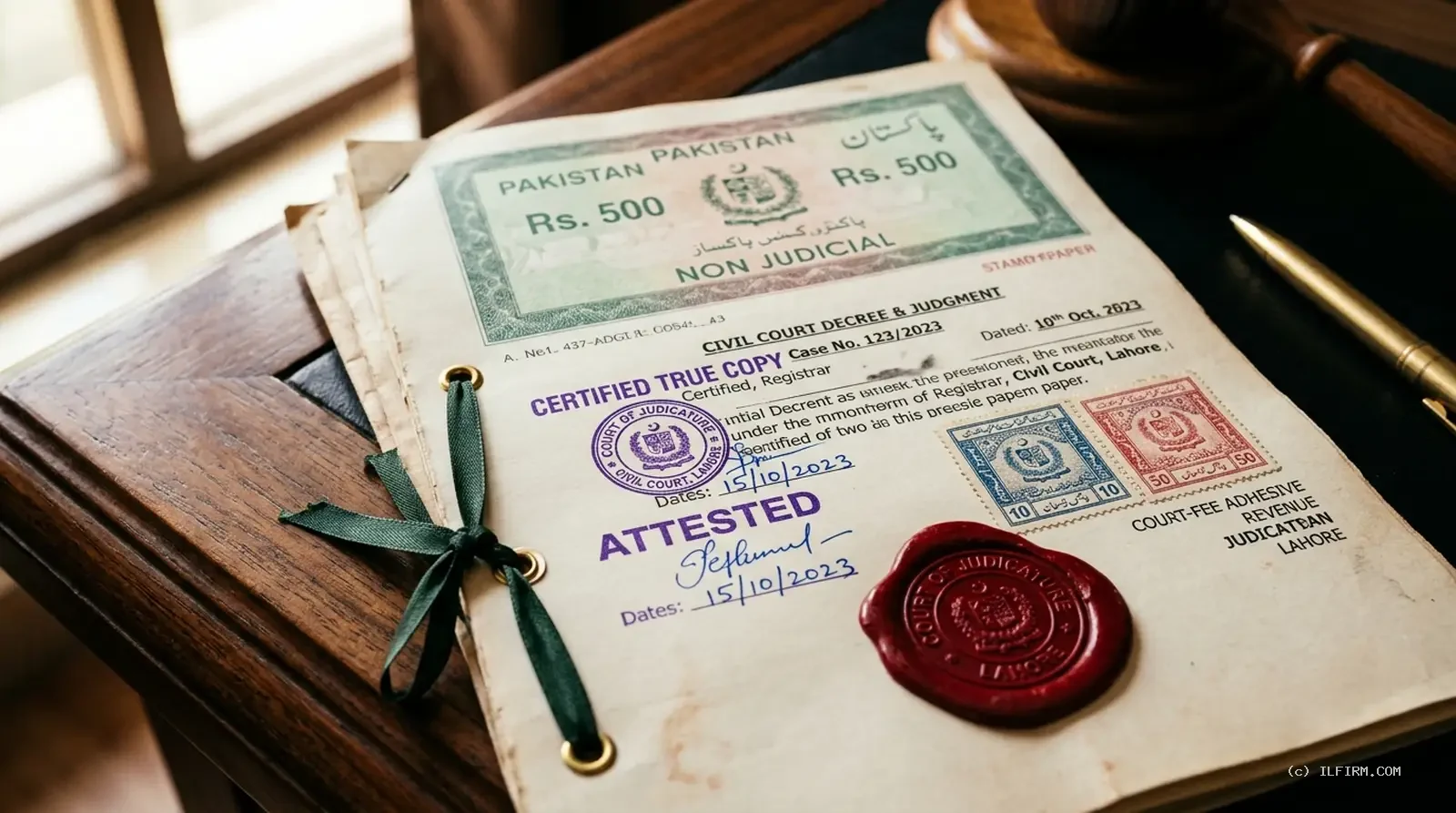
Certified copies of lower court judgments, orders, and judicial stamp papers necessary for instituting a Civil Revision petition before the High Court (مصدقہ نقول فیصلہ و ڈگری برائے دائرگی نگرانی دیوانی)
Evidence and Documents You Need to File a Civil Revision
A revision petition must be self-contained:
- Certified Copy of Impugned Order / Decree: Authenticated copy bearing official seals, stamps, and receipt dates.
- Certified Copies of Pleadings: Complete copies of the plaint, written statements, replications, and applications.
- Framed Issues and Order Sheets: Copies of issues framed under Order 14 CPC and order sheets (Zimniats).
- Exhibited Evidence: Copies of deeds, mutation extracts (Jamabandi), or instruments marked as exhibits.
- Memo of Grounds with Certificate: Structured grounds signed by counsel confirming no previous revision was filed.
- Vakalatnama or Special Power of Attorney: Stamped authorization or attested Special Power of Attorney (مختار نامہ خاص) if abroad.
Key Superior Court Judgments on Revisional Powers
1. Muhammad Sarwar v. Hashmal Khan (PLD 2022 Supreme Court 13)
Revisional jurisdiction under Section 115 CPC is supervisory, limited strictly to jurisdictional defects and material illegalities. The High Court cannot substitute its view on facts merely because another conclusion is possible.
2. Salamat Ali v. Muhammad Din (PLD 2022 Supreme Court 353)
A Revisional Court cannot overturn Concurrent Findings (ہم آہنگ عدالتی فیصلے) of fact recorded by lower courts unless findings suffer from gross misreading, non-reading, or perverse appraisal of evidence.
3. Trading Corporation of Pakistan v. Devan Sugar Mills Ltd. (PLD 2018 Supreme Court 828)
A civil revision is barred where a statutory appeal is provided, preserving the statutory hierarchy of remedies under the CPC.
4. Fazal Wahid v. Mst. Bakht Pari (PLD 2021 Peshawar 114 / 2021 CLC 1520 Dar-ul-Qaza Swat)
Civil revisions arising from Zilla Qazi decisions under the Sharia Nizam-e-Adl Regulation 2009 must strictly satisfy Section 115 CPC jurisdictional standards.
Practical Litigation Strategy and Common Mistakes
For the Revision Petitioner
- Show the lower court lacked jurisdiction, failed to exercise authority, or misread exhibits.
- File a stay petition under Order 39 Rules 1-2 with Section 151 CPC to halt execution.
- Avoid re-arguing witness credibility; ground challenges in documentary records and precedents.
For the Respondent
- Raise maintainability: if the order is appealable under Section 96 or 104 CPC, seek dismissal.
- Defend concurrent findings: cite precedents confirming factual findings cannot be disturbed.
- Scrutinize limitation: if filed past ninety days without sufficient cause, seek dismissal.
A frequent error is treating a revision as an appeal. An appeal re-evaluates evidence; a revision is strictly confined to correcting jurisdictional errors and illegalities. Arguing factual disputes without showing legal defects leads to summary dismissal.
In Swat & KPK: Dar-ul-Qaza Practice and Overseas Litigants
In Malakand Division and Swat valley, civil litigation operates under Sharia Nizam-e-Adl Regulation 2009. Suits are heard by Illaqa Qazis, appealed to Zilla Qazi (District Judge) Saidu Sharif, and revised before Peshawar High Court Mingora Bench / Dar-ul-Qaza Swat.
At Dar-ul-Qaza Swat, the registry strictly scrutinizes land records and certified copies. Petitioners must attach complete revenue extracts in partition and title disputes.
For overseas Pakistanis in the UAE, Saudi Arabia, the UK, or USA, managing litigation in Swat does not require travel:
- Special Power of Attorney: Execute a power of attorney at a Pakistani Embassy/Consulate or digitally via NADRA, attested by MOFA.
- Video-Link Hearings: Peshawar High Court and Dar-ul-Qaza Swat facilitate video-link appearances upon formal application.
- Protective Injunctions: Overseas owners challenging illegal sales or mutations can obtain stay orders to protect property.
Comparison Table: First Appeal vs. Civil Revision vs. Constitutional Writ Petition
| Legal Remedy (قانونی چارہ جوئی) | Judicial Forum (عدالتی فورم) | Statutory Grounds (بنیادی وجوہات) | Limitation Period (میعادِ سماعت) | Court Fee / Nature (عدالتی فیس و نوعیت) |
|---|---|---|---|---|
| Regular First Appeal (Section 96 CPC) | District Court or High Court | Re-hearing on facts and law against original decree | 30 days (District Court); 90 days (High Court) | Ad valorem or schedule fee; statutory right |
| Civil Revision (Section 115 CPC) | High Court / Dar-ul-Qaza (or District Court) | Jurisdictional error, failure of power, or illegality | 90 days (30 days for KPK Section 104 interlocutory orders) | Nominal court fee; discretionary remedy |
| Constitutional Writ (Article 199) | High Court (Constitutional Bench) | Violation of fundamental rights; unlawful state actions | No fixed limit; without unreasonable delay | Fixed fee; extraordinary remedy |
| CPLA Appeal (Article 185(3) Constitution) | Supreme Court of Pakistan | Substantial question of law of public importance | 30 days from final High Court judgment or order | Fixed Supreme Court fee; discretionary leave |
Review our related legal guides on instituting a suit for declaration of title and ownership in Pakistan, pursuing summary claims under an Order 37 CPC recovery suit, and executing decrees under execution of decree and Order 21 CPC objections. For supreme appellate recourse, consult our analysis on Supreme Court CPLA appeals under Article 185(3), as well as guidance on special versus general power of attorney for overseas Pakistanis.
Frequently Asked Questions (FAQ)
What is the limitation period for filing a Civil Revision under Section 115 CPC in Pakistan?
The limitation period for filing a civil revision before the High Court is ninety days from the impugned decree. In KPK, revisions against Section 104 interlocutory orders must be filed within thirty days. Time spent obtaining certified copies is excluded under Section 12 of the Limitation Act 1908.
What are the statutory grounds to file a Civil Revision under Section 115 CPC?
Section 115 CPC limits review to jurisdictional grounds: where the subordinate court exercised jurisdiction not vested by law, failed to exercise jurisdiction lawfully vested, or acted illegally or with material irregularity. It cannot be used for routine re-appraisal of facts.
Can the High Court overturn concurrent findings of fact in a Civil Revision?
As held by the Supreme Court in PLD 2022 SC 353, the High Court cannot disturb concurrent factual findings recorded by trial and appellate courts unless tainted by patent misreading or non-reading of evidence, or demonstrably perverse.
What is the key difference between a Civil Appeal and a Civil Revision?
An appeal is a substantive statutory right where the appellate court re-examines facts and law. A civil revision is a supervisory, discretionary remedy limited strictly to jurisdictional errors, illegalities, and procedural defects where no statutory appeal lies.
How does the KPK CPC Amendment affect civil revisions against interlocutory orders?
Under KPK civil procedure amendments, routine interlocutory revisions against interim procedural orders are curtailed. Revisions against appealable interlocutory orders under Section 104 carry a thirty-day limitation and require demonstrating an obvious misapprehension of law.
Schedule a Strategic Civil Revision Case Assessment
If a subordinate court has passed an unlawful order or decree affecting your ancestral land or assets, time is of the essence under limitation rules. Our senior advocates represent clients before the Peshawar High Court (Mingora Bench / Dar-ul-Qaza Swat) and District Courts across Khyber Pakhtunkhwa.
Disclaimer: The legal information provided in this article is published for educational purposes only and does not constitute formal legal advice. Judicial outcomes depend on the specific facts and records of each dispute. Reviewed by Senior Advocate, Peshawar High Court & Supreme Court of Pakistan, October 2026.