

Suit for Recovery under Order 37 CPC Pakistan (دعویٰ وصولی زر بربنائے آرڈر 37)
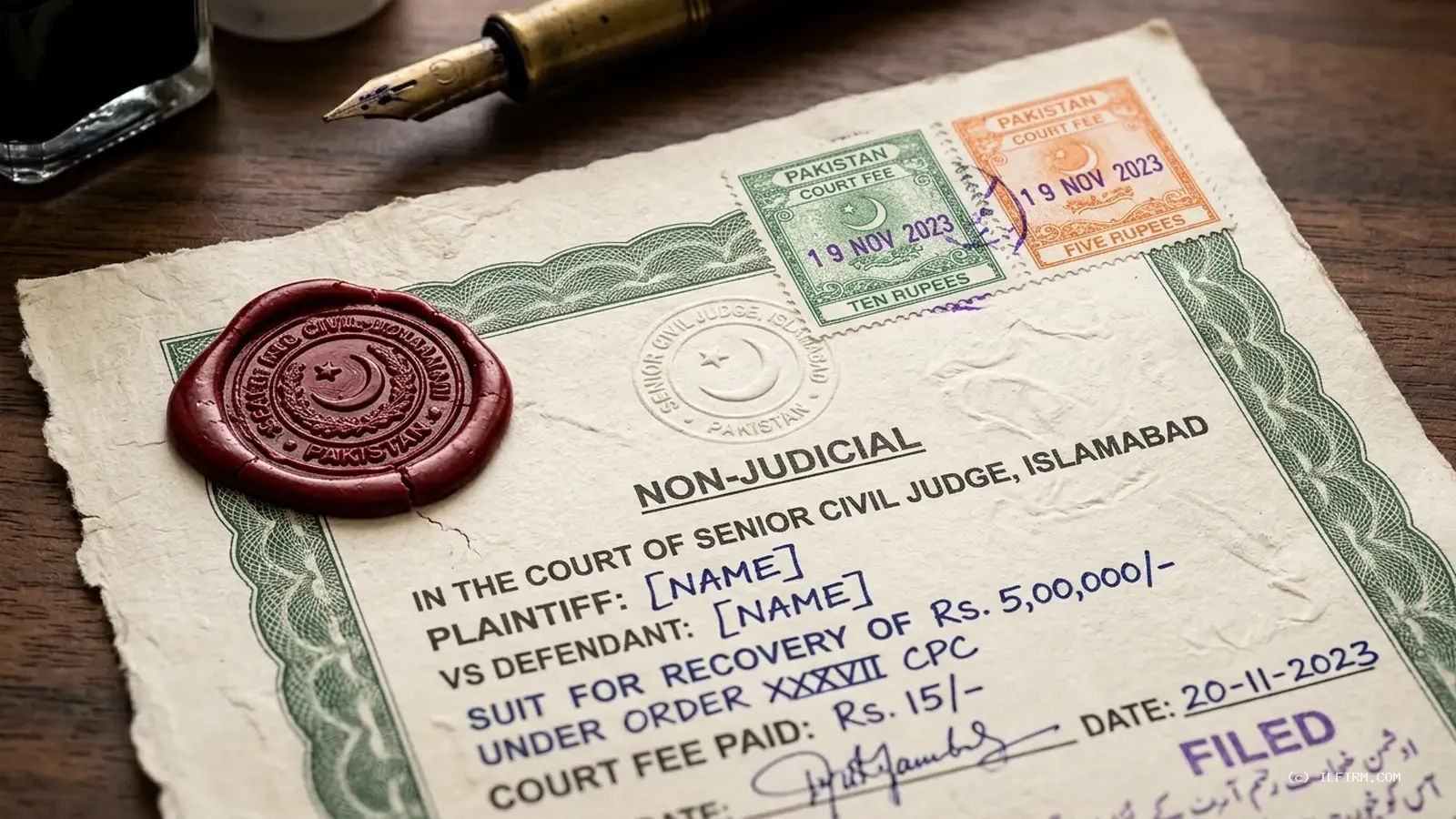
A suit for recovery under order 37 cpc pakistan is a summary civil action designed for the rapid recovery of financial debts arising from negotiable instruments, promissory notes, and dishonoured cheques. Governed by Order XXXVII of the Code of Civil Procedure 1908, it protects commercial lenders and creditors by preventing defaulting debtors from causing prolonged trial delays.
1. Quick Answer: What Is a Suit for Recovery under Order 37 CPC Pakistan?
A suit for recovery under order 37 cpc pakistan is a fast-track summary civil remedy filed before the Senior Civil Judge to recover debts based on cheques, promissory notes, or written contracts. The defendant has no automatic right to defend and must obtain court leave within ten days of summons, or an immediate money decree is passed.
2. What the Law Says: Statutory Framework & Legal Presumptions
The summary debt recovery framework in Pakistan is anchored in specific civil and commercial statutes:
- Code of Civil Procedure 1908 (Order XXXVII Rules 1–7): Under Rule 2, the creditor files a Summary Suit for Recovery of Money (دعویٰ وصولی زر بربنائے خلاصہ کارروائی) with original instruments. Under Rule 3, the debtor must apply for Leave to Appear and Defend (حکمِ پیشی و حصولِ اجازت برائے جوابدہی) within ten days. If leave is refused, plaint allegations are deemed admitted, resulting in an immediate decree. Under Rule 4, decrees are set aside only under strict special circumstances.
- Negotiable Instruments Act 1881: Sections 4, 5, and 6 define a Promissory Note (پرامیسری نوٹ / تمسک تحریری), bill of exchange, and Dishonoured Cheque (مسترد شدہ چیک). Section 118 presumes that every Negotiable Instrument (دستاویزِ قابلِ بیع و شریٰ) was executed for valid consideration, shifting the legal burden entirely onto the debtor.
- Limitation Act 1908: Article 64-A prescribes a 3-year limitation to institute an Order 37 suit. Article 159 imposes a strict 10-day limitation for the debtor to apply for leave to defend.
- Court Fees Act 1870: Ad valorem court fee is payable up to the statutory limit in Khyber Pakhtunkhwa [VERIFY: KPK position].
Civil recovery under Order 37 CPC and criminal prosecution under Section 489-F PPC for dishonoured cheques are independent, concurrent legal remedies that can be pursued simultaneously.
3. Step-by-Step Procedure to Institute and Win an Order 37 Recovery Suit
Instituting a summary recovery suit involves clear procedural steps:
- Step 1: Statutory Legal Demand Notice: The creditor’s advocate issues a formal demand notice giving the debtor seven to fourteen days to settle the debt.
- Step 2: Plaint Presentation: The plaint is filed under Order XXXVII Rule 2 CPC before the Senior Civil Judge, annexing original instruments and paying ad valorem court fees.
- Step 3: Special Form 4 Summons: The court issues Form 4 summons in Appendix B served via bailiff, registered post with A.D., and newspaper citation.
- Step 4: Leave to Defend Application: Within ten days of service, the debtor must file an affidavit disclosing substantial, bona fide triable issues.
- Step 5: Judicial Hearing on Leave: The court grants Unconditional Leave (غیر مشروط اجازت برائے پیروی مقدمہ) for solid defenses, or conditional leave requiring cash deposit or bank guarantee.
- Step 6: Decree & Execution: Upon refusal of leave or failure to deposit security, the court passes a final Money Decree (ڈگری وصولی زر), followed by execution of decree under Order 21 CPC for asset attachment.

Certified Pakistani judicial stamp paper and court fee revenue stamps required for instituting a summary suit under Order XXXVII CPC before the Senior Civil Judge (عدالتی اسٹامپ پیپر اور کورٹ فیس برائے دعویٰ وصولی زر آرڈر 37 ضابطہ دیوانی).
4. Essential Evidence & Documents You Need
Successful recovery requires presenting complete documentary evidence upon filing:
- Original promissory note (stamped and signed), cheque leaf, or written agreement.
- Bank return memo showing the exact reason for dishonour.
- Postal receipts and courier slips proving service of the legal demand notice.
- Bank account statements evidencing transfer of loan funds or commercial ledger.
- Authenticated Special Power of Attorney for overseas expatriates.
5. Landmark Superior Court Judgments & Precedents
Pakistani superior courts have established firm principles governing Order 37 summary debt recovery:
- Fine Textile Mills Ltd. v. Haji Umar (PLD 1969 SC 163): The Supreme Court held that where the defendant discloses a plausible, bona fide triable defense, leave to defend must not be arbitrarily refused.
- Haji Ali Khan & Co. v. Allied Bank of Pakistan (PLD 1995 SC 362): The Supreme Court affirmed that the 10-day limitation under Article 159 is mandatory; failure to apply for leave deems plaint averments admitted, mandating an immediate decree.
- Murtaza Haseeb Textile Mills v. Sitara Chemical Industries (2004 SCMR 882): The Supreme Court ruled that conditions attached to conditional leave (depositing cash or bank guarantee) are mandatory; non-compliance automatically forfeits defense rights.
- Peshawar High Court Precedents: The High Court held that general setting aside rules under Order IX Rule 13 do not apply to summary decrees; debtors must demonstrate “special circumstances” under Order XXXVII Rule 4 and Article 181 Limitation Act.
6. Practical Strategy & Common Pitfalls for Both Parties
Strategic foresight protects both parties in summary commercial litigation:
For Creditors
- Always file original instruments; copies invite debtor objections and delay.
- Exclude unliquidated damage claims to prevent conversion into an ordinary suit.
- Apply for conditional attachment of debtor assets under Order 38 Rule 5 CPC.
For Debtors
- Calculate ten calendar days immediately upon receiving summons or citation.
- Avoid vague denials; plead specific fraud, forgery, or receipts of partial payment.
- Deposit security promptly if conditional leave is granted to preserve defense rights.
7. Forum in Swat & KPK: Practical Procedures & Overseas Expatriate Claims
In Swat and Malakand Division, summary suits are instituted before the Court of the Senior Civil Judge (Civil Division) at the District Courts Complex in Gulkada, Saidu Sharif. High-value claims exceeding pecuniary limits are heard by the District Judge Swat. Appeals and civil revisions lie before the Peshawar High Court (Mingora Bench / Dar-ul-Qaza Swat). Interlocutory orders conditioning leave are challenged through civil revisions under Section 115 CPC.
Overseas Pakistanis (UAE, Saudi Arabia, UK, USA): Expatriates who lent money or sent remittances for investments can litigate without traveling to Pakistan. By executing a Special Power of Attorney through the NADRA Digital Power of Attorney portal or the Pakistan Embassy, authorized counsel in Swat can file the suit, present bank records, and secure decree enforcement. Overseas testimony can be recorded via authenticated video link under High Court guidelines.
8. Comparison: Order 37 Summary Suit vs. Alternative Legal Remedies
The table below compares Order 37 with ordinary civil and criminal remedies in Pakistan:
| Legal Remedy (قانونی چارہ جوئی) | Forum & Jurisdiction (عدالتی دائرہ اختیار) | Limitation Period (میعادِ سماعت) | Court Fee (عدالتی فیس) | Typical Timeline (متوقع دورانیہ) |
|---|---|---|---|---|
| Order 37 CPC Summary Suit | Senior Civil Judge / District Court | 3 Years (Article 64-A Limitation Act) | Ad valorem (KPK Schedule) [VERIFY: KPK position] | 3 to 9 Months (Fast-Track) |
| Ordinary Civil Suit (Section 9 CPC) | Civil Judge 1st / 2nd Class | 3 Years from default date | Ad valorem court fees | 3 to 5 Years (Regular Trial) |
| Section 489-F PPC Criminal FIR | Judicial Magistrate | Prompt filing upon dishonour | Nil (State Criminal Prosecution) | 6 to 18 Months (Penal Remedy) |
| Execution Petition (Order 21 CPC) | Executing Civil Court | 3 Years from final decree | Nominal process fee | 3 to 12 Months (Asset Attachment) |
9. Frequently Asked Questions (FAQ)
What is a summary suit under Order 37 CPC in Pakistan?
A summary suit under Order 37 CPC is an expedited civil procedure to recover money on negotiable instruments like cheques and promissory notes. Unlike regular civil trials, the defendant cannot defend automatically and must obtain leave from the court within ten days, eliminating frivolous delays.
What is the time limit (limitation period) to file an Order 37 recovery suit?
Under Article 64-A of the Limitation Act 1908, an Order 37 summary suit must be filed within three years from the date the debt became due or the cheque was dishonoured. Filing beyond three years renders the claim time-barred and liable to dismissal.
How many days does a defendant have to apply for leave to defend under Order 37 Rule 3?
Under Article 159 of the Limitation Act 1908, the defendant has strictly ten days from receiving special Form 4 summons to file an application for leave to defend. Failure to apply within ten days entitles the plaintiff to an immediate money decree.
What happens if the court refuses leave to defend in an Order 37 CPC suit?
If the court refuses leave to defend or if the debtor fails to deposit conditional security, all allegations in the plaint are deemed legally admitted. The judge immediately passes a final money decree for the principal amount, markup, and costs without recording further evidence.
Can a summary suit under Order 37 be filed simultaneously with a 489-F PPC cheque bounce FIR?
Yes, civil recovery under Order 37 CPC and criminal prosecution under Section 489-F PPC can proceed simultaneously. Superior courts hold that Section 489-F punishes dishonest intention while Order 37 recovers the financial sum. Neither action bars or delays the other.
Consult an Experienced Civil Recovery Advocate in Swat & KPK
If you are seeking to recover unpaid commercial debts, business loans, or dishonoured cheques in Swat, Malakand, or Khyber Pakhtunkhwa, our civil litigation team provides seasoned representation before the Senior Civil Judge and Peshawar High Court. We also represent overseas Pakistanis litigating remotely from the UAE, UK, and Saudi Arabia.
Disclaimer: This legal guide is for general informational purposes only and does not constitute formal legal counsel. Debt recovery litigation depends on individual documentation and court discretion. Official laws can be accessed at Pakistan Code and High Court rules at the Peshawar High Court. Reviewed by Senior Advocate, Peshawar High Court & Supreme Court of Pakistan, October 2026.