

Succession Certificate & Letters of Administration Pakistan (جانشینی سرٹیفکیٹ)
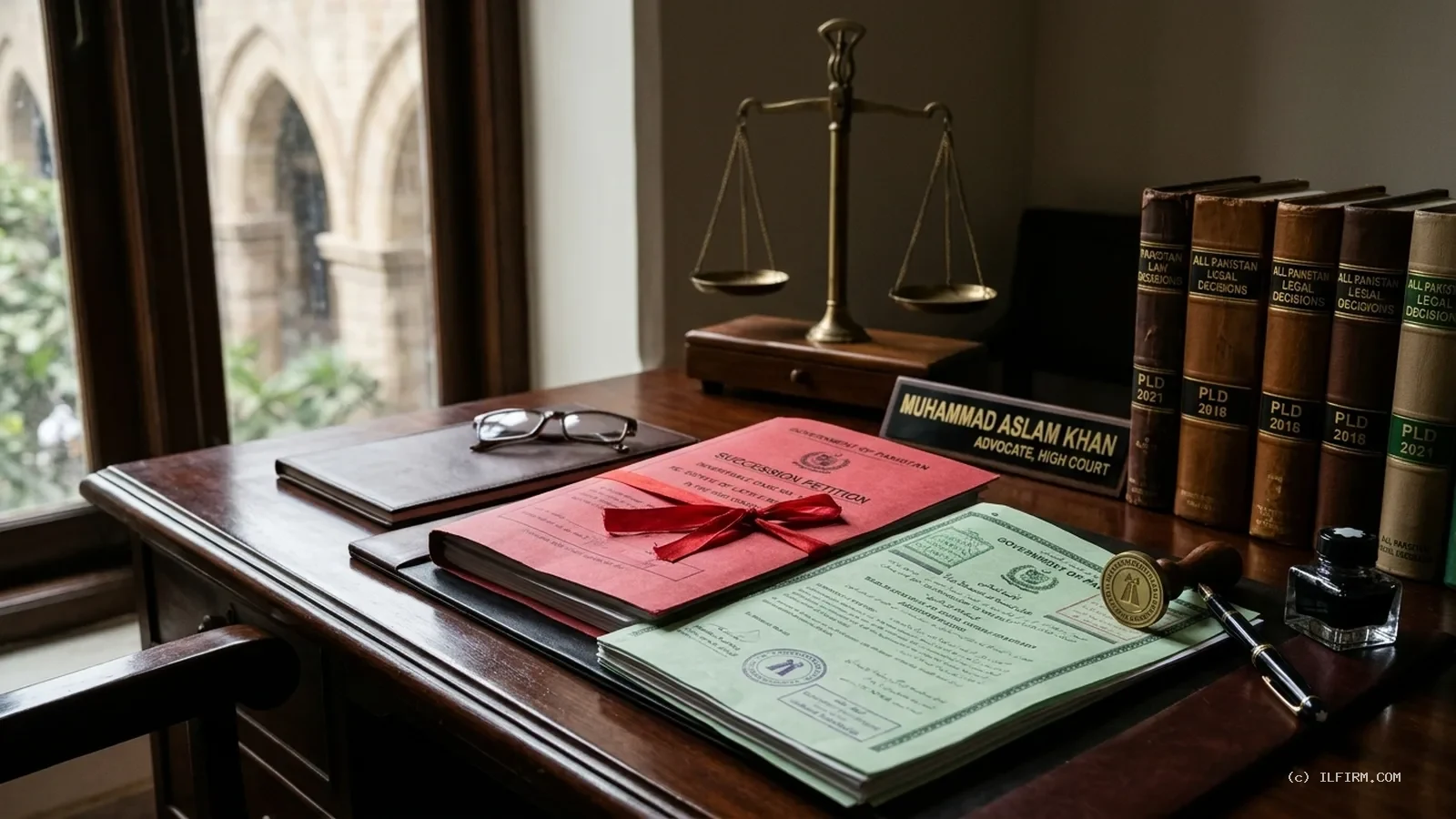
1. Quick Answer: Succession Certificate and Letter of Administration in Pakistan
To unfreeze estate assets in Pakistan, heirs follow the succession certificate letter of administration succession act nadra procedure pakistan. Uncontested claims are finalized via NADRA in 15 to 20 days. Where disputes or minors exist, heirs must petition the Senior Civil Judge under the Succession Act 1925.
2. What the Law Says: Statutory Framework under Succession Act 1925 & KP Act 2021
Estate devolution in Pakistan is strictly codified. Financial institutions and land registries cannot disburse funds without lawful authority under three primary statutes:
- Succession Certificate (دستاویزِ جانشینی) — Section 370 to 390, Succession Act 1925: Issued exclusively for Movable Assets (منقولہ جائیداد و اثاثہ جات), including bank balances, shares, prize bonds, and securities.
- Letters of Administration (اختیارات نامہ انتظام ترکہ / خطِ انتظام) — Section 218 & 278, Succession Act 1925: Empowers an administrator to manage an intestate estate, including Immovable Property (غیر منقولہ جائیداد) like residential and agricultural land.
- Summary Proceedings (سر سری سماعت و کارروائی) — Section 373, Succession Act 1925: Inquiries are summary in nature. Under Section 387, summary grants do not bar a regular civil suit for declaration of title and ownership.
- Surety Bond (ضمانت نامہ برائے ترکہ) — Section 375, Succession Act 1925: Mandates solvent sureties to guarantee the shares of absent or minor heirs.
- Revocation of Certificate (منسوخیِ سرٹیفکیٹ جانشینی) — Section 383, Succession Act 1925: Grants obtained by concealing heirs or through fraud are subject to immediate judicial cancellation.
- KP Letters of Administration and Succession Certificates Act 2021 (KP Act No. X of 2021): Empowers NADRA to issue certificates for undisputed estates in 15 days. Under Section 7, whenever an objection arises, NADRA issues a Decline Certificate, remitting parties to court.
- Court Fees Act 1870: Petitions require ad valorem court fees on declared assets. [VERIFY: KPK schedule of ad valorem court fees for high-value estates].
3. Step-by-Step Procedure: NADRA Facilitation vs Civil Court Petition
Heirs choose between administrative NADRA facilitation and judicial court petitions based on family consensus.
The Administrative NADRA Route (Uncontested Estates — 15 to 20 Days)
- Vital Records: Secure a Union Council Death Certificate, cancel the deceased’s CNIC, and obtain an updated Family Registration Certificate (FRC).
- SFU Application: A representative heir visits NADRA with authorization affidavits and asset details.
- Public Notice: NADRA publishes a 14-day notice in newspapers and on its digital tracking portal.
- Biometric Verification: All surviving Legal Heirs (شرعی و قانونی ورثاء) record live biometrics at NADRA or Pakistani consulates abroad.
- Certificate Delivery: Upon biometric clearance and expiry of the 14-day notice, NADRA issues the digital certificate.
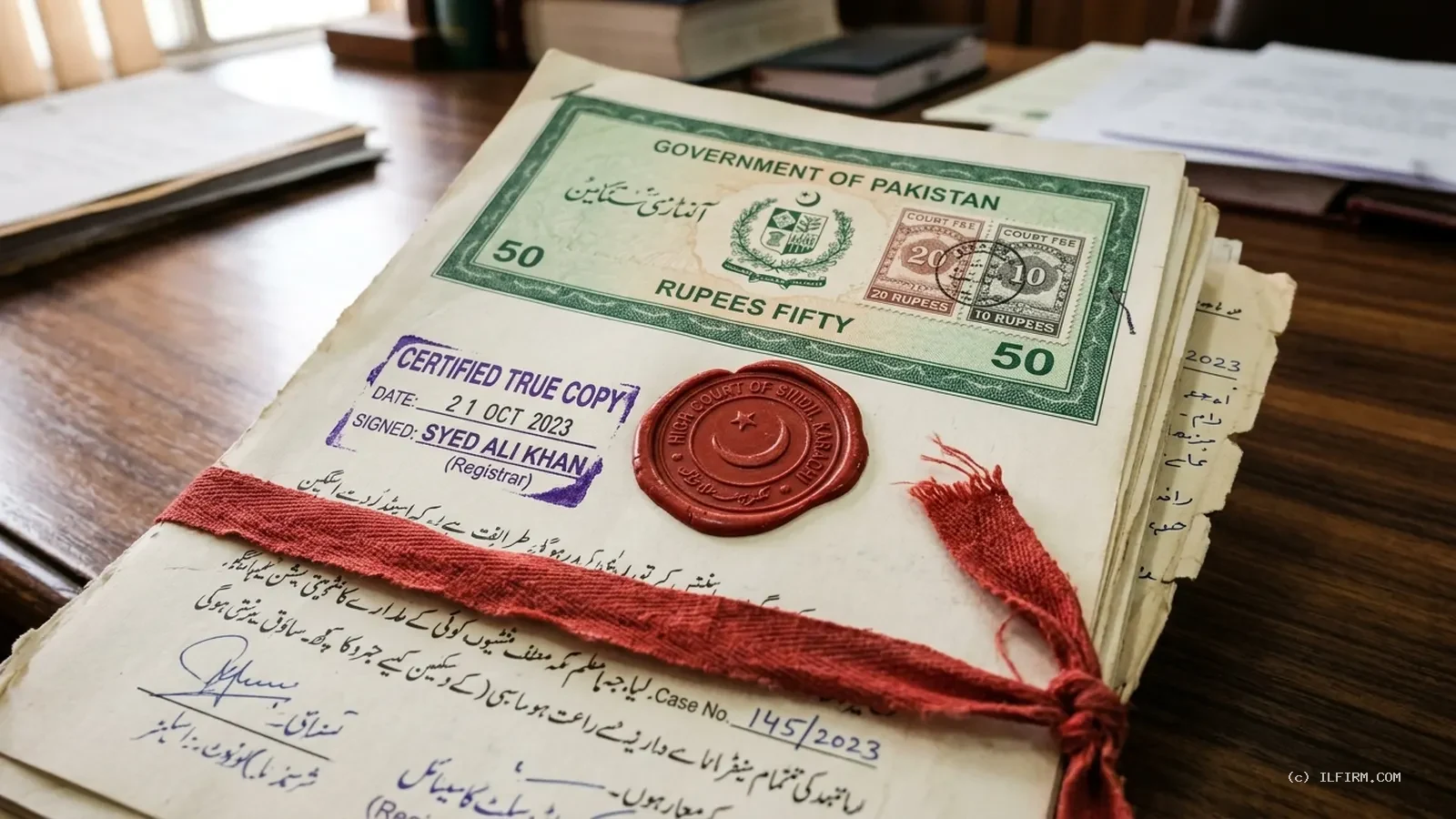
Judicial petition docket and stamped revenue paper for succession proceedings in Pakistan (عدالتی درخواست اور اسٹامپ پیپر برائے جانشینی)
The Civil Court Judicial Route (Contested Matters & Section 7 Declines — 3 to 6 Months)
When NADRA issues a Decline Certificate due to an objection or minor heir, the matter proceeds before the Senior Civil Judge:
- Petition under Section 372: Counsel files a petition containing the pedigree tree and schedule of assets.
- Court Citation: The court publishes public notices in regional newspapers and summons respondents.
- Summary Testimony: The petitioner and two independent witnesses depose on oath to verify family heirship.
- Surety Bonds (Section 375): The court grants the petition, subject to filing a solvent local surety bond.
- Final Decree: Upon accepting sureties and judicial stamp paper, the court delivers the certified certificate.
4. Essential Evidence and Documents Checklist
Applicants before NADRA or the Senior Civil Judge must submit verified documents:
- Vital Records: Union Council Death Certificate, NADRA CNIC Cancellation Slip, and Family Registration Certificate (FRC).
- Identity Proofs: Certified copies of CNICs or NICOPs for all surviving heirs.
- Financial Proofs: Bank balance certificates, National Savings statements, or share certificates.
- Property Proofs: Jamabandi (Fard Malkiat), registered sale deeds (Bainama), or housing transfer letters.
- NOCs & Powers of Attorney: Attested No Objection Certificates or consulate-attested Special Power of Attorney for expatriates.
- Section 7 Decline Certificate: Original Section 7 Decline Certificate if transitioning to court.
5. Landmark Superior Court Judgments on Succession and Estate Rights
Superior courts have established binding principles governing estate devolution:
Bank Nominee Acts Only as a Trustee — Supreme Court of Pakistan
Amt-ul-Habib v. Musarrat Parveen (PLD 1974 SC 185): The Supreme Court held that a bank nominee is merely a collection trustee, not beneficial owner. Proceeds remain part of the estate divisible per Shariah.
Summary Nature of Section 373 Inquiry — Supreme Court of Pakistan
Mst. Sughran Bibi v. Mst. Hajiran Bibi (PLD 1991 SC 731): Section 373 inquiries are summary, deciding prima facie entitlement without barring regular title suits under Section 387.
Constitutional Validity of KP Act 2021 — Peshawar High Court
Peshawar Bar Association v. Government of KP (Peshawar High Court): The High Court upheld the provincial law empowering NADRA for undisputed cases, preserving court jurisdiction for contested claims.
Revocation for Concealing Female Heirs — Superior Courts
Muhammad Umar v. Mst. Shireen (2011 SCMR 1222) & [VERIFY: citation on Section 383 revocation for fraudulent exclusion of female heirs before Peshawar High Court Mingora Bench Dar-ul-Qaza]: Concealing female co-heirs renders a grant void under Section 383, triggering cancellation and criminal charges under Sections 420 and 468 PPC.
6. Practical Strategy and Common Mistakes: Advice for Claimants and Objectors
Estate disputes frequently escalate from avoidable errors. Senior advocates highlight strategic guidance:
For Applicant Legal Heirs
- Disclose All Heirs Transparently: Omitting female or overseas siblings invites Section 383 revocation and criminal charges.
- Distinguish Succession from Land Partition: A succession certificate unfreezes bank funds but does not partition land. For physical division, co-sharers must file a suit for partition of joint immovable property before court.
- Arrange Solvent Sureties Promptly: Courts withhold certificate delivery until solvent sureties execute bonds under Section 375.
For Objecting or Excluded Heirs
- Lodge Timely NADRA Objections: Written objections during the 14-day notice halt NADRA processing and compel a Decline Certificate.
- Petition under Section 383: Apply for revocation under Section 383 and seek an immediate injunction freezing bank payouts.
- Assert Unpaid Dower Claims: A widow’s unpaid dower constitutes a priority debt against the estate before general inheritance distribution under recovery of dower and maintenance under family law.
7. In Swat & Khyber Pakhtunkhwa: Local Court Jurisdiction and Overseas Heirs
In Swat, succession petitions are instituted before the Senior Civil Judge at Gulkada, Saidu Sharif, Swat. Appeals from civil court orders under Section 384 lie before the District Judge Swat, with revisional remedies adjudicated before the Peshawar High Court (Mingora Bench / Dar-ul-Qaza Swat).
For expatriates living in the UAE, Saudi Arabia, the UK, or the USA, physical travel to Pakistan is not required. Overseas heirs can complete NADRA biometrics at Pakistani consulates abroad or issue a consular-attested Power of Attorney. Our chambers provide representation for consular attestation of Special Power of Attorney and handle succession certificates and inheritance distribution for overseas heirs.
8. Comparison Table: Succession Certificate vs Letter of Administration
| Legal Remedy / داد رسی | Competent Forum / مجاز فورم | Limitation / میعادِ سماعت | Official Fee / فیس | Timeline / مدت |
|---|---|---|---|---|
| Succession Certificate (Movable Assets) | NADRA SFU (uncontested) | No limitation | Rs. 10k (<100k) / Rs. 20k (>100k) | 15 to 20 Days |
| Succession Certificate (Contested / Decline) | Senior Civil Judge Swat | No limitation | Court Fees Act 1870 ad valorem [VERIFY] | 3 to 6 Months |
| Letters of Administration (Immovable Estate) | NADRA or Senior Civil Judge | No limitation | Fixed fee or assessed court fees | 15 Days / 4 to 8 Months |
| Revocation of Certificate (Section 383) | Senior Civil Judge | Promptly upon discovery | Nominal petition court fees | 2 to 5 Months |
| High Court Revisional Appeal | PHC (Dar-ul-Qaza Swat) | 90 days per rules | Prescribed High Court fee stamps | 4 to 10 Months |
9. Frequently Asked Questions (FAQs)
Q1: What is the difference between a Succession Certificate and a Letter of Administration in Pakistan?
A succession certificate is granted exclusively for movable assets like bank accounts, company shares, and securities under Section 370 of the Succession Act 1925. In contrast, letters of administration are granted under Section 278 to manage the general estate, including immovable landed properties left by an intestate deceased.
Q2: How long does NADRA take to issue a succession certificate, and what are the official fees?
When legal heirs consent unanimously and complete biometrics without objection, NADRA issues certificates within 15 to 20 working days following the mandatory 14-day newspaper notice. The official statutory fee is Rs. 10,000 for assets valued below Rs. 100,000, and Rs. 20,000 for estates exceeding Rs. 100,000.
Q3: When is it mandatory to approach the Civil Court instead of NADRA for a succession certificate?
Heirs must petition the Senior Civil Judge when NADRA issues a Decline Certificate under Section 7 of the KP Act 2021. This occurs when an heir raises an objection, minor heirs lack legal guardians, inheritance shares are disputed, or an heir is untraceable or refuses biometric verification.
Q4: Can a bank account nominee withdraw the deceased’s funds without a succession certificate?
Under settled Supreme Court jurisprudence in Amt-ul-Habib v. Musarrat Parveen, a nominee is merely an administrative trustee to collect funds on behalf of the estate. Banks routinely require a succession certificate, and nominees who convert funds to personal use face civil recovery and criminal prosecution.
Q5: How can overseas Pakistanis in the UK, UAE, or USA complete biometric verification for inheritance?
Overseas Pakistanis can visit any designated Pakistani Embassy or Consulate General abroad to record live biometrics linked to NADRA’s database. Alternatively, for judicial proceedings, expatriates can execute a Special Power of Attorney attested by the consulate and the Ministry of Foreign Affairs (MOFA) in Pakistan.
10. Consultation: Resolve Succession and Estate Matters with International Law Firm
Protecting Generational Family Inheritance and Unfreezing Estates
Unfreezing bank accounts and securing Letters of Administration require command of procedural civil law. International Law Firm (ILF) provides representation before the Senior Civil Courts in Swat and the Peshawar High Court (Dar-ul-Qaza Mingora Bench).
- Civil Court Succession Petitions: Civil & Property Dispute Practice
- Overseas Consular Representation: Overseas Legal Aid Practice
- Statutory Enactments: The Succession Act 1925 on Pakistan Code
- Superior Court Rulings: Peshawar High Court Judgments Portal
Disclaimer: This legal guide is provided for educational and informational purposes only and does not constitute formal legal counsel for any specific estate controversy. Inheritance statutes and court fee calculations depend on the factual circumstances of each case. Reviewed by Advocate Naseer Ullah Khan, Senior Advocate High Court, October 2026.