

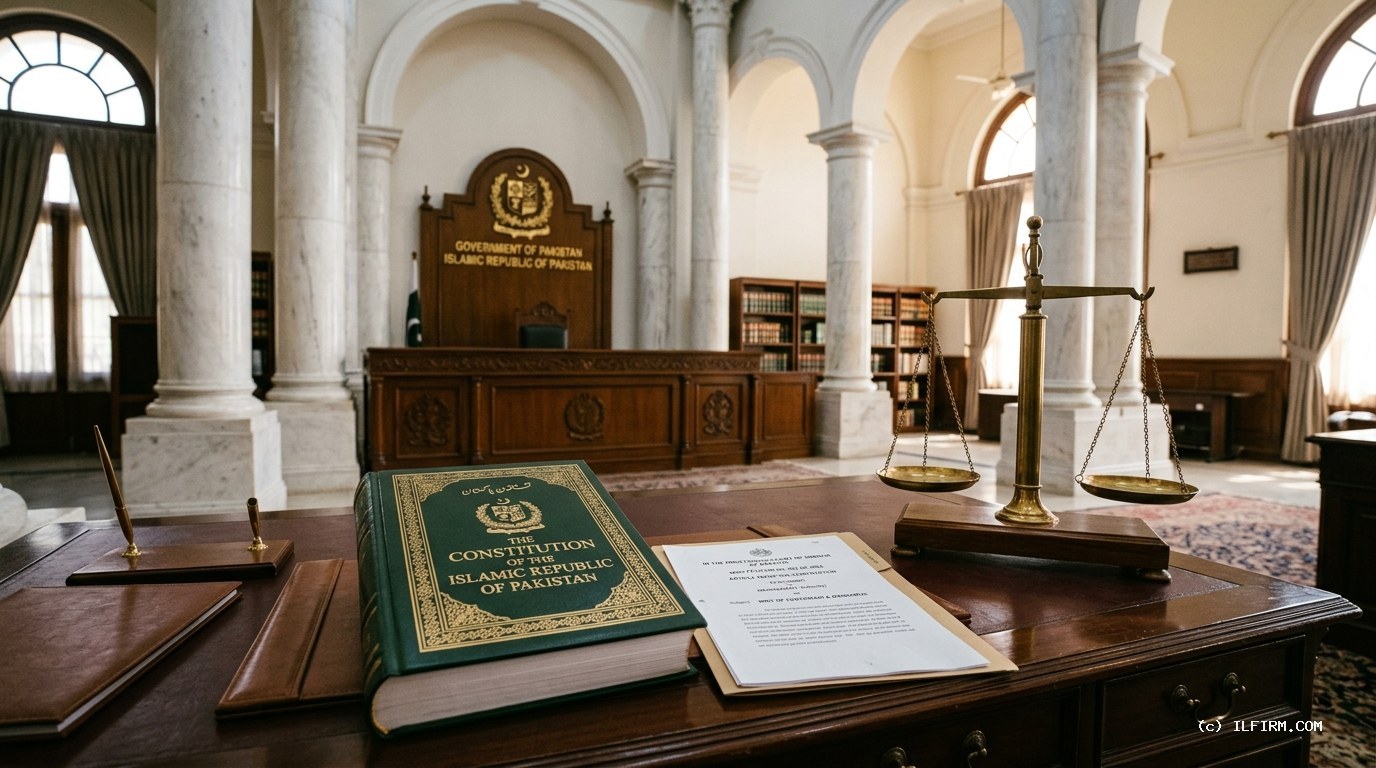
Supreme Court of Pakistan Appeals & CPLA
Apex court representation before the Supreme Court of Pakistan in Islamabad & Peshawar Branch Registry. Civil Petitions for Leave to Appeal (CPLA), Criminal Petitions, Article 185 appeals, and Review Petitions.
Comprehensive Legal Representation & Strategy
Apex Court Advocacy before the Supreme Court of Pakistan
The Supreme Court of Pakistan is the supreme judicial authority of the federation, possessing final constitutional, appellate, and advisory jurisdiction under Articles 184, 185, 186, and 188 of the Constitution of 1973. An appeal or petition before the Supreme Court represents the final opportunity to rectify adverse High Court judgments, correct erroneous statutory interpretations, and establish binding judicial precedent that governs all subordinate courts and tribunals across Pakistan.
Advocacy before the Supreme Court requires an exceptional standard of legal scholarship, mastery of constitutional doctrine, and surgical precision in identifying substantial questions of law of public importance. At International Law Firm, our senior legal practitioners include licensed Advocates Supreme Court (ASC) and experienced Advocates-on-Record (AOR) who represent corporate entities, private landowners, public servants, and overseas expatriates before both the Principal Seat in Islamabad and the Peshawar Branch Registry.
Understanding Petitions for Leave to Appeal (Article 185(3))
Unlike ordinary civil appeals where an appeal lies as a matter of statutory right, appeals to the Supreme Court from High Court judgments are primarily governed by Article 185(3) of the Constitution. An aggrieved litigant must first petition the court for Leave to Appeal. The Supreme Court exercises discretionary jurisdiction to determine whether the impugned High Court judgment suffers from:
- Gross misreading or non-reading of material evidence on record.
- Direct conflict with existing binding judgments of the Supreme Court under Article 189.
- Flawed interpretation of federal or provincial statutory enactments.
- Apparent failure of justice resulting in substantial legal grievance.
Once our advocates establish that the case raises a substantial point of law, the court issues a Grant of Leave Order, converting the petition into a Regular Civil or Criminal Appeal and granting interim suspension of the High Court decree.
Civil Petitions for Leave to Appeal (CPLA) & Urgent Stays
Under the Supreme Court Rules, 1980, a CPLA must be filed within a strict statutory limitation period of sixty (60) days from the date of the High Court judgment or decree. In urgent commercial matters, land auction disputes, and property evictions, filing an accompanying application for Civil Miscellaneous Relief (Stay of Execution) is vital to ensure that properties are not alienated, demolished, or transferred during the pendency of the appeal.
Criminal Petitions for Leave to Appeal (Cr.PLA) & Capital Defense
In criminal matters, particularly convictions under Section 302 PPC (Murder) where the High Court has confirmed a death sentence or life imprisonment, our appellate team moves Criminal Petitions for Leave to Appeal within the thirty (30) day limitation period. We scrutinize ballistics evidence, medical contradictions, interested witness reliability, and procedural breaches under the Qanun-e-Shahadat Order 1984 to secure sentence suspensions, commutations, and acquittals.
Apex Court & Appellate Divisions
Explore our appellate services connecting Dar-ul-Qaza High Court Bench to the Supreme Court of Pakistan:
Review Petitions under Article 188 of the Constitution
When an error apparent on the face of the record exists in a final Supreme Court determination, our team prepares Constitutional Review Petitions under Article 188 of the Constitution. Adhering to the rigorous requirements of Order XXVI of the Supreme Court Rules, we formulate substantial grounds highlighting judicial oversights, jurisdictional deficiencies, or new material evidence.
Key Representation Scopes & Deliverables
Request Case Assessment
Direct matter evaluation by High Court Advocates within 24 hours.
Frequently Asked Legal Questions
Essential information regarding court timelines, documentation, and client representation.
What is the limitation period for filing an appeal before the Supreme Court?
Under the Supreme Court Rules 1980, a CPLA against a civil judgment must be filed within 60 days, and in criminal convictions within 30 days from the date of the High Court decision.
What is the role of an Advocate-on-Record (AOR) in the Supreme Court?
An AOR is a specialized Supreme Court officer who is statutorily authorized to file petitions, draw pleadings, and formally instruct the Senior Advocate Supreme Court (ASC) during hearings.
Does filing a CPLA automatically stay the High Court judgment?
No. Filing a petition does not operate as an automatic stay. An explicit application for interim relief must be argued before the Supreme Court bench.
Can an overseas Pakistani pursue a Supreme Court appeal remotely?
Yes. By executing a verified digital Power of Attorney, our Advocates-on-Record and Advocates Supreme Court represent overseas clients without their physical presence in Islamabad.