

Partition of Joint Property & Agricultural Land in Pakistan: Complete Legal Guide to Suits for Partition (دعویٰ تقسیم اراضی), Revenue vs. Civil Jurisdiction, Mode of Partition, and Co-Sharer Rights

1. Executive Summary & The Anatomy of Joint Property Disputes in Pakistan
In the legal landscape of Pakistan, land ownership constitutes not only the primary repository of family wealth and agricultural livelihood, but also the most frequent catalyst for acrimonious, protracted superior court litigation. Under Islamic laws of inheritance applied across Pakistan through the West Pakistan Muslim Personal Law (Shariat) Application Act, 1962, the demise of a landowner results in the immediate and automatic devolution of title upon all legal heirs—sons, daughters, widows, and parents—as tenants-in-common. Consequently, millions of acres of fertile agricultural land, prime commercial properties, and residential estates across Khyber Pakhtunkhwa (including Swat, Malakand, Peshawar, Mardan, and Abbottabad), Punjab, Sindh, and Islamabad are held under joint khatas (شراکتی کھاتہ جات).
In a joint khata, every co-owner (شریک کھاتہ دار) holds an undivided fractional interest in the entire estate. Until that joint estate is lawfully and physically demarcated through a final decree of partition or a lawful revenue instrument, no single co-sharer possesses an exclusive claim to any specific parcel, khasra number, or prime roadside boundary. However, in day-to-day reality, dominant family members, influential local co-owners, or fraudulent land grabbers frequently attempt to usurp possession of the best portions, alter the agricultural nature of the property, construct commercial structures, or sell specific high-value parcels to third parties to the grave detriment of weaker co-heirs and Overseas Pakistanis.
When mutual negotiation breaks down, the sole authoritative remedy under Pakistani law is the institution of a Suit for Partition (دعویٰ تقسیم اراضی). Far from being a routine procedural filing, a partition action represents a high-stakes litigation campaign governed by an intricate intersection of procedural codes, revenue enactments, and substantive property statutes. Initiating the action before the incorrect judicial forum—confusing the jurisdiction of the Civil Court with that of the Revenue Court—is one of the most fatal errors in Pakistani property litigation, frequently leading to years of wasted litigation and ultimate dismissal on jurisdictional grounds.
This authoritative practice guide provides superior court litigants, in-house legal counsel, and overseas Pakistanis with a comprehensive operational roadmap of the statutory architecture, landmark Supreme Court of Pakistan and Peshawar High Court precedents, jurisdictional demarcations, emergency injunctive advocacy (stay orders), procedural milestones from preliminary decree to court bailiff possession, and court fee calculations governing suits for partition in Pakistan.
Foundational Jurisprudential Principle: The Joint Khata Doctrine
Every Co-Sharer Owns Every Inch Until Partition
Under settled Pakistani superior court jurisprudence reaffirmed in multiple landmark Supreme Court judgments, every co-owner in an undivided property is deemed to be an owner of each and every inch, square foot, and particle of the joint estate in proportion to their legal share. Exclusive possession of a specific parcel by one co-sharer does not equate to exclusive title, nor does it extinguish the co-ownership rights of other co-sharers. A co-sharer in exclusive possession is considered in the eyes of the law to hold that possession on behalf of all co-owners as a constructive trustee until formal partition by metes and bounds.
2. Statutory Architecture Governing Land Partition in Pakistan
A successful legal partition requires mastery over five distinct legislative frameworks, each regulating different aspects of title, valuation, forum jurisdiction, and physical demarcation:
A. The Partition Act, 1893 (Act IV of 1893)
The Partition Act, 1893 applies primarily to civil court partition proceedings involving immovable properties—particularly urban homes, commercial plazas, industrial sites, or small parcels—that cannot be conveniently partitioned into separate physical units without destroying their intrinsic utility and market value:
- Section 2 (Power to Court to Order Sale Instead of Division): Where a division of the property cannot reasonably or conveniently be made by metes and bounds, and the court is satisfied that a sale and distribution of proceeds would be more beneficial for all co-owners, the court may, upon the application of co-owners holding at least a one-half (50%) share in the estate, direct the public sale of the property.
- Section 3 (Procedure When Co-Sharer Undertakes to Buy): When an application for sale is submitted under Section 2, any other co-sharer possesses the statutory preemptive right to apply to purchase the shares of the parties seeking sale at a valuation determined by the court. This statutory mechanism protects ancestral family heritage from falling into the hands of outside commercial speculators.
- Section 4 (Partition Suit by Transferee of Share in Dwelling-House): Where a stranger to the family acquires an undivided fractional share in an undivided family dwelling-house and sues for partition, any member of the family who is a co-sharer may undertake to buy the share of such outside transferee, preventing the intrusion of strangers into private domestic residences.
- Section 7 & 8 (Court Auction Procedures & Deemed Decrees): Regulates the procedural conduct of court sales and explicitly establishes that an order for sale under Section 2 or 3 operates as a formal appealable decree within the meaning of Section 2 of the Code of Civil Procedure, 1908.
B. The Code of Civil Procedure, 1908 (Act V of 1908)
The Code of Civil Procedure, 1908 governs the procedural lifecycle of all partition suits instituted in the civil courts:
- Section 54 (Partition of Estate or Separation of Share): Mandates that where a civil court decrees the partition of an undivided estate assessed to the payment of revenue to the government, the physical separation or partition of shares shall be executed by the Collector or a gazetted subordinate deputed by him in accordance with revenue enactments.
- Order XX Rule 18 (Decree in Suit for Partition of Property): Governs the two-stage adjudication of partition suits. Under Rule 18(1), for revenue-paying estates, the court declares the rights of the parties and refers the ministerial partition to the Collector. Under Rule 18(2), for all other immovable properties (urban, residential, or commercial), the court passes a Preliminary Decree (ابتدائی ڈگری) declaring the respective proprietary shares, followed by proceedings to demarcate physical shares through a court commissioner leading to a Final Decree (حتمی ڈگری).
- Order XXVI Rules 13 & 14 (Commissions to Make Partition): Empowers the court to appoint a Local Commissioner (مقامی کمشنر)—frequently a senior civil advocate, retired revenue tehsildar, or certified surveyor—to inspect the site, survey the land, prepare proposed lots (قرعہ اندازی / parcels), hear objections of the parties, and submit an authoritative report with layout maps (نقصہ جات).
- Order XXXIX Rules 1 & 2 (Temporary Injunctions / Emergency Stay Orders): The critical shield during partition litigation. Empowers the court to issue restraining orders prohibiting co-sharers from altering the physical nature of the land, raising unauthorized masonry constructions, cutting commercial timber/orchards, or transferring undivided shares to third-party purchasers pending final decree.
C. The Khyber Pakhtunkhwa Land Revenue Act, 1967 (Act XVII of 1967)
In Khyber Pakhtunkhwa and Punjab, the Land Revenue Act, 1967 provides the exclusive statutory mechanism for the partition of purely agricultural land where title is not in dispute:
- Chapter XI (Sections 135 to 150) — Partition of Agricultural Land: Any joint owner of agricultural land recorded in the revenue record (Jamabandi / Register Haqdaran Zameen) may apply to a Revenue Officer (Assistant Collector Grade-I or Tehsildar) for the partition of their share under Section 135.
- Section 137 (Notice to Other Co-Sharers): Mandatory issuance of notices to all co-sharers entered in the jamabandi, ensuring that no partition is conducted ex-parte or behind the backs of lawful co-heirs.
- Section 141 (Disposal of Questions of Title): If any question of title to the land is raised by a co-sharer, the Revenue Officer is statutorily prohibited from proceeding with partition until that question of title is determined. The Revenue Officer must either pause proceedings to allow parties to obtain a declaration from the Civil Court or, in exceptional cases, constitute himself as a Civil Court to determine title.
- Section 142 to 145 (Mode of Partition / طریقہ تقسیم): The Revenue Officer frames the authoritative Mode of Partition (*طریقہ تقسیم*), which governs road access, irrigation watercourses (*وارہ بندی / کھالہ جات*), division of prime frontage land, and equality of soil classification.
- Section 148 & 149 (Instrument of Partition / Sanad Taqseem): Following finalization of partition and expiration of appellate periods, the Revenue Officer executes the formal Instrument of Partition (*سند تقسیم*), which takes effect on a specified date and serves as title deed, accompanied by actual delivery of possession under Section 149.
D. The Specific Relief Act, 1877 (Act I of 1877)
Where a co-sharer’s very title is challenged—such as where another co-heir relies on a forged mutation (*انتقال*), a fabricated gift deed (*ہبہ نامہ*), or an unauthorized sale deed—a simple partition action cannot proceed alone. The litigant must institute a consolidated Suit for Declaration under Section 42 of the Specific Relief Act, 1877 (دعویٰ استقرارِ حق) accompanied by consequential relief for cancellation of instruments under Section 39, permanent injunction under Section 54, and partition by metes and bounds.
E. The Constitution of the Islamic Republic of Pakistan, 1973
Property rights in Pakistan are constitutionally enshrined under Articles 23 and 24 of the Constitution, guaranteeing every citizen the fundamental right to acquire, hold, and dispose of property, and prohibiting compulsory deprivation of property save in accordance with law. Where revenue authorities act arbitrarily, violate the principles of natural justice, or frame a discriminatory Mode of Partition in defiance of statutory guidelines, the extraordinary supervisory jurisdiction of the High Court under Article 199 (such as before the Peshawar High Court Mingora Bench Dar-ul-Qaza Swat) provides instant corrective relief via constitutional writ petition.
3. The Jurisdictional Battlefield: Civil Court vs. Revenue Court
Determining whether to file before a Civil Judge or an Assistant Collector is the most pivotal threshold strategic choice in Pakistani property litigation. The table below delineates the statutory jurisdictional boundaries:
| Jurisdictional Parameter | Civil Court Jurisdiction | Revenue Court Jurisdiction |
|---|---|---|
| Primary Subject Matter | Urban immovable properties, residential buildings, commercial plazas, plots, and agricultural land where title is disputed. | Purely agricultural land assessed to land revenue where all co-sharers’ recorded titles and shares are undisputed. |
| Governing Statute | Code of Civil Procedure, 1908 & Partition Act, 1893. | Khyber Pakhtunkhwa / West Pakistan Land Revenue Act, 1967 (Chapter XI). |
| Primary Presiding Forum | Senior Civil Judge / Civil Judge Class-I. | Assistant Collector Grade-I / Tehsildar. |
| Impact of “Question of Title” | Possesses exclusive, plenary jurisdiction to adjudicate questions of title, fraud, inheritance validity, and mutation legality. | Statutorily barred under Section 141. Must stay partition until Civil Court determines the title question. |
| Remedy for Impartible Property | Court auction sale under Section 2 Partition Act 1893 with preemptive right to co-sharer under Section 3. | Cannot auction; can only divide agricultural land according to soil and water metrics. |
| First Appellate Forum | District Judge / Additional District Judge (within 30 days). | Collector of the District (within 30 days under Section 161). |
| Superior Appellate / Revision Tier | Civil Revision under Sec. 115 CPC before High Court (Dar-ul-Qaza Mingora / Principal Seat). | Additional Commissioner & Board of Revenue (BOR), followed by Constitutional Writ (Article 199). |
Under Section 172 of the Land Revenue Act, 1967, civil courts are generally excluded from exercising jurisdiction over matters within the cognizance of revenue officers. However, the superior courts have repeatedly held that the moment a bona fide question of title (تنازعہ ملکیت) arises—such as a challenge to an inheritance mutation, a disputed registered deed, or an assertion of adverse possession—the bar under Section 172 evaporates, and the Civil Court assumes exclusive jurisdiction.
4. Landmark Superior Court Precedents: Principles Established by the Apex Bench
Litigating a partition action in Pakistan requires anchoring every petition, preliminary objection, and appeal in binding precedents reported in Pakistan Legal Decisions (PLD), Supreme Court Monthly Review (SCMR), and Civil Law Cases (CLC). The following landmark judgments form the bedrock of superior court jurisprudence:
A. The Inherent Co-Ownership Rule & Inadmissibility of Exclusive Construction
In PLD 2021 SC 468, the Supreme Court of Pakistan delivered an authoritative pronouncement regarding the rights of co-sharers in undivided estates. The Court held:
- Until partition is effected by metes and bounds, every co-owner remains an owner of every particle of the joint property. Possession of one co-sharer is considered possession of all co-sharers in law.
- A co-sharer in physical possession of a portion cannot, without the express consent of other co-sharers, alter the character of the joint land, raise permanent constructions, or convert agricultural land into commercial housing schemes.
- Where a co-sharer attempts to raise unauthorized construction on joint land exceeding their proportionate share or on the most valuable roadside portion, the other co-sharers are entitled as of right to a temporary injunction under Order XXXIX Rules 1 & 2 CPC without having to prove irreparable injury.
B. Jurisdictional Boundary: Question of Title Ousts Revenue Jurisdiction
In 2019 SCMR 1707, the Supreme Court addressed the jurisdictional tension between Civil and Revenue courts under Section 141 of the Land Revenue Act, 1967:
- The apex court authoritatively held that when a party to an agricultural partition application raises a substantial objection disputing title, shares, or the validity of an underlying inheritance or transfer mutation, the Revenue Officer possesses no jurisdiction to determine such civil questions summary manner.
- The Revenue Officer is legally bound under Section 141 to stay the partition proceedings and direct the parties to obtain a declaratory decree from the competent Civil Court within a specified timeframe. Any final partition order passed by a revenue officer without resolving the question of title is void ab initio and an absolute nullity in law.
C. Preemptive Buyout Rights Under Partition Act, 1893
In PLD 2015 SC 242, the Supreme Court interpreted the equitable philosophy underpinning Sections 2 and 3 of the Partition Act, 1893:
- Where an undivided family property is indivisible (such as a multi-story residential building or a commercial plaza), the court must prioritize the rights of existing co-sharers over public auctions to outsiders.
- If one co-sharer moves for a court auction under Section 2, any other co-sharer possesses an absolute statutory entitlement under Section 3 to buy out the shares of the willing sellers at the court’s official valuation. This principle was designed to preserve family patrimony and prevent external commercial vultures from dispossessing vulnerable family members.
D. Injunction Against Sale of Specific Khasra Numbers Prior to Partition
In 2018 SCMR 1885, the apex court ruled on the rampant practice of co-sharers executing sale deeds specifying exact, prime khasra numbers to unsuspecting buyers:
- A co-sharer cannot sell a specific parcel or demarcated piece of land out of an unpartitioned joint khata to the exclusion of other co-owners. The purchaser merely steps into the shoes of the vendor as a co-sharer in the undivided khata.
- Any registered deed purporting to transfer exclusive possession of a specific khasra number does not confer exclusive ownership on the buyer. The aggrieved co-sharers are entitled to maintain an action for declaration and injunction, restraining the purchaser from taking exclusive possession until formal partition.
E. Superior Court Standards for Framing the Mode of Partition (طریقہ تقسیم)
In 2022 CLC 1450 (Peshawar High Court, Dar-ul-Qaza Mingora Swat Bench) and 2020 MLD 1892, the High Court established rigorous guidelines for framing the Mode of Partition (*طریقہ تقسیم*):
- A lawful Mode of Partition cannot merely divide land based on gross acreage or mathematical square footage. It must scrupulously account for the quality of soil, access to public roads, frontage value, and irrigation watercourse rights (وارہ بندی).
- Where a revenue officer frames a Mode of Partition allocating all prime commercial frontage or fertile irrigated land to dominant parties while consigning female co-heirs or overseas owners to rocky, landlocked, or infertile rear portions, such an order represents a colorable exercise of power liable to be set aside on appeal, revision, or constitutional writ under Article 199.
F. Absolute Protection of Female Inheritance Rights in Partition Suits
In 2023 SCMR 891 and PLD 2021 SC 495, the Supreme Court firmly reiterated that Islamic shares of female co-heirs (mothers, daughters, sisters, and widows) cannot be defeated by fraudulent oral relinquishments (*دستبرداری*), tampered revenue mutations, or artificial limitation defenses:
- Brothers or male co-heirs who claim that their sisters or mother “relinquished” their shares without consideration carry an extraordinarily heavy burden of strict proof. Courts view alleged oral gifts or relinquishments by purdahnashin ladies with profound skepticism.
- No statutory limitation period runs against a co-heir seeking their rightful inheritance share in a joint khata. A suit for partition and declaration can be filed at any time as long as the joint character of the estate persists.
5. The Procedural Roadmap: Step-by-Step From Institution to Court Bailiff Possession
Navigating a Suit for Partition in the Civil Court requires methodical adherence to a disciplined, multi-stage procedural journey:
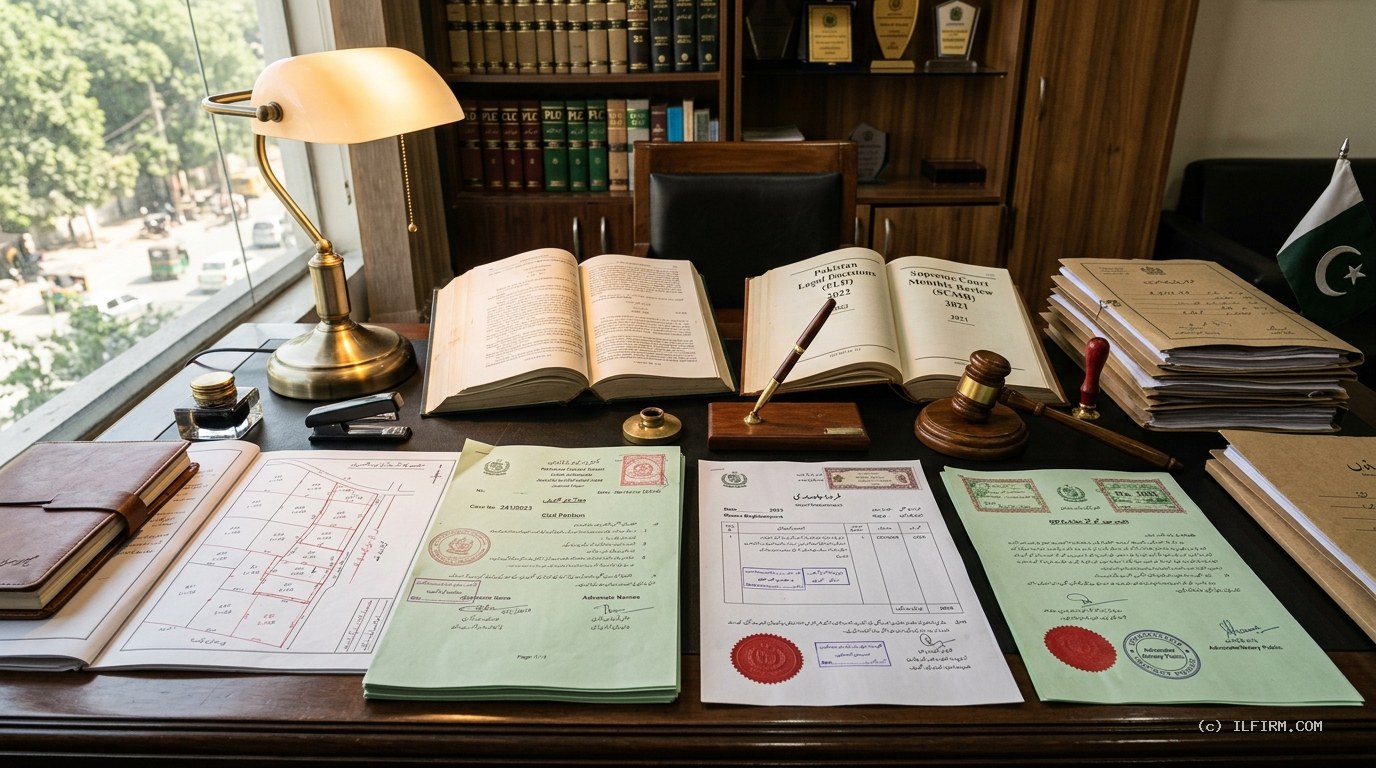
Figure 1: Authentic certified land records, revenue fard jamabandi, cadastral survey maps, and legal petitions essential for instituting a partition suit in Pakistan.
Phase 1: Pre-Litigation Due Diligence & Record Procurement
Before instituting the plaint, legal counsel must conduct thorough land record intelligence:
- Certified Jamabandi / Register Haqdaran Zameen: Procuring the latest certified four-year revenue record from the Halqa Patwari or computerized Service Delivery Center (Arazi Record Center / Land Record Authority) to ascertain exact ownership fractions, khewat numbers, and encumbrances.
- Pedigree Table (Shajra Nasab / شجرہ نسب): Reconstructing the complete family tree from the original common ancestor (*مورث اعلیٰ*) down to every living legal heir, ensuring no lawful co-sharer is omitted.
- Aks Shajra / Cadastral Map (عکس شجرہ): Obtaining the physical field map showing the layout, surrounding paths, watercourses, and adjacent properties of the khasra numbers.
- Legal Notice to Co-Sharers: Serving a formal legal notice demanding voluntary amicable partition by metes and bounds, providing proof of refusal necessary to establish the cause of action.
Phase 2: Plaint Drafting & Securing Emergency Temporary Injunction (Order 39 Rules 1 & 2 CPC)
The plaint must precisely describe the suit property by khasra numbers, boundaries (*چوحدی*), total acreage, and respective shares. Concurrently, counsel moves an urgent application under Order XXXIX Rules 1 & 2 CPC for an ad-interim status quo order. Securing an immediate stay order prevents opposing co-sharers from alienating shares to third parties, commencing illegal construction, or altering possession patterns before the court examines the merits.
Phase 3: Service of Summons, Written Statement & Framing of Issues
All co-sharers must be formally impleaded as parties (either plaintiffs or defendants). Non-joinder of a necessary co-sharer is fatal to a partition suit. Upon service of summons through ordinary process, registered post, and newspaper proclamation under Order V CPC, the defendants submit their Written Statement (*جواب دعویٰ*). If title or shares are contested, the Civil Judge frames specific legal and factual issues under Order XIV CPC and calls for evidence.
Phase 4: Pronouncement of the Preliminary Decree (ابتدائی ڈگری)
Once the court determines the proprietary entitlement and mathematical shares of each party under Order XX Rule 18(2) CPC, it pronounces the Preliminary Decree. The preliminary decree judicially confirms the exact percentage or fractional entitlement of every co-sharer, definitively extinguishing all disputes regarding the extent of ownership.
Phase 5: Appointment of Local Commissioner & Field Demarcation
Following the preliminary decree, the court appoints a Local Commissioner under Order XXVI Rule 13 CPC to physically demarcate the shares. The Local Commissioner visits the spot with the Field Kanungo and Halqa Patwari, conducts measurements, prepares a site plan, and drafts proposed distinct lots (*قرعہ جات / کھاتہ علیحدہ*). In agricultural or semi-urban parcels, the commissioner prepares three statutory plans:
- Naksha Alif (نقشہ الف): Detailed inventory and evaluation of the unpartitioned land, showing total area, current possession, soil quality, and existing structures.
- Naksha Bay (نقشہ ب): The proposed Mode of Partition (*طریقہ تقسیم*), detailing how road access, thoroughfares, and irrigation rights will be equitably allocated.
- Naksha Jeem (نقشہ ج): The final demarcated allotment map designating the exact physical boundaries assigned to each co-sharer.
Phase 6: Adjudication of Objections & Passing of the Final Decree (حتمی ڈگری)
Parties are granted opportunity to file written objections against the Local Commissioner’s report. The court may examine the commissioner under oath regarding valuation and fairness. If objections are dismissed or the report modified, the court formally accepts the demarcation and passes the Final Decree (حتمی ڈگری). The final decree is engrossed on non-judicial stamp paper in accordance with Article 45 of Schedule I to the Stamp Act, 1899, transforming it into an executable title instrument.
Phase 7: Execution of Decree & Physical Delivery of Possession via Court Bailiff
A decree on paper does not cultivate land or construct boundaries. The successful party must institute execution proceedings under Order XXI Rule 35 CPC. The executing court issues a warrant of possession (*وارنٹ قبضہ*), deputing the Court Bailiff (*عدالتی بیلف*) along with revenue field staff and, where resistance is anticipated, mandatory local police escort. The bailiff establishes physical boundary pillars, dispossesses recalcitrant occupants, and hands over peaceful, vacant possession to the decreed owners, submitting a signed compliance report (*رپورٹ تعمیل*) back to the court.
6. Practical Timelines, Document Checklist, and Court Fee Comparison
Litigants must approach partition proceedings with full transparency regarding practical timelines, required statutory documents, and court fee obligations under the Court Fees Act, 1870.
A. Comprehensive 10-Point Document Checklist
Before initiating an agricultural or urban partition lawsuit, assemble the following verified documentary dossier:
- Certified Jamabandi / Register Haqdaran Zameen (فرد ملکیت): Attested copy issued within the last 30 days demonstrating unbroken co-ownership records.
- Pedigree Table (Shajra Nasab / شجرہ نسب): Certified genealogical table from the revenue department tracing devolution of inheritance.
- Cadastral Field Map (Aks Shajra / عکس شجرہ): Official survey layout highlighting the exact khasra numbers under partition.
- Chain of Title Instruments: Copies of registered sale deeds (*بیع نامہ جات*), registered gift deeds (*ہبہ نامہ جات*), or mutation vouchers (*انتقالات*).
- NADRA Family Registration Certificate (FRC): Official NADRA civil status certificate verifying family relationship and surviving legal heirs.
- Attested Site Valuation Plan: In urban/commercial estates, certified architectural floor plans and valuation reports from an authorized surveyor.
- Pre-Litigation Legal Notice & Courier Tracking: Proof of written demand for amicable partition delivered to opposing co-sharers.
- Non-Encumbrance Certificate (NEC): Sub-Registrar / Land Authority search report proving property is free from undisclosed bank mortgages.
- Proof of Possession / Khasra Girdawari: Certified harvest inspection records (*خسرہ گرداوری*) confirming agricultural cultivating possession.
- Attested Special Power of Attorney (Mukhtar Nama Khas): For Overseas Pakistanis, NADRA-verified or MOFA-attested power of attorney appointing legal counsel or family representative.
B. Court Fee Schedule & Valuation Dynamics
Under the Court Fees Act, 1870 and the Suits Valuation Act, 1887, court fee calculation in partition suits depends on the plaintiff’s possession status:
- Where Plaintiff is in Joint Possession: Where the plaintiff is in actual or constructive joint possession of the suit property, the suit is treated as an action for declaration and separation of share. In Khyber Pakhtunkhwa, fixed court fee stamps (nominal fee of PKR 15 to PKR 500 depending on forum) are affixed, rather than ad-valorem fees.
- Where Plaintiff is Completely Dispossessed: Where the plaintiff has been completely ousted from possession by other co-sharers and seeks partition with recovery of separate possession, the suit is subject to ad-valorem court fees under Section 7(v) of the Court Fees Act, 1870, calculated on the market value of the plaintiff’s specific share, capped at the statutory provincial maximum limit (PKR 15,000 in KP / Punjab).
- Final Decree Stamp Duty: Under Article 45 of Schedule I to the Stamp Act, 1899, the final decree of partition must be engrossed on non-judicial stamp papers calculated as a percentage of the separated property’s value before execution can be ordered.
C. Realistic Litigation Timelines Across Judicial Tiers
| Litigation Stage | Estimated Duration | Critical Milestones & Expedited Triggers |
|---|---|---|
| Emergency Interim Injunction (Stay Order) | 1 to 14 Days | Urgent motion under Order 39 Rules 1 & 2 CPC to restrain alienation, demolition, or construction. |
| Preliminary Decree Adjudication | 6 to 18 Months | Pleadings, admission/denial of documents, framing of issues, and evidence on title/shares. |
| Local Commission & Final Decree Demarcation | 4 to 12 Months | Field measurements, preparation of Naksha Alif/Bay/Jeem, hearing objections to commissioner report. |
| First Appeal (District Judge) | 6 to 12 Months | Statutory appeal under Section 96 CPC challenging preliminary or final decree. |
| Civil Revision (High Court / Dar-ul-Qaza) | 1 to 2 Years | Revision under Section 115 CPC before Peshawar High Court Mingora Bench Dar-ul-Qaza Swat. |
| Execution & Delivery of Possession (Bailiff) | 2 to 6 Months | Issuance of warrant of possession, police escort deployment, and physical demarcation on site. |
7. Strategic Advisory for Overseas Pakistanis: Safeguarding Ancestral Lands From Abroad
For non-resident Pakistanis residing in the United Arab Emirates (Dubai, Abu Dhabi, Sharjah), United Kingdom (London, Birmingham, Manchester), Saudi Arabia (Riyadh, Jeddah), and North America, undivided ancestral properties in Khyber Pakhtunkhwa and Punjab represent vulnerable targets. Disreputable relatives and local land syndicates frequently exploit the physical absence of expats to manipulate revenue records, construct unauthorized buildings, or orchestrate collusive sales.
Expatriates possess powerful legal mechanisms to enforce partition and protect their inheritance without undertaking disruptive, expensive travel to Pakistan:
- Digital Power of Attorney Execution: Overseas co-sharers can execute a Special Power of Attorney (Mukhtar Nama Khas / مختار نامہ خاص) specifically authorizing senior advocates of International Law Firm to institute, prosecute, and execute partition suits before the Civil and Revenue Courts. This can be accomplished seamlessly via the NADRA Digital Power of Attorney portal or through consular attestation at the Embassy of Pakistan / Consulate General in their host nation, followed by MOFA countersigning in Islamabad or Peshawar.
- Zero Personal Appearance Mandate: In civil suits for partition, the physical presence of the overseas plaintiff in the courtroom is not statutorily mandatory. All procedural steps—including filing plaints, submitting affidavits, moving stay applications, cross-examining opposing witnesses through counsel, and receiving court commission demarcation—are carried out through the authorized attorney and designated advocates.
- Emergency Preemptive Injunctions: Where local relatives attempt to alienate or build upon undivided land, our chambers moves instantaneous emergency motions under Order XXXIX Rules 1 & 2 CPC, securing protective court orders that freeze all patwari mutation registers and halt municipal building permits within days of detection.
- Recovery Under the Illegal Dispossession Act, 2005: Where land grabbers have forcefully encroached upon unpartitioned family land, our litigation division coordinates simultaneous criminal prosecution before the Court of Session under the Illegal Dispossession Act, 2005, obtaining emergency eviction orders within 60 days alongside civil partition.
8. Integrated Chambers Practice & Superior Court Representation
International Law Firm operates a comprehensive superior court litigation and land title chambers representing domestic clients, corporate estates, and overseas Pakistanis across all tiers of the judicial hierarchy:
- Land Title & Partition Litigation Practice: Full representation in Suits for Partition (دعویٰ تقسیم اراضی), Suits for Declaration (دعویٰ استقرار حق), cancellation of fraudulent mutations, and court commissioner boundary disputes before Civil Courts, Revenue Courts, and the Board of Revenue (BOR).
- Constitutional Writs Practice (Article 199): High Court constitutional writ petitions before the Peshawar High Court (Dar-ul-Qaza Mingora Swat Bench and Principal Seat Peshawar) challenging unlawful revenue actions, defective partition modes, and administrative overreach.
- Criminal Defense & Protective Bail Desk: 24/7 representation for Pre-Arrest Bail under Section 498 CrPC (ضمانت قبل از گرفتاری) and post-arrest bail against fabricated criminal FIRs orchestrated by rival land claimants.
- Overseas Expatriate Legal Desk: Turnkey legal management for Pakistanis in the UAE, UK, USA, and GCC, handling remote power of attorney verification, patwari record authentication, and property recovery without travel.
👉 Direct Chambers Line via WhatsApp: Consult Senior Land Litigation Advocates | Headquarters: Opposite Peshawar High Court (Dar-ul-Qaza Mingora Swat Bench), Khyber Pakhtunkhwa, Pakistan.
Superior Court Property Litigation Chambers
Facing a Contested Land Partition Dispute or Joint Property Encroachment?
Our Advocates of the High Court and Supreme Court of Pakistan provide strategic litigation counsel in partition lawsuits, emergency stay applications against illegal construction, and title declarations for domestic litigants and overseas Pakistanis. Schedule an urgent chambers review with our senior property litigation partners today.