

Family, Custody & Matrimonial Law
Compassionate and expert family law representation across Family Courts in Swat & KPK. Khula decrees, child custody under Guardian and Wards Act 1890, maintenance claims, dower recovery, and overseas divorce registration.
Comprehensive Legal Representation & Strategy
Dignified Resolution of Family & Matrimonial Disputes
Marital breakdown, custody disputes, and family property contentions are among the most sensitive and emotionally draining legal proceedings an individual can experience. Under the Family Courts Act, 1964, the Muslim Family Laws Ordinance, 1961 (MFLO), and Islamic jurisprudence, family law is structured to achieve expeditious, compassionate justice while strictly safeguarding the financial and proprietary rights of women and the welfare of minor children.
At International Law Firm, our family litigation team provides discreet, empathetic, and strategic representation before Family Courts, Guardian Courts, and Appellate District Benches across Swat, Malakand, and KPK. We represent both female and male clients, ensuring matrimonial disputes are resolved with dignity, fairness, and strict statutory compliance.
Khula (Judicial Dissolution of Marriage) & Union Council Talaq
Under Islamic law, a woman possesses the unconditional right to seek Khula (dissolution of marriage) if she can no longer live within the limits ordained by Allah Almighty. Our firm institutes consolidated family suits for Khula, ensuring immediate decrees during the pre-trial reconciliation phase without protracted trial delays. Following court decrees or husband-pronounced Talaq, we manage statutory 90-day Union Council proceedings to procure the final NADRA Computerized Divorce Registration Certificate.
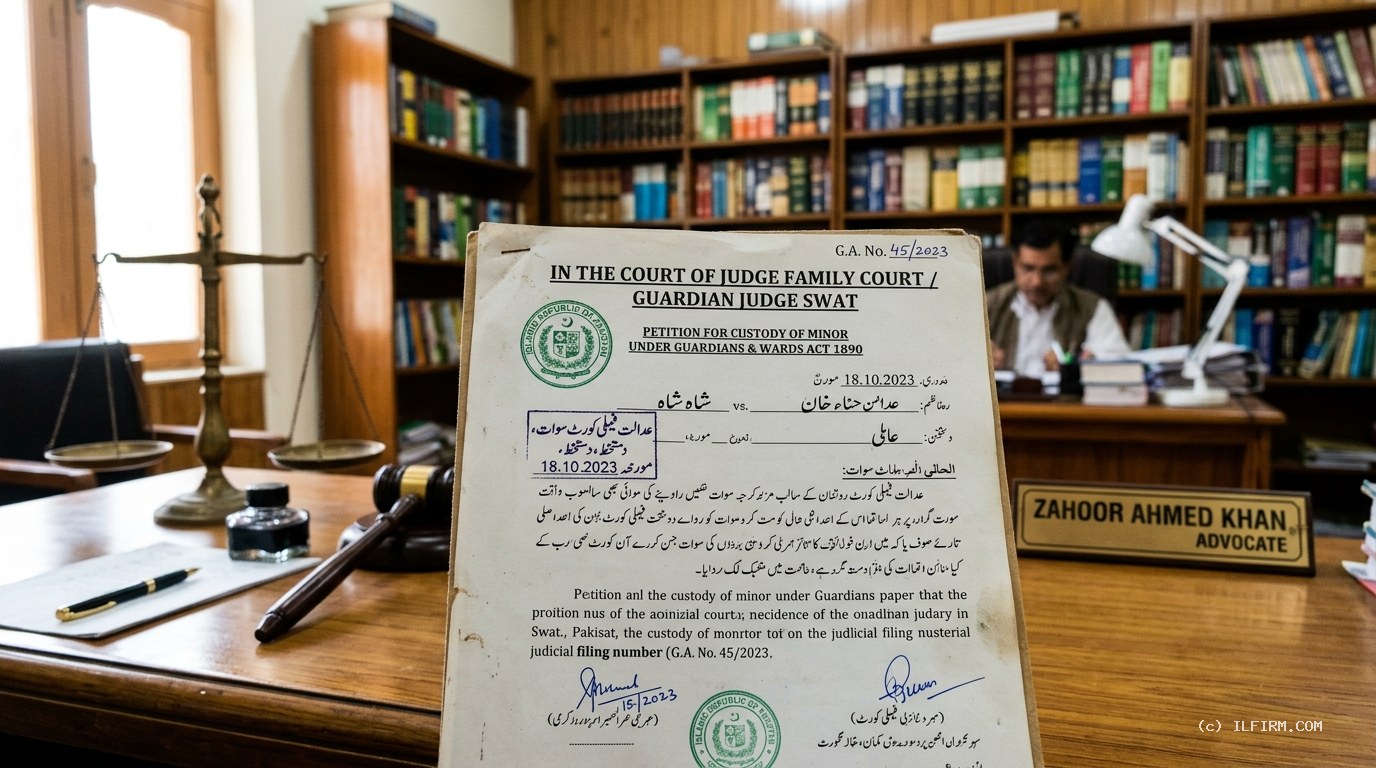
Child Custody & Guardianship: The Paramount Welfare of the Minor
In all child custody and guardianship matters under the Guardian and Wards Act, 1890, the Supreme Court of Pakistan has firmly established that the Welfare of the Minor (Hizanat) is the supreme and overriding consideration that supersedes all personal claims, financial standing, or gender presumptions. Our custody advocates formulate compelling evidence regarding educational stability, emotional bonding, moral guidance, and living environments.
While the substantive custody petition is pending, we secure fast-track Interim Visitation Schedules, ensuring non-custodial parents maintain active, regular bonding through courtroom visits, weekend overnight stays, and holiday schedules. Where risk exists of unauthorized removal of the child abroad, we obtain immediate restraining orders placing the minor on the Exit Control List (ECL) / PNIL.
Child & Spousal Maintenance: Strict Financial Enforcement
A father holds an absolute, non-negotiable legal obligation to maintain his minor children. Under Section 17-A of the Family Courts Act, 1964, the family judge is legally mandated to fix interim monthly maintenance at the preliminary hearing stage without waiting for evidence. If the father defaults, his defense is immediately struck off. We also prosecute claims for past maintenance, educational expenses, medical allowances, and statutory 10%–20% annual increments.
Family & Matrimonial Law Divisions
Explore our specialized matrimonial, custody, and succession practice areas:
Recovery of Haq Mehr (Dower) & Dowry Articles (Jahez)
We represent wives in recovering prompt (Mu’ajjal) and deferred (Mu’wajjal) dower, including enforcing transfers of agricultural land or houses promised in the Nikahnama. Simultaneously, we prosecute claims for the physical return of dowry articles and gold jewelry, or their alternate market cash value, executing decrees via asset attachment and arrest warrants against defaulters.
Key Representation Scopes & Deliverables
Request Case Assessment
Direct matter evaluation by High Court Advocates within 24 hours.
Frequently Asked Legal Questions
Essential information regarding court timelines, documentation, and client representation.
Does a woman lose her dower (Haq Mehr) when seeking Khula?
If Khula is granted purely due to mutual incompatibility, the court may direct the wife to surrender unpaid deferred dower or return a reasonable portion (25% to 50%) of the prompt dower already received.
Can an overseas Pakistani mother or father contest child custody remotely?
Yes. Guardian courts permit overseas parents to be represented via verified Power of Attorney and arrange video-link hearings for testimony and virtual visitation.
What happens if a father fails to pay court-ordered child maintenance?
Under Section 13 and 17-A of the Family Courts Act, the court will strike off his defense, issue arrest warrants, attach his bank accounts/properties, and commit him to civil prison until arrears are satisfied.
How long does a Khula case typically take in Swat Family Court?
A suit for Khula can be concluded very rapidly, often within two to four hearings if pre-trial reconciliation fails, as the court is statutorily required to grant the decree immediately.